
What Is NIST AI RMF?
The NIST AI Risk Management Framework (AI RMF) is voluntary guidance for managing risks associated with AI systems. It helps organizations organize decisions about trustworthy AI across design, development, deployment, and operation; it is not a product certification or a security control catalogue.
By Agent Guard Team2 min read
What Is NIST AI RMF?
The NIST AI Risk Management Framework (AI RMF) is voluntary guidance for managing risks associated with AI systems. It helps organizations organize decisions about trustworthy AI across design, development, deployment, and operation; it is not a product certification or a security control catalogue.
The four functions
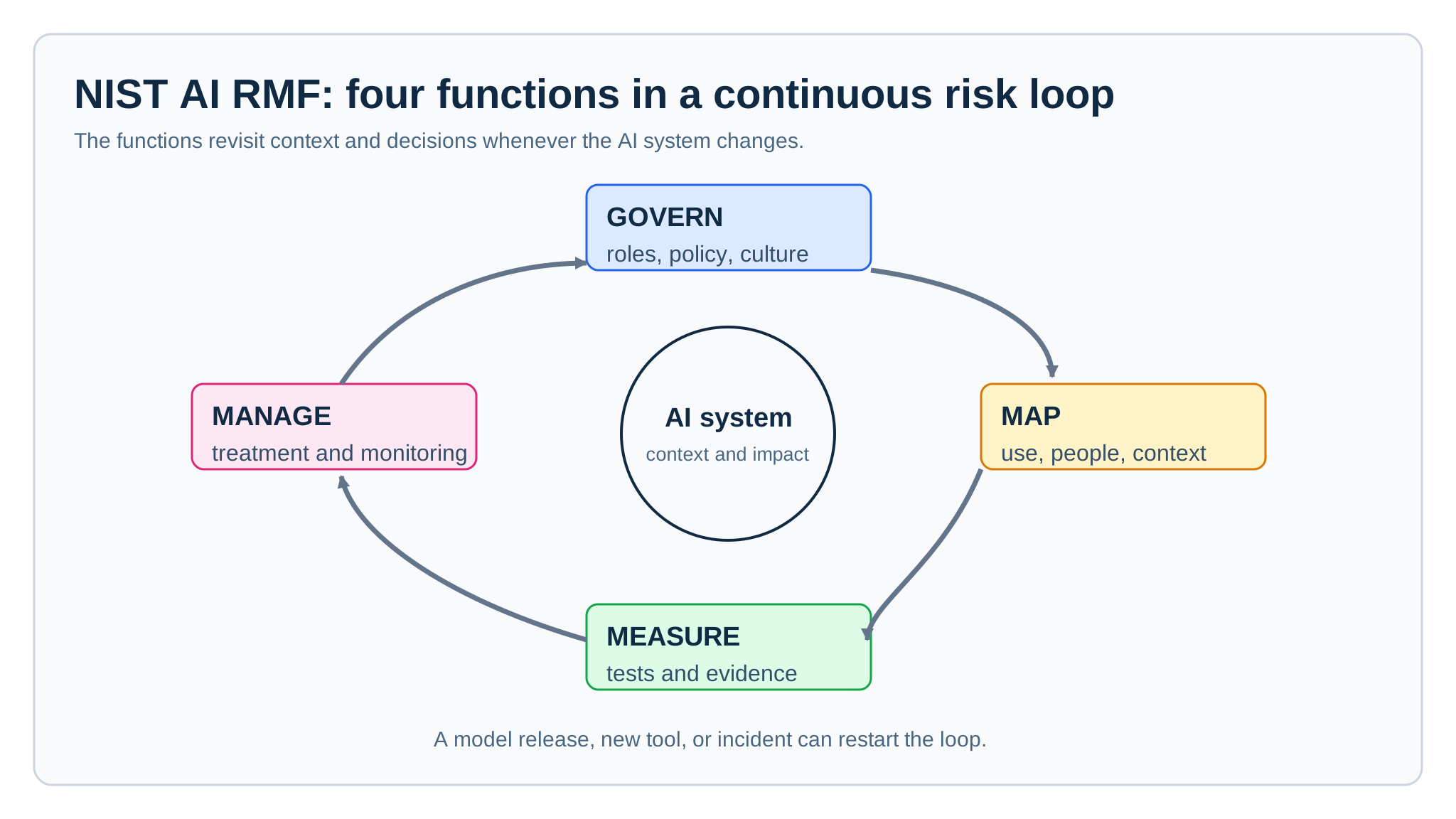
AI RMF 1.0 organizes work around GOVERN, MAP, MEASURE, and MANAGE. GOVERN establishes roles, policies, culture, and accountability. MAP describes the system, context, affected people, and intended use. MEASURE assesses risks and the effectiveness of controls. MANAGE prioritizes and acts on the results.
The NIST AI RMF publication is the primary source for those functions. They are iterative: a new model, user population, data source, or incident can require the team to return to mapping and measurement.
Applying the functions to an agent
For an agent that can retrieve records and call external tools, GOVERN identifies the accountable owner and decision rights. MAP identifies the users, data classes, tools, targets, and potential impacts. MEASURE tests failure cases such as misleading retrieved content or an over-broad tool request. MANAGE decides whether to narrow permissions, add approval, accept residual risk, or defer deployment.
This makes AI RMF useful for connecting business risk management to engineering evidence. The AI agent threat modeling guide can provide the system-level attack paths that feed the MAP and MEASURE work.
What AI RMF does not prescribe
NIST does not prescribe one model, vendor, evaluation suite, or enforcement architecture. An organization must define methods appropriate to its context. That flexibility is a strength, but it also means a team cannot claim meaningful adoption merely by naming the functions in a policy document.
Evidence matters. A risk register needs a current owner and treatment decision. An evaluation needs a stated model and configuration. A control needs a placement and observable outcome. Without those artifacts, the framework can describe intent without showing how a deployed agent is governed.
AI RMF and technical controls
AI RMF helps decide which controls are needed; it does not itself intercept a tool call. An AI agent security controls design can implement component checks, identity restrictions, and pre-action policy. The framework supplies the reasoning and accountability for selecting and reviewing those controls.
That distinction is important during review. A team can document a risk treatment in MANAGE, but it still needs to show where the selected control runs, which request it evaluates, and who reviews an exception. Those implementation details make a framework decision testable rather than merely aspirational.
For example, a team may measure whether untrusted document content changes an agent’s tool proposal. The prompt injection glossary defines that risk class, while AI RMF helps the organization decide ownership, measurement approach, and acceptable residual risk.
How to begin without creating paperwork
Choose one high-impact workflow rather than starting with an enterprise-wide catalogue. Write a short context statement, name the owner, list the data and actions in scope, select two or three realistic failure modes, and record the treatment decision. Use the NIST AI RMF Playbook to locate suggested actions without treating it as a mandatory checklist.
Revisit the record after material changes. The goal is not a frozen compliance artifact; it is a reviewable decision loop that stays connected to how the agent actually operates.
Profile, Playbook, and the core framework
The AI RMF core describes the functions and characteristics that organize risk management. The NIST AI RMF Profiles apply that structure to a particular use case, risk domain, or organizational context. The Playbook offers suggested actions and resources; it is not a separate compliance standard or a scorecard. For an agent review, the core can frame GOVERN, MAP, MEASURE, and MANAGE, while a local profile records the agent’s tools, data classes, affected users, and decision owners. That distinction prevents a team from copying generic actions without first defining the system it is trying to govern.
The NIST AI RMF Playbook provides implementation-oriented actions that complement the framework publication.
Frequently Asked Questions
What are the four NIST AI RMF functions?
GOVERN establishes accountability and policy, MAP describes the system and its context, MEASURE assesses risks and control results, and MANAGE prioritizes and acts on those findings. Teams revisit the functions as the system changes.
Is NIST AI RMF mandatory or a product certification?
No. AI RMF is voluntary risk-management guidance. It does not certify a product, prescribe one model or vendor, or guarantee that selected controls work in a deployed workflow.
How can a team start using NIST AI RMF?
Choose one high-impact AI workflow, name its owner, document users, data, tools and effects, select realistic failure modes, decide how to measure them, and record a treatment decision that can be reviewed after changes.
Connect AI risk decisions to the controls that govern real agent actions.
Map controls