
What Is Policy Enforcement?
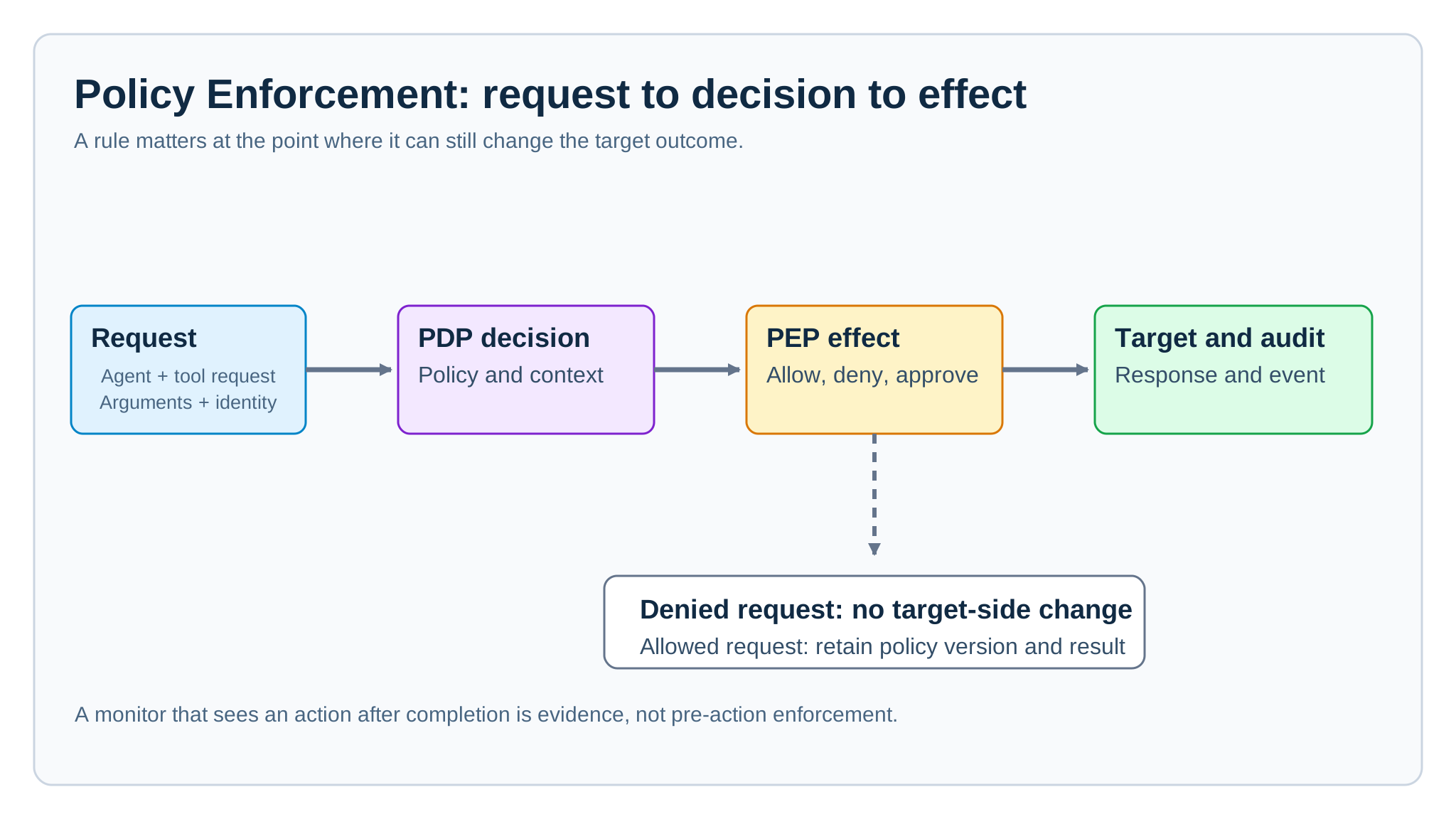
Policy enforcement is the application of a rule to a requested action. An enforcement point evaluates relevant context and then permits, blocks, modifies, escalates, or records the action. A policy document defines intent; enforcement is where that intent can change what reaches the target system.
By Agent Guard Team3 min read
What Is Policy Enforcement?
Policy enforcement is the application of a rule to a requested action. An enforcement point evaluates relevant context and then permits, blocks, modifies, escalates, or records the action. A policy document defines intent; enforcement is where that intent can change what reaches the target system.
The decision and enforcement path
In a mature design, a policy decision point evaluates rules and an enforcement point applies the result. The request may be an API call, a browser submit, a tool invocation, a file transfer, or an agent-proposed operation. Relevant context can include the agent identity, user, tool, arguments, data classification, target, approval state, and environment.
The NIST policy enforcement point glossary entry distinguishes the component that enforces a decision from the policy administration and decision functions. The division matters when a rule exists but no reliable component is positioned to apply it.
Why placement determines what can be protected
A control placed before model reasoning may see an initial prompt but not the final tool argument. A control placed after a target API call may only record an effect that already happened. Put enforcement where it can see the decision inputs needed for the rule and still prevent or safely constrain the downstream action.
For an AI agent, this often means evaluating a proposed tool call before execution, while retaining server-side authorization at the target. The AI agent security controls guide explains why layered checks are needed: a model-side guardrail and a target-side authorization rule have different evidence and failure modes.
An agent-tool example
Suppose an agent proposes sending a customer record to a third-party service. The enforcement logic can inspect the calling identity, destination, classification, tool arguments, and approval token. It may deny the request, redact a field, require a person to approve it, or allow it with an event record. The target service should still verify its own authorization rather than trust the agent’s assertion.
This example makes the difference between monitoring and enforcement visible. An alert after a successful export can support investigation, but it did not prevent the export. A policy result that never reaches the tool or target is likewise only a recommendation.
Policy enforcement and AI guardrails
Guardrails can guide model behavior, filter content, or evaluate outputs. They are useful, but they are not automatically deterministic enforcement for an external action. Model behavior may vary with context, while a policy enforcement point can validate known fields and apply a repeatable decision at a defined boundary.
The prompt injection glossary is relevant because untrusted instructions may influence a model’s proposed action. Strong enforcement limits the authority of that proposal even when an upstream model-side control misses the instruction.
Designing a testable rule
Write policies in terms of observable inputs and effects. Define the request schema, the identity source, the data labels, allowed targets, exception mechanism, failure behavior, and required event fields. Then test both paths: an allowed request should produce the expected target result, while a denied request should not create a partial side effect.
Connected tool servers require their own review. The MCP security tools review compares products that help assess MCP-server risk; it is not a glossary and it does not prove that a particular enforcement point sees every tool route.
When to use the term
Use “policy enforcement” when discussing the part of a system that can make a rule effective at runtime. It is the right concept for consequential actions with explicit inputs and targets. It is not the right name for a dashboard, a written rule, or a retrospective alert unless that component actually applies a decision before the action completes.
The OWASP Agentic AI Top 10 provides a complementary view of the agent risks that enforcement must constrain.
Frequently Asked Questions
What is the difference between a policy decision point and a policy enforcement point?
A policy decision point evaluates rules and context to produce a result. A policy enforcement point applies that result to the request by allowing, blocking, modifying, or escalating the action before it reaches the target.
Is monitoring the same as policy enforcement?
No. Monitoring records or alerts on behavior. Enforcement changes whether or how an action proceeds. An alert created after a data export may support investigation, but it did not prevent the export.
How do you test a policy enforcement rule?
Define the request fields, identity source, data labels, permitted targets, exception path, failure behavior, and audit record. Then verify that an allowed request reaches the expected target and a denied request creates no partial side effect.
See where policy can intercept an agent action before an external system changes.
Map enforcement