
What Is Shadow AI?
Understand shadow AI, how it differs from shadow IT, where it appears, which risks it creates, and how to discover and govern it.
By Agent Guard Team10 min read
What Is Shadow AI?
Shadow AI is the use of AI tools, models, features, or agent workflows outside an organization's approved visibility and control process. It includes ordinary workarounds and experiments as well as risky deployments, so the first response should establish ownership and context before assigning intent.
Shadow AI Definition and Scope
Shadow AI appears when people adopt AI without the review, inventory, data rules, access controls, or operating owner required by the organization. Examples include pasting customer data into a public assistant, installing an unreviewed coding extension, enabling an AI feature inside approved SaaS, running a local model, or connecting an agent to internal tools without registration.
IBM's Shadow AI overview describes the governance problem created when AI is used without organizational approval or oversight. The key boundary is visibility and control, not whether the user meant harm.
An approved experiment can remain governed when it has an owner, bounded data, scoped access, a review date, and a defined path to production or retirement. An expensive enterprise subscription can still create shadow AI when a team enables a new model, integration, or autonomous action outside the approved process.
Shadow AI vs Shadow IT
Shadow IT covers technology used outside formal IT approval or management. Shadow AI shares that inventory, procurement, identity, data, and support gap, then adds risks created by probabilistic outputs, model providers, prompts and context, generated code, autonomous actions, and changing components.
| Dimension | Shadow IT | Shadow AI |
|---|---|---|
| Typical object | SaaS app, device, cloud service | AI app, model, assistant, agent, plugin, MCP server, embedded feature |
| Data flow | User submits or stores data | Data may enter prompts, retrieval, memory, training, output, or tools |
| Behavior | Mostly application-defined | Model behavior varies with context and external content |
| Output | Stored or processed data | Generated text, code, decisions, classifications, or actions |
| Authority | User and application permissions | User, model, agent host, tools, and downstream identities |
| Change | Vendor release or configuration | Model, prompt, tool, retrieval, policy, and component changes |
The AI-specific concern is composition. A low-risk chatbot can become a high-impact workflow when it gains a browser session, cloud credential, code execution tool, or an MCP server connected to business systems.
How Shadow AI Appears
Public AI applications
Employees may use consumer assistants for drafting, research, translation, analysis, or document processing. Risk depends on the data submitted, account terms, retention, model-training settings, identity, and whether the output affects a regulated or consequential decision.
AI features inside approved SaaS
An approved CRM, meeting platform, office suite, or support tool may add AI features after procurement. The base application can be governed while the new feature introduces a different model provider, data path, retention rule, permission, or subprocessors.
Coding and browser assistants
Extensions and IDE agents can read repositories, terminals, environment variables, cloud configuration, and internal documentation. Browser assistants may inherit authenticated sessions and act across websites. Installation through a familiar marketplace does not replace component and permission review.
Agents, plugins and MCP servers
Teams can assemble agents from open-source frameworks, skills, plugins, tools, MCP servers, models, and SaaS APIs. Each part may have a different owner and update channel. The composed workflow can act on production systems even when no central inventory lists it as an application.
Inventory signals should therefore cover procurement and network use alongside code repositories, browser and IDE extensions, service identities, API tokens, cloud workloads, model endpoints, agent configuration, and component registries.
Why Shadow AI Creates Risk
Data and privacy
Sensitive data can enter prompts, files, retrieval stores, memory, model provider logs, support tools, or generated outputs. Teams may not know the region, retention, training use, deletion path, or people with administrative access.
Identity and access
An unregistered agent may use a personal token, standing cloud key, shared account, or privileged browser session. Offboarding and rotation become difficult when no owner knows where the credential is stored or which actions it permits.
Supply chain and model behavior
Models, extensions, packages, skills, plugins, prompts, and MCP servers can change independently. Untrusted content can influence model behavior. Generated code or decisions can introduce defects even when every component is well intentioned.
Actions and accountability
An agent can send messages, modify records, deploy code, purchase services, change permissions, or delete data. When the workflow sits outside governance, the organization may lack an approval point, audit trail, incident owner, or tested stop mechanism.
Compliance risk follows these technical gaps. The organization cannot reliably answer which data was processed, which model contributed, who approved the workflow, how outcomes are reviewed, or how the system is retired.
Build an AI Usage Inventory
Inventory the workflow, not only the vendor name. A single vendor can support several models, features, integrations, identities, and data paths with different risk.
| Field | Minimum inventory record |
|---|---|
| People and owners | Users, business owner, technical owner, security reviewer |
| Purpose | Task, decision, customer impact, expected benefit |
| Tool and model | Product, feature, model, provider, version where available |
| Data | Inputs, outputs, classifications, regions, retention, training use |
| Credentials | Identity, owner, scope, storage, lifetime |
| Components | Extensions, libraries, skills, plugins, MCP servers, prompts |
| Integrations | SaaS, APIs, databases, files, browsers, cloud systems |
| Actions | Read, write, send, deploy, purchase, delete, change permission |
| Environment | Personal, test, internal, customer-facing, production |
| Lifecycle | Approval, exception, review date, change trigger, retirement |
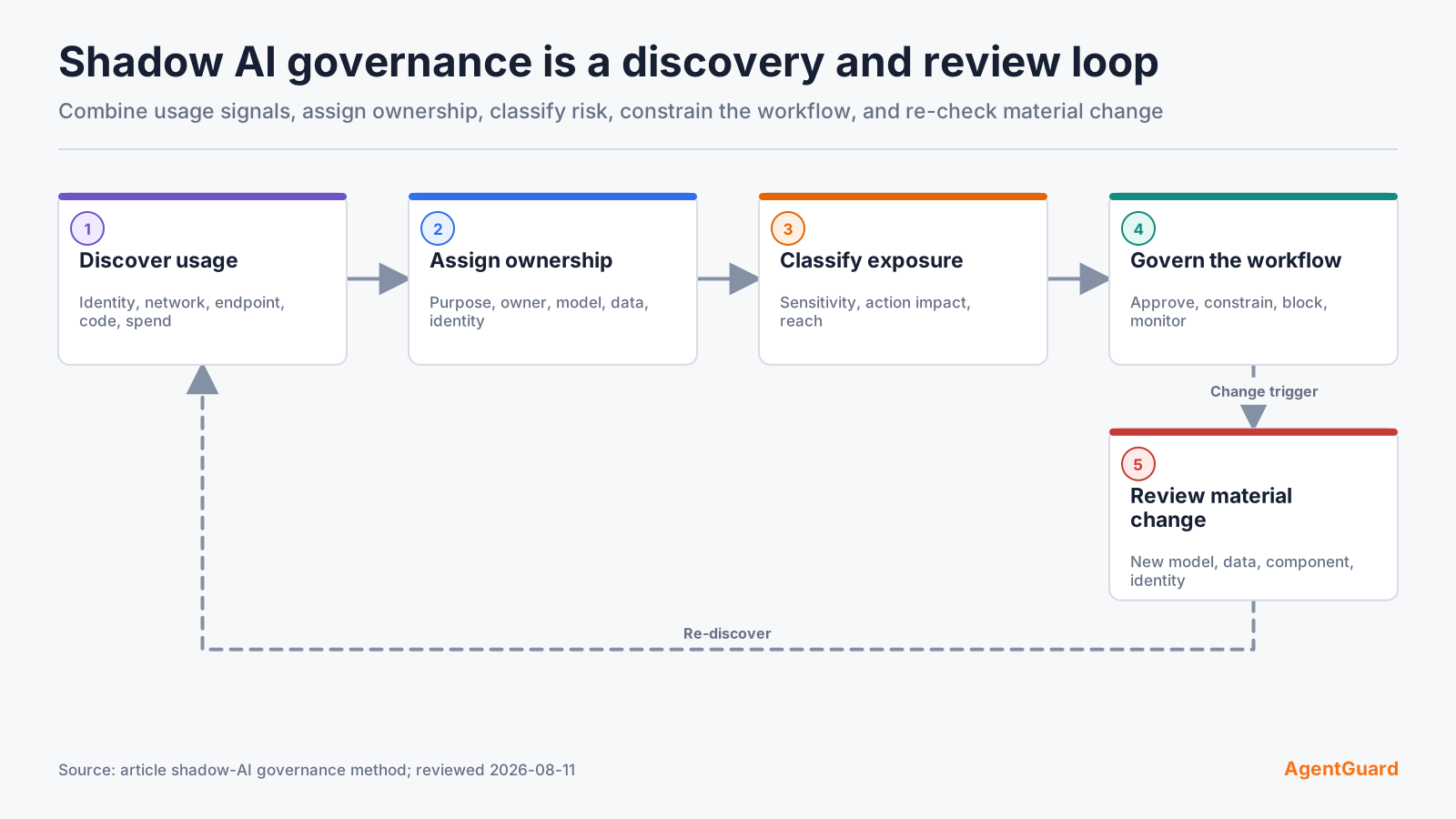
Use several discovery sources. Procurement and expense data find paid tools. Identity and network records find services and model endpoints. Endpoint and browser inventories find extensions. Code and cloud inventories find agent frameworks, service accounts, API keys, and deployed workloads. Surveys and an easy intake path reveal experiments that technical telemetry misses.
AgentGuard Deep Scan publicly covers named agent component types, and OpenClaw Environment Patrol is documented for suspicious skills, modified plugins, new MCP servers, and trusted-file drift in that environment. These are bounded signals within AgentGuard's documented security capabilities; they do not establish enterprise-wide shadow-AI discovery.
Map an Agent Environment around one business workflow, including its owners, data, identities, components, actions, and review date.
Classify Workflows by Data and Action
Prioritize review by consequence rather than popularity. Score each workflow on data sensitivity, external action, autonomy, reversibility, privilege, customer or regulatory impact, and dependency on unreviewed components.
| Class | Example | Governance response |
|---|---|---|
| Low | Public-data drafting with no external action | Approved tool, basic guidance, periodic review |
| Moderate | Internal documents, human-reviewed output | Access controls, data rules, owner, logging |
| High | Sensitive data or production read access | Security review, scoped identity, testing, monitoring |
| Consequential | External messages, writes, payments, permissions, deletion | Pre-execution approval or enforcement, evidence, kill switch |
| Prohibited | Unlawful use or data/action outside accepted policy | Block, revoke access, investigate as appropriate |
Avoid a single score that hides why the workflow is risky. A public-data agent with production deployment permission and a read-only analytics assistant handling regulated records need different controls.
Classification should produce an action: approve, approve with conditions, move to a supported alternative, reduce data or permissions, grant a time-bound exception, pause, or retire.
Govern Without Driving Usage Underground
Approved alternatives
Provide tools that cover real user needs. Publish which data classes, models, features, and actions are allowed. A policy that only says "do not use AI" leaves teams to choose their own workaround.
Structured intake
Make registration faster than evasion. Ask for owner, purpose, data, model, integrations, credentials, actions, environment, and deadline. Route low-risk use through a lightweight path and reserve deep review for high-impact workflows.
Role-based rules
Different roles need different data and actions. Developers may need code assistance without production credentials. Support teams may draft responses while requiring approval before sending. Analysts may query de-identified data through a read-only broker.
Time-bound exceptions
An exception needs scope, owner, compensating controls, expiry, and a decision at expiry. Track what evidence is missing. A temporary experiment should not become an unowned production dependency through inertia.
Palo Alto Networks' Shadow AI guidance emphasizes visibility, policy, access, and employee guidance. Apply those mechanisms as an adoption system: approved paths, usable controls, and accountable exceptions.
Monitor, Review, and Retire
Keep the inventory current through change triggers. Reassess when the model, provider, terms, data source, prompt, tool, plugin, MCP server, credential, permission, output use, or deployment environment changes. Require owners to attest that the record still matches reality.
Monitor signals proportionately: new model endpoints, unregistered OAuth grants, agent service accounts, privileged browser sessions, repository dependencies, extensions, outbound destinations, component changes, and consequential actions. Use the signals to find review candidates, not to claim that every observation is malicious.
Retirement should revoke credentials and sessions, remove integrations and components, export required records, delete data according to policy, notify users, and confirm that background jobs have stopped. Assign ownership for any retained output or downstream dependency.
Measure governance by known ownership, time to approve safe uses, expired exceptions, remediated high-risk workflows, and evidence completeness. A rising inventory can indicate improved visibility rather than worsening behavior.
Use review tiers to keep the program responsive. A public-data drafting tool with no integration can follow a short registration path. A coding assistant that reads private repositories needs component, identity, data, and output review. An autonomous workflow with production writes needs architecture review, runtime controls, approval, target-side authorization, evidence, and a tested stop path.
Share findings with users in language tied to their task. Explain which data, identity, component, or action created the risk and offer an approved way to reach the same outcome. This creates better reporting signals than a generic violation message and helps security distinguish missing policy from deliberate evasion.
Review the discovery system for privacy and proportionality. Collect only the telemetry required to identify and govern AI use, restrict analyst access, set retention, and define how employees can correct an inaccurate record. Governance should not create an uncontrolled repository of prompts, browsing history, or source code.
Finally, connect retirement to procurement, identity, endpoint, cloud, and code workflows. Cancelling a subscription does not remove extensions, local models, tokens, scheduled jobs, stored prompts, generated artifacts, or downstream OAuth grants. Confirm each dependency is closed or transferred to a named owner.
Use an AI agent security guide when the inventory reveals autonomous tools, identities, or downstream actions. Apply browser agent security controls when an assistant inherits authenticated sessions or transfers data across web origins. These are contextual follow-through paths; they do not turn every chatbot or AI feature into an agent.
Report program results with context. Separate newly discovered workflows from newly created workflows, and distinguish registered low-risk use from unresolved high-risk use. Track time to provide an approved alternative, because slow governance can recreate the demand that produced shadow adoption.
The durable goal is accountable AI use: a named purpose and owner, known data and identity, reviewed components and actions, usable guardrails, evidence, a change process, and a retirement path. Discovery becomes valuable when it moves a workflow toward that state.
Publish the approved path in the places where work begins: procurement, browser and endpoint guidance, developer templates, cloud onboarding, data policy, and security review. Include a contact and expected response time. Users are more likely to register experiments when governance answers practical questions before a deadline.
Review the program with business and technical owners each quarter. Retire unused tools, update approved alternatives, close expired exceptions, and choose a few changed workflows for evidence-based retesting.
Frequently Asked Questions
What is an example of shadow AI?
An employee using an unapproved public assistant with customer data, or a team deploying an agent with internal API access outside the registration and review process.
How is shadow AI different from shadow IT?
It shares the unapproved-technology problem and adds model behavior, prompts, generated outputs, autonomous actions, AI-specific data flows, and rapidly changing components.
Is every unapproved AI tool unsafe?
No. Unapproved means the organization lacks the evidence to make a governed decision. Review the purpose, data, identity, integrations, actions, and owner before deciding.
How can an organization detect shadow AI?
Combine procurement, identity, network, endpoint, browser, code, cloud, model-endpoint, and user-intake signals. No single source reveals every form of AI use.
Should companies ban unapproved AI tools?
Block prohibited uses and high-risk paths, while offering approved alternatives and a fast intake process. Blanket bans can push legitimate demand outside visible channels.
Map one shadow AI workflow and assign an owner before expanding access.
Book a Demo