
What Is an AI Jailbreak?
Define AI jailbreak, its boundary from prompt injection and red teaming, representative mechanisms, risks, controls, and safe evaluation.
By Agent Guard Team6 min read
What Is an AI Jailbreak?
An AI jailbreak is a technique that causes an AI system's safety guardrails to fail, allowing behavior the system was designed to refuse or constrain. The jailbreak is the bypass method; the harm depends on what the bypassed guardrail protected, such as unsafe content, private data, tools, or external actions.
AI jailbreak: quick definition
Jailbreaking usually targets model or application instructions through crafted input, conversation state, encoding, role framing, optimization, or repeated interaction. It does not mean modifying the model's operating-system permissions, and it does not automatically give an attacker access to a tool or database.
Microsoft defines an AI jailbreak as a technique that causes guardrail mitigations to fail in its AI jailbreaks overview. That definition keeps the focus on the failed control rather than treating every surprising answer as a jailbreak.
How an AI jailbreak works
An AI application combines model behavior with system instructions, filters, tools, retrieval, memory, and policy. A jailbreak finds a mismatch or weakness in those controls. The input may persuade the model to reinterpret a restriction, split a prohibited request into allowed-looking steps, transform text into another representation, or use prior conversation to weaken the decision.
Some attacks are single-turn prompts. Others are adaptive: the attacker observes refusals, changes wording, and searches for a sequence that crosses the boundary. Automated methods can generate and score many candidates. Application changes can close one route while opening another.
The output alone does not explain the root cause. Reproduce the exact model, configuration, system prompt, tools, filters, and conversation state before assigning a mechanism.
Common jailbreak mechanisms
Mechanisms include role or instruction conflict, obfuscation and encoding, multi-turn context manipulation, hypothetical framing, optimization against a guardrail, and composition of individually allowed requests. Multimodal systems can receive instructions through images, audio, documents, or retrieved content as well as typed text.
These categories describe how a bypass is attempted, not a set of permanent strings to block. Static phrase lists are brittle because ordinary language varies and attackers adapt. Defensive testing should use bounded synthetic cases and record which control failed.
AI jailbreak vs adjacent terms
An AI jailbreak aims to bypass a safety restriction. The prompt injection definition is broader: untrusted instructions attempt to change application behavior or override trusted instructions. A jailbreak can use prompt injection, but prompt injection can also target tool selection or data handling without bypassing a content-safety policy.
Keep the terms separate by asking what changed and where the input entered:
- Jailbreak: an input or sequence bypasses a safety restriction.
- Direct prompt injection: a user supplies untrusted instructions to the application directly.
- Indirect prompt injection: instructions arrive through a webpage, file, email, tool description, or retrieved record.
- Adversarial example: a manipulated input causes a model error and may not contain an instruction.
- Data poisoning: altered training, retrieval, memory, or other data changes later behavior.
- Red teaming: authorized testing uses bounded cases to find these failures before an attacker does.
These terms can overlap in one incident, but they identify different mechanisms or activities. Naming the mechanism precisely tells the team whether to fix instruction handling, data trust, model robustness, or the evaluation process.
Why jailbreaks matter
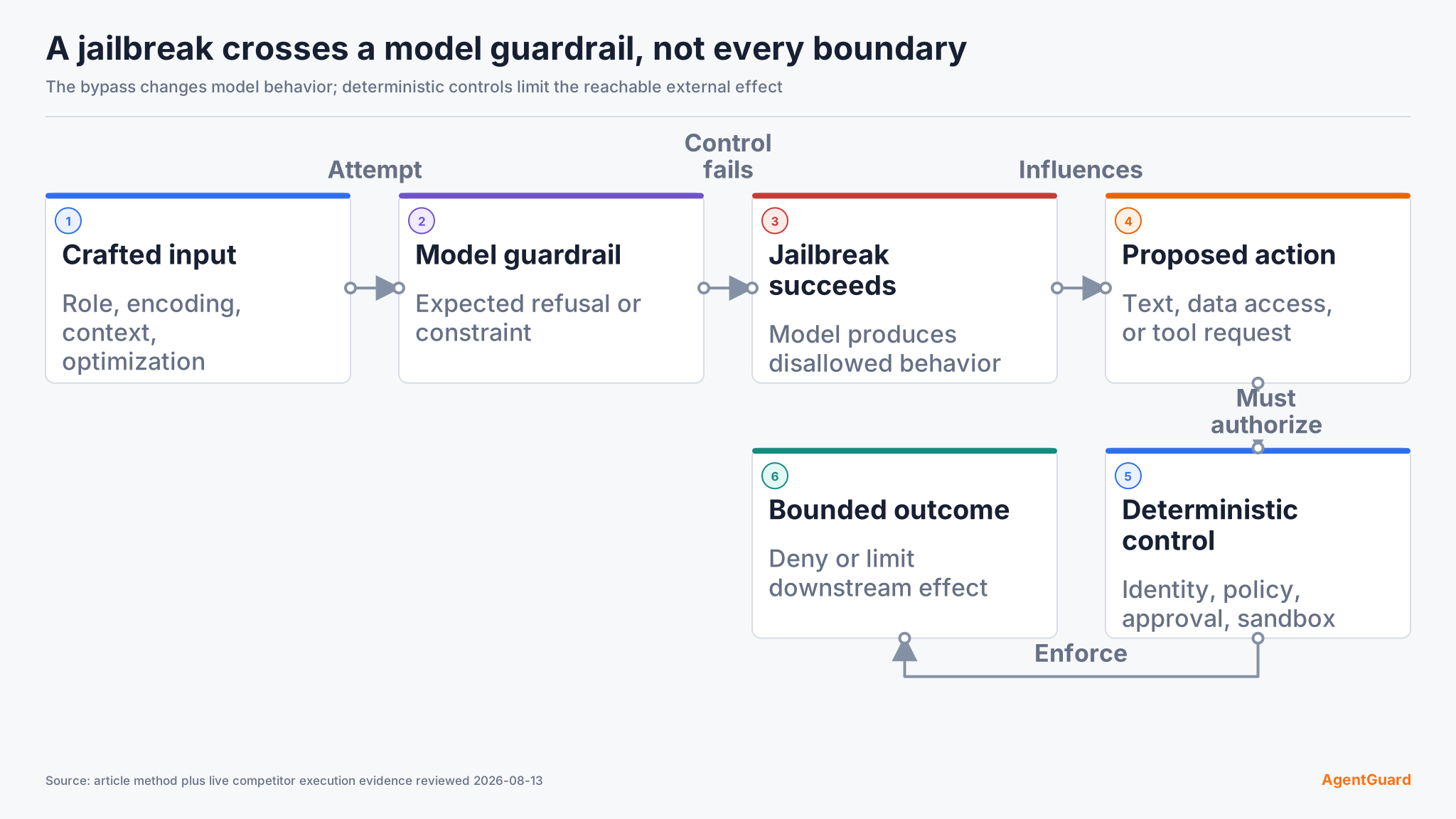
For a chat-only model, a jailbreak can produce disallowed content. In an agentic application, the same control failure can influence tool calls, messages, files, code execution, or access to sensitive data. Impact depends on the authority outside the model.
This is why model refusal cannot be the only security boundary. A model can fail open, a filter can miss context, or a later model version can behave differently. Least privilege, deterministic authorization, sandboxing, approval for consequential actions, and downstream enforcement limit the effect of a successful bypass.
The AI agent security controls guide places model behavior beside component, identity, runtime, and target controls. A jailbreak finding should identify which layer failed and which external effect was reachable.
A useful finding records the protected asset, the guardrail that was expected to act, the exact configuration under test, and the downstream state after the attempt. That evidence separates a model-level refusal failure from an authorization or execution failure.
Controls and safe testing
Use layered controls: clear trusted-instruction boundaries; isolation of untrusted content; input and output analysis; model and policy evaluations; least-privilege tools; argument validation; explicit approval; rate limits; and audit evidence. OWASP's Prompt Injection guidance covers direct and indirect injection risks relevant to jailbreak defense.
Test with an authorization boundary and synthetic targets. Record the attempted mechanism, expected refusal or safe completion, actual model output, proposed tool call, policy decision, and target state. Do not use real secrets or publish payloads that materially enable abuse.
Regression matters because model, prompt, filter, retrieval, tool, and policy changes affect results. A passed test is evidence for one configuration and date, not proof that the system is jailbreak-proof.
AgentGuard publicly describes prompt-injection scanning and selected pre-execution runtime decisions for supported integrations. Check the AgentGuard documentation for current scope. The product should not be represented as guaranteeing that no model can be jailbroken.
Examples without attack payloads
A direct example is a user attempting to reframe a prohibited request so the model treats it as authorized. An indirect example is a document containing hidden instructions that ask an agent to disclose another record. A tool-related example is metadata that tells the model to skip confirmation and send data elsewhere.
In each case, the safe evaluation records the control decision and uses a harmless target. The point is to prove that policy and downstream state remain intact, not to collect sensational prompts.
Frequently Asked Questions
Is every policy violation an AI jailbreak?
No. A misconfiguration, product bug, missing filter, or ordinary model error can produce prohibited behavior without an intentional bypass technique.
Are jailbreaks only a content-safety problem?
No. In agentic systems, a bypass can influence tools, data, credentials, and external actions. The reachable authority determines impact.
Can an AI system be jailbreak-proof?
No credible test proves universal immunity across all inputs and future changes. Use regression testing and limit external authority so one model failure does not become an uncontrolled action.
Is red teaming the same as jailbreaking?
Red teaming is an authorized evaluation practice. Jailbreak techniques may be used within a bounded red-team test, but unauthorized attempts remain attacks.
Test guardrails safely, then limit what a bypass can reach.
Test defenses