
AI Risk Management That Reaches the Release Gate
A risk register becomes useful when every important risk maps to an owner, control, test, release decision, and recovery action.
By Agent Guard Team4 min read

AI Risk Management That Reaches the Release Gate
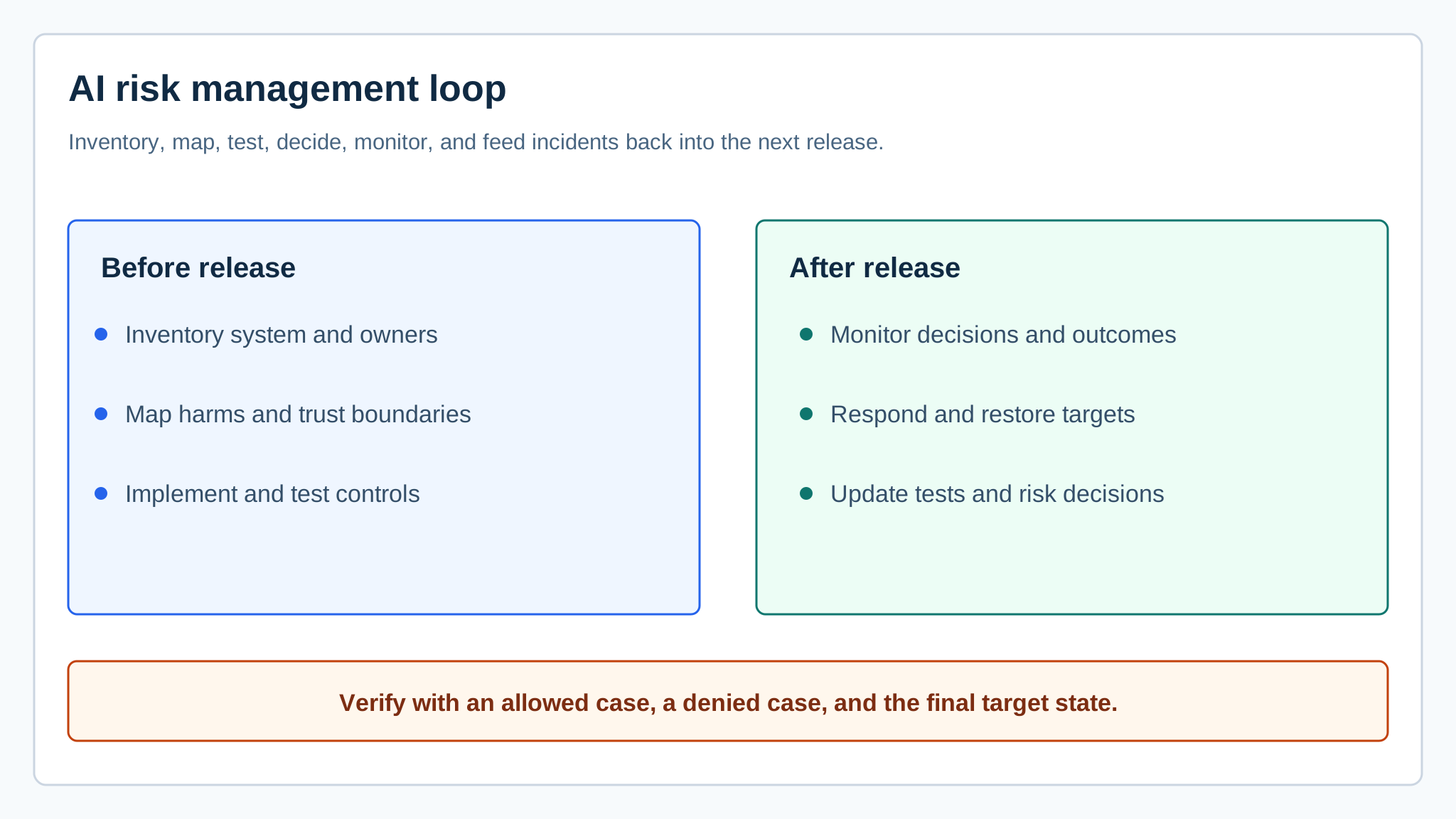
AI risk management is the operating process that connects a system inventory to real release and incident decisions. A risk register by itself does not reduce risk. Each important entry needs an owner, a control, a test, evidence, a residual-risk decision, and a recovery path.
Start with one system and one consequence. The process can expand after the team proves that it can identify the risk, implement a control, test both allowed and prohibited behavior, and use the result at a release gate.
Build an inventory that reflects the deployed system
Record purpose, owner, users, affected people, model and provider, data classes, deployment, integrations, decision authority, monitoring, and retirement plan. For an agent, add identities, tools, memory, retrieval sources, credentials, network destinations, approval thresholds, and stop mechanisms.
The NIST AI Risk Management Framework organizes the work into Govern, Map, Measure, and Manage. Use those functions as a continuous cycle rather than four folders that teams complete once. The AgentGuard glossary also provides a concise NIST AI RMF implementation reference for teams translating the framework into an internal workflow.
Write risks as testable cause and impact statements
“Hallucination” is a failure mode, not a complete risk. A stronger statement names the condition and harm: an unsupported answer may cause an operator to change a production configuration, leading to downtime. That wording reveals controls at the model, interface, approval, and target layers.
Include safety, security, privacy, discrimination, reliability, compliance, misuse, financial, operational, and reputational impact where relevant. Avoid a universal checklist that gives every system the same risks. Context determines severity.
Map controls to the system boundary
Controls can prevent, detect, limit, or recover from failure. Assign each control an owner and a location in the architecture. Data access may be constrained at retrieval, output, and destination. A high-impact agent action may need deterministic argument checks and a pre-action approval.
ISO 42001 can support the management-system layer: policy, roles, objectives, lifecycle processes, documentation, and continual improvement. It does not decide the exact tool arguments or tenant boundary in one application.
Test controls with allowed and prohibited cases
Every critical control needs an allowed baseline, a prohibited case, and a check of the final target. Add edge cases for changed identity, stale approval, malformed input, cross-tenant access, unavailable policy, and recovery. Retain the configuration and version so the result can be reproduced.
NIST's Generative AI Profile describes risks and actions specific to generative AI. Use it to challenge the local risk register, but keep deployment evidence local. A framework reference is not proof that a control worked.
Make the release decision explicit
A release record should state which risks were accepted, mitigated, transferred, or avoided; who decided; what evidence they reviewed; which limitations remain; and what changes force a new review. Conditional approval should include measurable limits such as user group, data class, transaction amount, tool set, or monitoring period.
Use AI agent threat modeling for systems that can call tools or change state. It identifies the trust boundary where the release control must act and the target that proves success or failure.
Monitor outcomes and policy decisions
Watch model and system behavior, denied actions, overrides, approvals, target outcomes, drift, incidents, and user reports. Choose signals tied to the risk statement. A high refusal rate may be harmless for one task and a dangerous availability failure for another.
A rogue agent test belongs in the regression set when software has delegated authority. Check repeated denial, tool switching, privilege expansion, hidden persistence, and continuation after a stop signal.
Close the incident loop
Stop the affected path, preserve evidence, revoke exposed access, inspect downstream effects, restore targets, communicate with owners, and update the risk record. The fix is incomplete until the failed case becomes a regression test and the release decision is revisited.
Where AgentGuard fits
AgentGuard can supply component review and selected runtime policy evidence for supported agent paths. That evidence can support a control test and release decision. It does not replace the organization-wide inventory, impact assessment, model evaluation, legal review, business ownership, or controls outside its integration scope.
A workable first cycle
Pick the highest-consequence action in one AI system. Name the owner and target. Define one allowed and one prohibited case. Put a control at the relevant boundary, run both tests, record the target state, and decide whether the system can ship within a narrow scope. Schedule a trigger-based review for changes to models, data, tools, identities, or policy.
Book an AI risk control mapping if the selected risk involves a supported agent component or action path.
Frequently Asked Questions
What is AI risk management?
AI risk management is the continuous process of identifying AI systems and impacts, assigning owners, selecting controls, testing them, making release decisions, monitoring outcomes, and responding to incidents.
What should an AI risk register contain?
Record the system, use case, affected people and assets, risk statement, owner, existing controls, evidence, residual risk, decision, review trigger, and recovery plan.
How is agent risk different from model risk?
An agent adds delegated identity, tools, memory, external data, side effects, and runtime decisions. A model evaluation alone does not cover those execution risks.
Where should a small team start?
Start with one deployed or planned system, identify its highest-consequence action, assign an owner, implement one control, and run an allowed and prohibited test before expanding the inventory.
Turn one high-priority AI risk into a testable release control and evidence record.
Build the control