
Using the OWASP Top 10 for LLM Applications in a Real Security Program
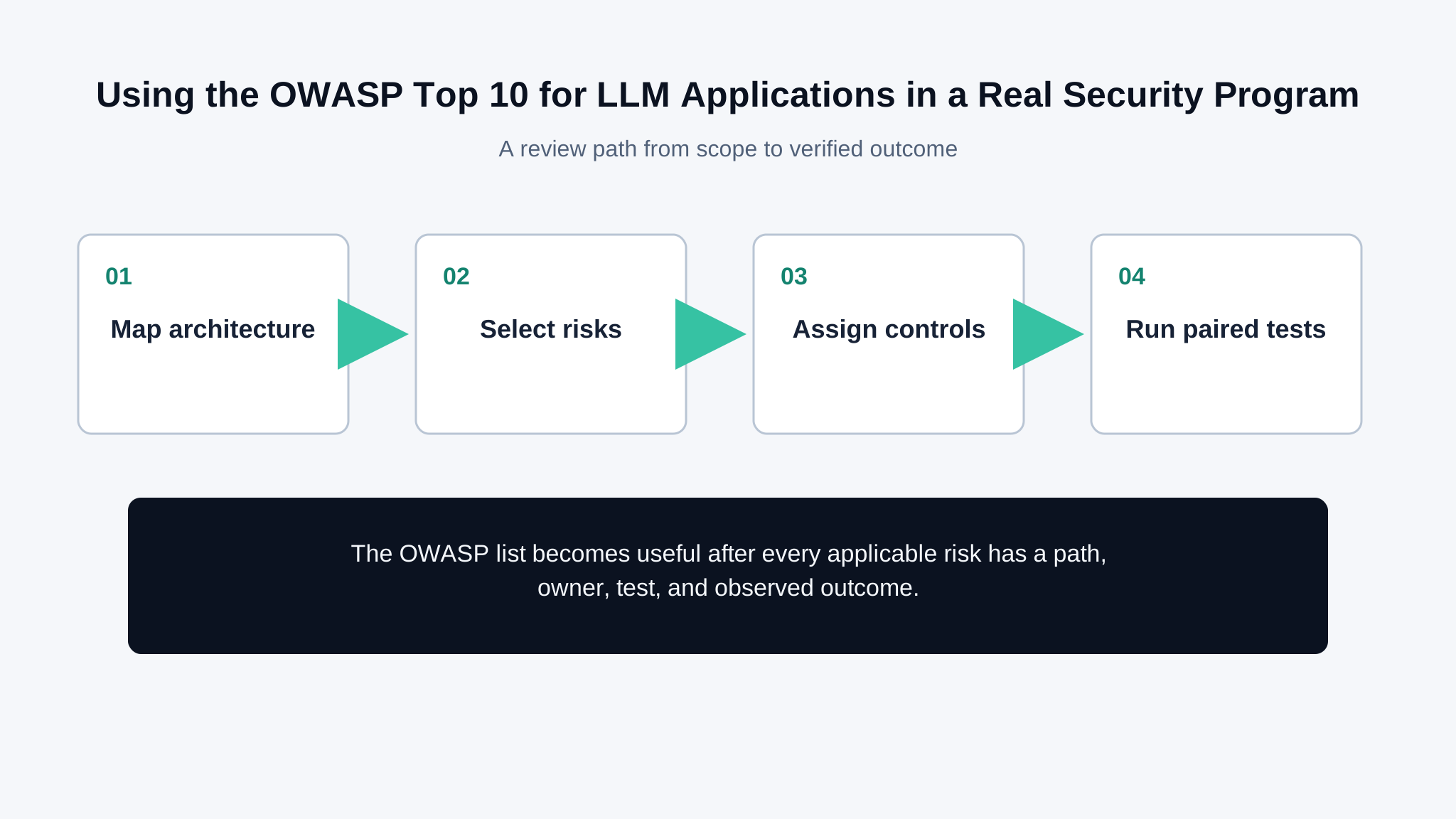
Use the OWASP LLM Top 10 as a risk index, then map each relevant item to a deployed path, control, and test.
By Agent Guard Team4 min read

Using the OWASP Top 10 for LLM Applications in a Real Security Program
The OWASP Top 10 for LLM Applications is useful because it gives teams shared names for recurring failure modes. It is not a turnkey test plan. A team still has to decide which risks apply to its architecture, where a control can act, and what evidence would prove that the control worked. This guide turns the list into that operating process.
Start with architecture, not ten equal boxes
Map the model, application, retrieval layer, data stores, plugins or tools, identities, users, and downstream targets. Then select the OWASP risks that have a reachable path. A system without retrieval has a different exposure to data poisoning than an agent indexing third-party documents. A chat interface without tools has a different impact from an agent that can change records.
Our OWASP Agentic AI Top 10 guide covers risks that become more specific when an agent has goals, memory, and tools. Use the LLM list for model-and-application risks and the agentic list where autonomy changes the control question.
Convert each relevant risk into a scenario
Write an actor, entry point, trust boundary, prohibited outcome, and observable result. For prompt injection, the scenario may be an untrusted document changing a tool destination. For sensitive-information disclosure, it may be a user retrieving another tenant's record. For unbounded consumption, it may be recursive tool calls that exceed a per-task budget.
The current OWASP Top 10 for LLM Applications should be the source for category definitions. Keep the version in your evidence because category names and emphasis can change.
Assign controls to components
A model prompt can influence behavior, but access control belongs before data retrieval and tool authorization belongs before execution. Output handling belongs in the application that renders or executes the output. Rate and budget controls belong around requests, loops, and paid tools. Assign every control to a component owner and specify whether it prevents, detects, or limits impact.
The prompt-injection prevention guide shows why a refusal in the transcript is not sufficient evidence. Inspect the proposed action, policy result, and final target state.
Build paired tests
For every negative test, add an allowed baseline. A control that blocks every request is not effective in a usable system. Change attack channels as well as wording: direct user text, retrieved pages, files, tool responses, and multi-turn context can exercise different paths. Retain fixtures and component versions so the result can be reproduced after an update.
NIST AI 600-1 provides a generative-AI risk profile that can supplement the OWASP security focus with broader measurement and governance considerations.
Report coverage honestly
Mark a risk tested only when the applicable path and expected outcome were examined. Use not applicable with an architectural reason, not as a way to shorten the report. Separate missing controls from missing evidence and from tests that produced a failure. Link every material finding to an owner, release decision, and retest.
Use AI agent threat modeling to find paths that a list can miss. AgentGuard can help inspect agent components and action controls; it does not make every OWASP category applicable or prove an application safe. Test a high-impact agent path when you have a concrete component and expected decision.
Maintain a coverage table with the OWASP version, applicable scenario, exposed component, preventive or detective control, test fixture, last result, owner, and next trigger. This makes two gaps visible: a category marked covered with no observed test, and a passing test that belongs to an older model or application revision. Retire rows when the architecture removes the path, but preserve the reason for the not-applicable decision.
Frequently Asked Questions
What is the OWASP Top 10 for LLM Applications?
It is a community-maintained list of common security risks affecting LLM applications, intended to support threat modeling, design, testing, and education.
Is passing an OWASP checklist proof that an LLM application is secure?
No. The list does not cover every architecture or prove that controls work. Teams need system-specific scenarios and observed test outcomes.
How often should OWASP LLM tests be rerun?
Rerun relevant tests after changes to models, prompts, retrieval, tools, permissions, output handling, budgets, or the OWASP version used.
Choose one applicable OWASP risk and prove the control on the deployed path, not a mock interface.
Test a path