
Anthropic's Context Engineering Guidance, Reviewed for Security
Context engineering improves relevance, but every added context source also creates a trust and data boundary.
By Agent Guard Team4 min read

Anthropic's Context Engineering Guidance, Reviewed for Security
Anthropic's context engineering guidance is useful because it treats context as finite and managed, not as an unlimited prompt. The security consequence is equally important: every retrieved document, memory entry, tool result, and summary becomes an input that can influence later actions.
Good context engineering should improve relevance while preserving provenance, data boundaries, and an independent authorization layer.
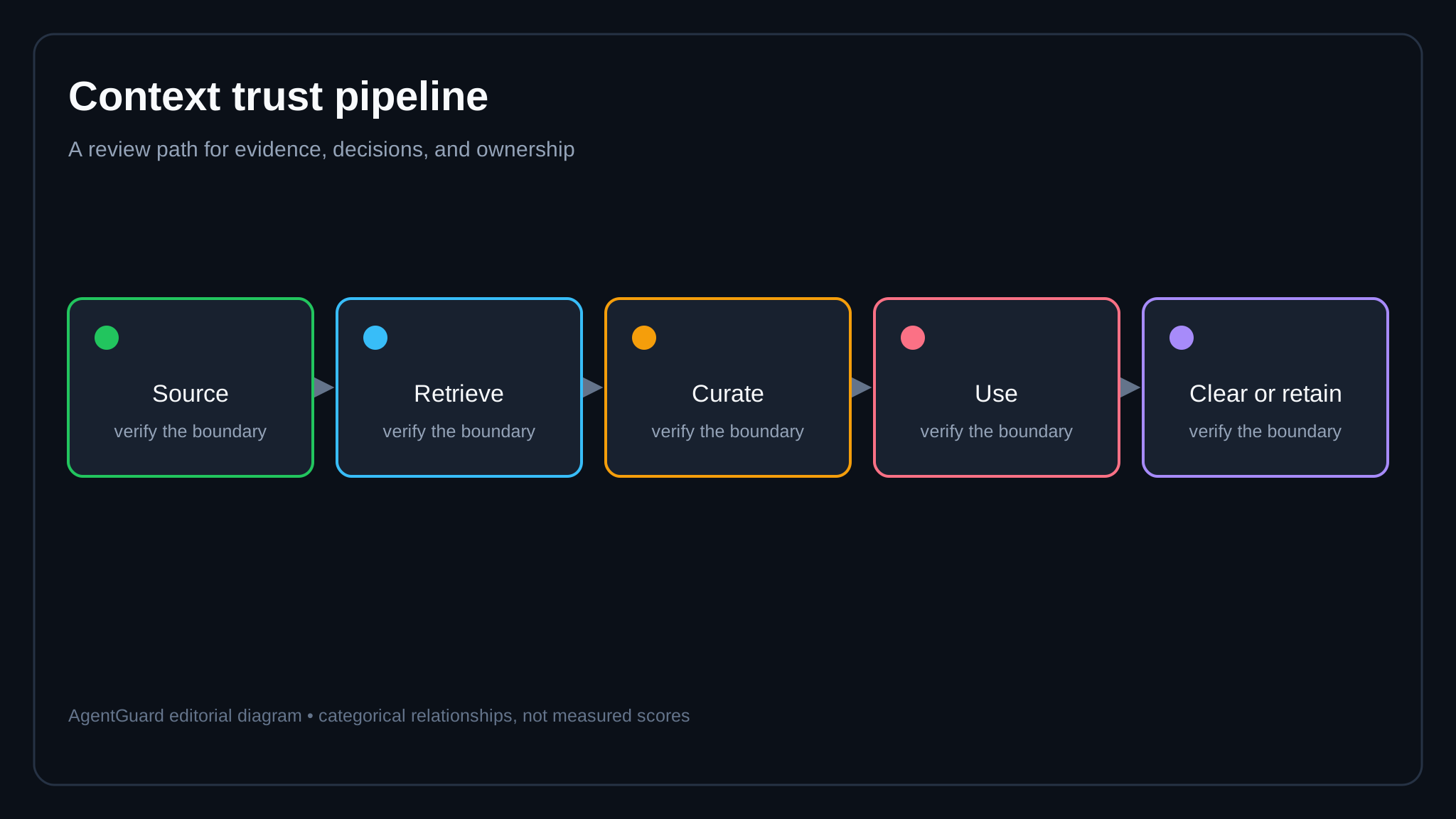
*Each context stage needs a rule for trust, sensitivity, ownership, and lifetime.*
What the guidance gets right
Anthropic's article on effective context engineering for AI agents emphasizes curating the information an agent needs. Its context engineering cookbook demonstrates memory, compaction, and tool-result clearing for long-running work.
This is a better operational frame than sending every available document on every turn. Smaller, relevant context can reduce noise and cost. It also makes control boundaries easier to inspect.
Source trust must survive retrieval
Tag context with source, owner, collection time, sensitivity, and trust level. Preserve those attributes when chunks are retrieved or reranked. A document from an untrusted web page should not become “trusted context” because it entered a vector index.
The RAG security problem is end to end: ingestion, indexing, retrieval, prompt assembly, response, and downstream action all matter.
Keep system instructions, user requests, retrieved content, and tool output in distinct channels or structures where the application supports it. Do not ask the model to infer authority from prose formatting.

Memory creates a durable attack surface
Long-running agents need memory, but a poisoned memory can outlive the conversation that introduced it. Define which facts may be written, who can update or delete them, and when they expire.
Require provenance for memory writes. Store sensitive values only when the workload genuinely needs them, preferably by reference to an access-controlled system rather than as free text.
Test conflicting and stale memories. The agent should not follow an old permission or instruction after the owner changes it.
Compaction can erase security meaning
Summaries and compaction reduce context size. They can also drop qualifiers, source labels, approval conditions, or the distinction between a fact and an instruction.
Protect invariants outside free-form summaries: identity, permissions, prohibited actions, approved destinations, data classifications, and policy version. If the agent compacts a long run, verify that these controls remain enforceable.
The same principle applies to prompt injection prevention: a summary must not promote an untrusted page instruction into a trusted task.
Tool results need scope and lifetime
Tool output can be large, stale, sensitive, or adversarial. Clear bulky results when they are no longer needed, but retain the minimum audit evidence separately. Mark the tool, arguments, result time, and resource scope.
Do not let a previous tool result authorize a new action. Recheck permissions and current state at execution time.
Context does not authorize side effects
Even well-curated context can lead to a wrong plan. Keep tool authorization outside the model. Evaluate the caller, tool, normalized arguments, target resource, and expected consequence before execution.
AgentGuard is relevant where its documented scans or runtime decisions cover the actual environment. Public materials describe component scanning and decisions around supported commands, files, tools, network requests, and secrets. That can complement context controls; it does not validate every retrieved statement.
An AI bill of materials can help inventory models, data sources, tools, and components that feed the workflow.
A practical review
Choose one long-running task. Trace every context source, retrieval filter, memory write, compaction event, tool result, and final action. Inject a harmless instruction into an untrusted document, revoke a previously valid permission, and update a memory after compaction.
The test passes only if provenance remains visible, stale context does not restore authority, sensitive data stays inside policy, and the final action is independently authorized.
Review the context and action path for one Claude agent before expanding its memory or tool access.
Frequently Asked Questions
What does Anthropic mean by context engineering?
It is the practice of selecting, structuring, retrieving, compacting, and managing the information available to an AI system as it performs a task.
Why is context engineering a security issue?
Context can contain untrusted instructions, sensitive data, stale permissions, poisoned memory, or misleading tool results that influence later actions.
How should teams secure long-running agent context?
Track provenance, classify data, limit retrieval scope, separate instructions from content, clear stale tool results, protect memory writes, and authorize actions outside the model.
Trace context provenance and tool authority through one Claude agent workflow.
Review Context