
CrowdStrike Falcon MCP Review: Powerful Security Data, Consequential Tool Access
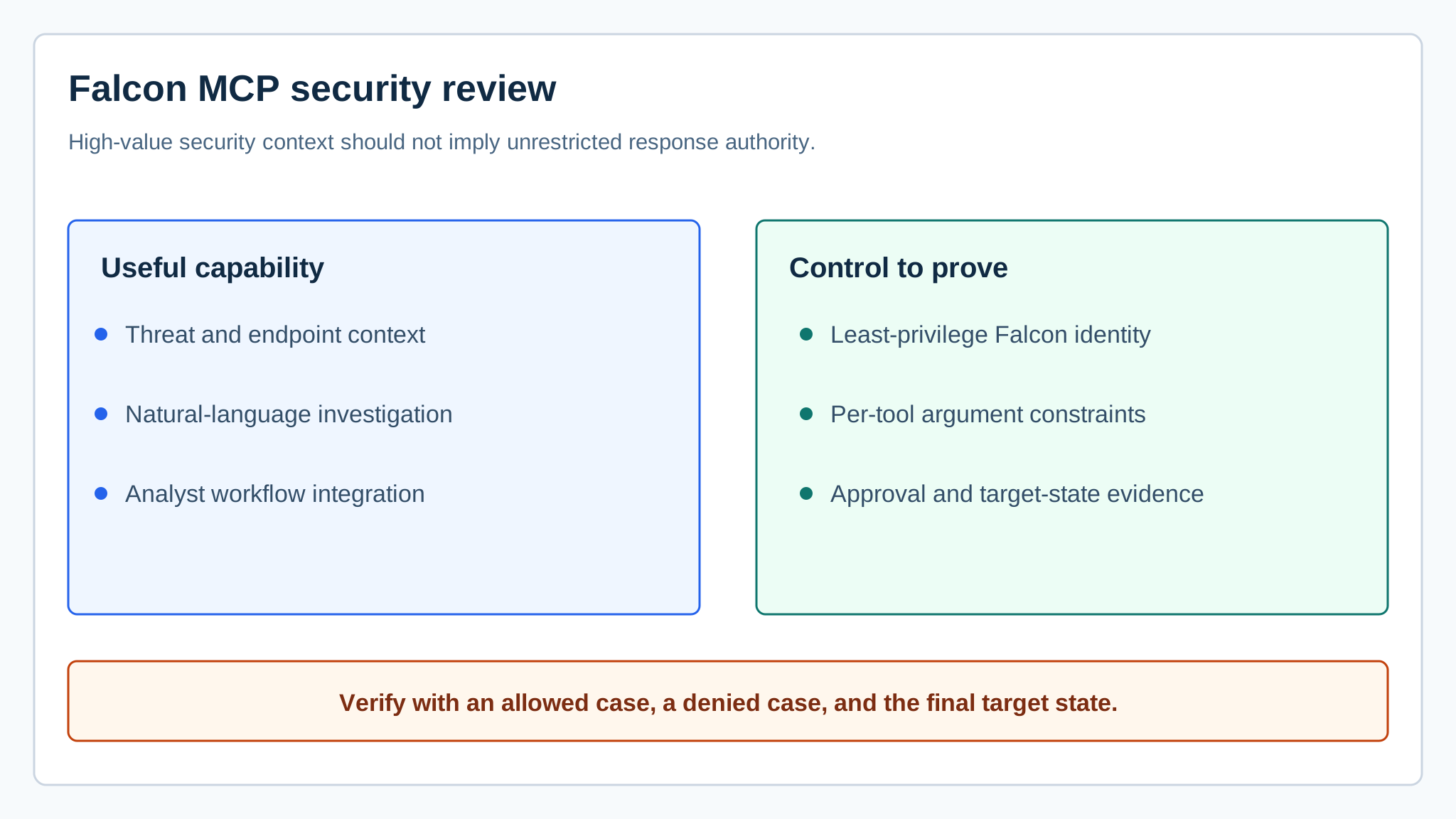
Falcon MCP can bring security operations into an agent workflow. That value raises the bar for identity, tool scope, approvals, and evidence.
By Agent Guard Team4 min read

CrowdStrike Falcon MCP Review: Powerful Security Data, Consequential Tool Access
CrowdStrike Falcon MCP connects AI clients to security operations data and workflows. That can shorten an investigation, but it also gives an agent a path into sensitive telemetry and potentially consequential operations. The security question is not whether Falcon is a trusted security product. It is whether this client, credential, enabled tool set, and approval path are safe for the task.
This review uses CrowdStrike's public repository and developer documentation. It does not claim an independent exploit test or full coverage of a customer tenant.
What the server exposes
CrowdStrike describes Falcon MCP as a way for AI agents to work with Falcon for security analysis and threat hunting. The public Falcon MCP repository is valuable because teams can inspect setup, supported tools, and changes instead of treating the server as a black box.
Begin with an inventory of the exact tools enabled in the deployed configuration. The MCP server security guide provides the minimum fields: package and version, source, transport, credentials, tool schemas, network destinations, data classes, and expected side effects.
Authentication is necessary, not sufficient
Falcon API credentials determine what the server can reach. Store them outside prompts and model-visible configuration, bind them to a dedicated identity, and remove permissions that the selected MCP tools do not need. A broad analyst credential can turn a narrow natural-language task into a wide data access path.
Test the credential against one allowed resource and one prohibited neighbor. Keep the requested tool, normalized arguments, Falcon response code, and target state. A client-side refusal is not proof when the server credential could still execute the call through another path.
Tool descriptions need argument-level policy
MCP tool discovery tells a model which operations exist. A tool allowlist does not constrain every query, host, device, tenant, time range, or response action. Validate arguments after the model proposes them and before the MCP server sends the request.
The official MCP security best practices discuss confused-deputy, token, and authorization risks. For Falcon MCP, make the policy concrete: cap result scope, restrict tenant and host selectors, reject secrets in free-text fields, and require approval for operations that change state or influence response.
Separate investigation from response
A practical rollout starts with read-only investigation tools. Let an analyst compare the agent's result with the Falcon console and verify citations. Add state-changing operations only after the read path has stable identity, argument validation, rate limits, and audit evidence.
Use MCP security scanners before admission to inspect the server package and declared capabilities. Repeat that review when the package, dependencies, tool schemas, or installation source changes. Component scanning cannot prove that a live query is authorized, so keep runtime checks separate.

Evidence an operator should retain
Save the MCP client, Falcon MCP version, configuration hash, credential identity, exposed tool list, prompt, selected tool, normalized arguments, approval decision, returned record scope, and any changed target. Redact sensitive telemetry while preserving enough structure for a reviewer to reproduce the decision.
The Model Context Protocol defines interoperability, not a universal authorization policy. Client owners, server owners, and Falcon administrators need one shared ownership record. Otherwise each team may assume another layer validates the risky argument.
Where AgentGuard fits
AgentGuard can review MCP components and apply selected pre-action policy checks where the client or host integration is supported. That is useful for identifying an unexpected server change or blocking a known disallowed action shape. It does not replace Falcon RBAC, secret management, MCP client controls, analyst approval, or the server's own logging.
Verdict
Falcon MCP is most defensible as a narrow analyst aid with a dedicated identity and an explicit progression from read-only queries to approved actions. Its access to high-value security context is the reason to use it and the reason to constrain it carefully.
Book a bounded MCP review if you need to map one Falcon tool from client prompt to final Falcon effect.
Frequently Asked Questions
What is CrowdStrike Falcon MCP?
It is an MCP server that exposes selected CrowdStrike Falcon capabilities to compatible AI clients so an agent can query or work with Falcon data through tools.
Why is Falcon MCP high impact?
Security telemetry is sensitive, and some connected operations may affect investigations or response workflows. The effective risk depends on enabled tools, credentials, arguments, and downstream permissions.
Should every Falcon MCP tool require human approval?
Not necessarily. Read-only, narrow queries may run automatically, while state-changing or broadly scoped actions should use stronger approval and argument checks based on consequence.
Can AgentGuard replace Falcon authorization?
No. AgentGuard can add component and selected action checks on supported paths. Falcon permissions, identity controls, client configuration, and operational approvals still remain necessary.
Review one Falcon MCP tool with a synthetic incident and a least-privilege identity.
Review the tool