
General Analysis Review: Where It Fits and What to Verify
A buyer-side General Analysis review covering product scope, trial evidence, AgentGuard fit, and a five-test pilot plan.
By Agent Guard Team11 min read
General Analysis Review: Where It Fits and What to Verify
General Analysis presents a broad security stack for agentic AI: asset inventory, red teaming, runtime guardrails, and detection and response. The harder buying question is whether those stages connect on your systems and produce evidence you can act on.
TL;DR: General Analysis is worth a pilot if you want one program-level workflow across discovery, testing, and runtime operations; performance, coverage, and pricing still need to be verified in your environment.
This is a desk review based on public pages, not an authenticated product benchmark; AgentGuard publishes the article and appears as an alternative where developer-facing component and action controls are the narrower requirement.
The short review: broad scope, but prove the handoffs
The strongest part of the General Analysis story is its operating model. The public site does not stop at a prompt filter. It describes an inventory of AI assets and permissions, system-level adversarial testing, controls derived from findings, runtime monitoring, and incident response. That shape makes sense for a security team trying to manage several AI applications instead of adding another isolated detector.
The unproven part is execution in a buyer's environment. A list of supported surfaces does not show whether a connector finds every relevant agent, whether a red-team trace becomes a usable policy, or whether that policy blocks the same path in production without unacceptable noise. Those handoffs should decide the pilot.
Our verdict is therefore conditional. General Analysis deserves consideration when one team owns discovery, testing, and runtime response across a mixed AI estate. Buyers looking for a narrower developer control should compare it with tools built around component admission and supported checks before a high-risk action. In both cases, ask for observed coverage rather than a broad category claim.
What General Analysis publicly documents
General Analysis divides its public product surface into asset management, automated red teaming, runtime guardrails, and AI detection and response. The descriptions are specific enough to design a trial, but they remain first-party statements.
AI security asset management
The asset-management page says the platform can inventory models, endpoints, knowledge bases, MCP servers, tools, permissions, and shadow AI across cloud accounts, code repositories, and agent infrastructure. It also describes ownership mapping, change tracking, risk tags, and relationships between tools, data sources, identities, and deployment surfaces.
That is useful when the first problem is visibility. A security team cannot test or govern an agent path that it does not know exists. The pilot should still define its own denominator: a known list of repositories, model accounts, MCP servers, credentials, knowledge stores, and production workflows. Compare the platform's inventory with that list and investigate every miss and duplicate.
Automated AI red teaming
The red-team page describes campaigns for LLM applications, RAG systems, MCP servers, coding agents, and production agents. Its stated test areas include direct and indirect prompt injection, tool misuse, data leakage, unsafe autonomy, privilege escalation, and multi-step exploit paths. Findings are described as reproducible traces that can become remediation tasks and release regression tests.
The interesting claim is system context. A useful agent test includes the prompt, retrieved material, tool graph, identity, permissions, and business action. This is where an LLM agent exploit vectors inventory helps: choose paths that cross more than one component and require the test to preserve the full sequence.
Do not score the pilot by attack count. Score it by reproducibility and decision value. A finding should identify the starting input, intermediate state, privileged action, affected asset, policy expectation, and exact replay result after the fix.
Runtime guardrails and detection response
General Analysis's runtime product page says it can inspect prompts, retrieved context, model responses, tool arguments, and streamed output. It also describes tool allowlists, approvals, blocking, redaction, traces, policy hits, and drift signals. A separate detection-and-response page extends the story to endpoint activity across local agents, browser copilots, IDE assistants, terminals, MCP servers, and shadow AI.
Taken together, those pages describe controls at several layers: model traffic, agent actions, endpoints, and incident workflows. That breadth can reduce gaps between application security and security operations. It can also make a trial harder, because each layer has a different integration path and a different definition of coverage.
| Decision area | Publicly documented scope | Evidence to require in a pilot |
|---|---|---|
| Asset discovery | Models, MCPs, knowledge bases, tools, permissions, endpoints, and shadow AI | Reconciliation against a buyer-owned inventory, with misses and duplicates explained |
| Red teaming | Prompt, retrieval, tool, permission, and multi-step agent attacks | Reproducible trace, expected policy, affected asset, owner, and clean replay after remediation |
| Runtime controls | Input, output, retrieved context, tool arguments, approvals, blocks, and redaction | Observed allow, block, escalate, and fail-open or fail-closed behavior on real paths |
| Detection and response | Endpoint and agent traces plus containment actions | Searchable incident record, response timing, evidence retention, and ownership handoff |
Who General Analysis fits, and what remains trial-only
The public scope points toward a platform buyer, not a team shopping for one prompt classifier. That distinction affects procurement, implementation, and success criteria.
Good-fit conditions
General Analysis is a plausible fit when a central security or AI-platform team owns several models, RAG systems, agents, MCP connections, and employee AI tools. The team should also be prepared to connect repositories, cloud accounts, runtime telemetry, identities, and incident workflows. Without those inputs, the platform cannot demonstrate the connected loop it sells.
The buyer also needs authority to act on findings. Inventory without ownership becomes a dashboard. Red-team results without a release gate become reports. Runtime alerts without a response process become another queue. Assign an owner and an action for each output before expanding the pilot.
This is also where MCP security tools need to be compared by control point. A product may discover a server, test a tool chain, inspect a call, block an action, or reconstruct an incident. Those are different jobs. Map each General Analysis integration to the exact decision it can make and the evidence it retains.
Questions the public pages cannot answer
The reviewed pages do not establish integration completeness for your stack. Ask which agents, MCP hosts, model providers, endpoint environments, and tool paths are supported today; which require custom work; and which remain visible only through logs. Test at least one supported path and one awkward path.
Performance and policy quality also remain trial questions. General Analysis publishes performance language, but we did not independently test latency, throughput, false-positive rates, or efficacy. Measure them with your traffic, policies, and failure budget. Include safe but unusual actions so the trial does not reward a system that blocks everything.
Comparable plan pricing and contract detail were not visible on the product pages we reviewed. Ask how pricing changes with assets, endpoints, events, tests, model calls, retention, connectors, and support. The cheapest quote can still be expensive if several controls require separate integrations or constant tuning.
Data handling deserves the same scrutiny. Document which prompts, code, files, retrieved text, tool arguments, traces, and secrets leave the environment; where they are processed; how they are redacted; and how long evidence is retained. Use the contract and a live data-flow test, not a general security statement.
General Analysis or AgentGuard? Start with the control point
This comparison is published by AgentGuard, so the useful question is not which vendor wins an abstract category. It is where the buyer needs a decision and what each product publicly documents at that point.
Choose General Analysis when
Start with General Analysis when the main requirement is a connected security-program workflow across asset discovery, adversarial testing, runtime guardrails, endpoint visibility, and incident response. Its public pages speak to central teams that need a view across many AI systems and want findings to move into controls and operations.
That breadth is the reason to run a pilot, not a reason to skip one. Require the product to show the same asset and exploit path moving from discovery to test, control, runtime decision, and incident evidence. A handoff that depends on manual reconstruction weakens the platform advantage.
Choose AgentGuard when
AgentGuard is the closer fit when developers want to scan agent components and place a supported decision immediately before a high-risk action. Its public product and documentation cover scans for skills, plugins, MCP servers, and agent code, alongside checks for shell commands, file access, tool actions, network requests, secret access, and sensitive writes. The public repository also provides an open-source CLI under an MIT license.
That gives AgentGuard a concrete evaluation path: select one component, one supported action path, and one policy. Record the pre-action decision and resulting audit evidence. The narrower scope can be useful for a team that needs an operator-visible control in a development workflow rather than a broad security-operations platform.
AgentGuard also documents a limitation: it cannot fully monitor or block every third-party MCP server runtime call. It combines component scans, reputation, trust data, and supported hook-layer controls instead. Buyers should inventory every MCP path and assign a control or an explicit exception rather than assume universal coverage.
Where both products need a coverage test
Neither a platform diagram nor an integration logo proves interception. For each agent action, record the host, model, tool or MCP server, identity, data source, downstream effect, policy owner, and evidence location. Then trigger a harmless allowed action and a bounded disallowed action.
The winner for that path is the product that makes the intended decision at the correct point, fails predictably, and leaves evidence an operator can retrieve. Different paths may justify different controls. A central General Analysis deployment and a developer-facing AgentGuard control are not automatically mutually exclusive.
If supported pre-action checks are the immediate requirement, Inspect AgentGuard's controls against one real workflow before widening deployment.
How to test General Analysis in a pilot
Do not begin with every connector and every attack library. Pick one production-representative agent, one high-value action, and one known data boundary. A two-week pilot with a clear denominator can reveal more than a wide deployment that cannot explain its misses.
The proof loop
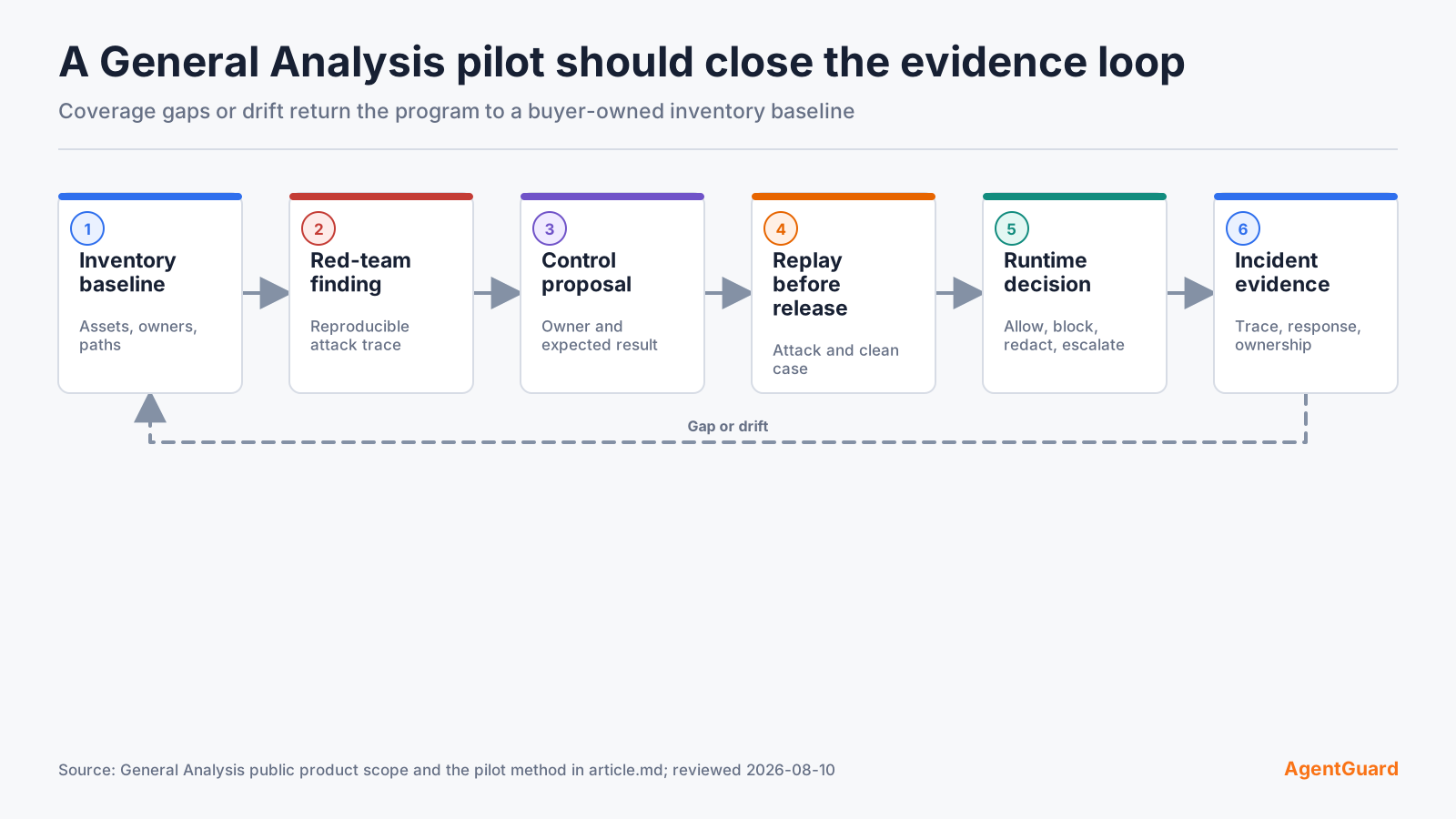
The loop is complete only when each arrow has an owner, a timestamp, and a retrievable artifact. If a finding cannot become a control, or a runtime decision cannot be connected to the original finding, record the break rather than treating the stages as one system.
Five tests with observable outcomes
1. Reconcile the inventory. Give the platform a bounded environment with a buyer-owned list of agents, models, MCP servers, tools, knowledge sources, identities, and owners. Record true matches, misses, duplicates, stale assets, discovery time, and the evidence behind each risk label.
2. Reproduce one system-level exploit. Use a harmless direct prompt and an indirect instruction embedded in retrieved content. The OWASP LLM01:2025 Prompt Injection guidance distinguishes direct and indirect paths; the test should preserve the prompt, retrieved content, selected tool, requested action, policy expectation, and final result.
3. Convert the finding into a control. Ask General Analysis to propose or configure a policy for the confirmed path. Review who approves it, which layer enforces it, how it is versioned, and what happens when the policy service or connector is unavailable.
4. Replay allowed and denied behavior. Run the exploit again, then run a safe action with similar language and the same tool. Capture the decision, latency, user experience, false positive, fallback behavior, and downstream side effect. Repeat after a model, prompt, tool, or permission change.
5. Retrieve the incident evidence. Give an analyst only the alert or case identifier. Measure whether they can reconstruct the asset, identity, input, retrieved content, tool arguments, response action, policy version, owner, and replay result without asking the pilot team to rebuild the timeline.
Before expanding, apply enterprise AI agent security best practices to the rollout: define the control owner, exception process, change triggers, evidence retention, and rollback path. Price the production configuration, not the demo configuration, and document any untested agent or MCP routes.
Frequently Asked Questions
Is General Analysis pricing public?
Comparable plan pricing and contract detail were not visible on the General Analysis product pages reviewed for this article. Ask for a quote tied to your asset count, endpoints, events, red-team volume, retention, connectors, deployment model, and support requirements. Confirm which capabilities are included rather than comparing one headline number.
Does General Analysis replace a red-team tool?
General Analysis publicly describes automated red teaming for LLM apps, RAG systems, MCP servers, coding agents, and production agents. Whether it replaces an existing tool depends on attack coverage, reproducibility, custom scenarios, release integration, export formats, and the evidence your team needs. Test those requirements with a known vulnerable workflow.
Does it provide runtime protection?
Yes, as a first-party product claim. General Analysis documents inspection across prompts, retrieved context, responses, tool arguments, and streamed output, plus policy actions such as block, redact, approve, and escalate. A buyer still needs to verify which paths are actually in line, what happens on failure, and how decisions affect latency and safe traffic.
When is AgentGuard the closer fit?
AgentGuard is the closer fit when the immediate task is to scan agent components or apply a supported decision before a shell, file, tool, network, secret, or sensitive-write action in a developer workflow. It offers an open-source CLI and a direct test surface. It does not claim full runtime interception for every third-party MCP server call, so coverage must be mapped path by path.
Test each agent action against a clear policy decision and an evidence trail.
Book demo