
HiddenLayer Review: Where It Fits and What to Verify
An evidence-led HiddenLayer review covering documented controls, procurement unknowns, pilot checks, and AgentGuard's runtime fit.
By Agent Guard Team14 min read
HiddenLayer Review: Where It Fits and What to Verify
The short version of this HiddenLayer review: HiddenLayer is a credible shortlist candidate for teams that need model scanning, AI runtime monitoring, attack simulation, and controls for agentic or MCP traffic. Its public material documents a broad platform, but it does not answer every buyer-specific question about deployment, data flow, latency, pricing, or comparative efficacy.
The practical verdict is conditional: keep HiddenLayer in the evaluation if model and enterprise AI coverage are central, then test the exact enforcement point and evidence trail in your architecture. Add AgentGuard when local-first control over developer agents, high-risk actions, and agent components is a required path rather than a secondary use case.
HiddenLayer review: the short verdict
HiddenLayer presents one platform for four security jobs: finding AI assets, scanning the AI supply chain, testing AI systems with simulated attacks, and protecting systems at runtime. Its current product pages also describe controls for agentic systems and MCP traffic. That breadth makes the product relevant to security teams that want one evaluation to cover traditional machine learning, generative AI, and autonomous agent workflows.
This review is based on current public documentation and product pages, not a private customer deployment or a controlled head-to-head test. First-party material can establish what a vendor documents. It cannot establish how well a control will perform in your environment, how much latency it will add, or whether every integration behaves the same way.
The strongest public case for HiddenLayer is scope. Model scanning addresses malicious model files, vulnerable dependencies, backdoors, integrity, and genealogy. Runtime material describes visibility, detection, inline enforcement, and connections to security operations. The agentic and MCP material adds indirect prompt-injection detection, memory and context checks, tool and action inspection, and traffic inspection through proxy, SDK, and gateway paths.
The main buyer risk is treating that documented scope as a completed architecture decision. A product can support an integration category without sitting on the exact path that matters to your team. It can generate events without retaining the fields your auditors need. It can block one action class while only observing another. Those details belong in the pilot contract.
| Buyer question | What the public evidence supports | What still needs proof |
|---|---|---|
| Does HiddenLayer cover more than LLM prompts? | Yes. Public pages cover model, supply-chain, runtime, discovery, attack-simulation, agentic, and MCP surfaces. | Which modules and integrations are included in the proposed package. |
| Can it inspect agent actions? | The agentic page documents tool and action inspection across APIs, MCP tools, code execution, communication tools, and filesystem operations. | The exact interception point, policy result, and failure behavior for your agent stack. |
| Is it ready for a production purchase? | The documentation is detailed enough to design a pilot. | Price, deployment boundary, data flow, latency, efficacy, support, and retained evidence. |
What HiddenLayer actually covers
The HiddenLayer platform documentation organizes the product into AI Discovery, AI Supply Chain Security, AI Attack Simulation, and AI Runtime Security. This is more useful than a single "AI firewall" label because each module addresses a different security job.
AI Discovery is the inventory layer. A security team cannot define coverage if it cannot identify the models, applications, providers, and shadow AI already in use. The buyer should still verify which cloud accounts, registries, endpoints, and development environments the discovery module can enumerate with the proposed permissions.
AI Supply Chain Security covers the model before production use. HiddenLayer's model-scanning page describes checks for malware, vulnerabilities, backdoors, model integrity, and genealogy across proprietary, open-source, and vendor models. That is a meaningful control for teams pulling models or model components from external sources. It should be tested with the formats, registries, CI jobs, and exception workflow that the team actually operates.
AI Attack Simulation addresses pre-production and continuous testing. The public positioning says the module simulates real-world AI attacks to find weaknesses. A buyer needs more detail than the category name: what attack corpus is used, how tests are updated, what success means, whether results are reproducible, and how findings become engineering work.
AI Runtime Security is the in-production control surface. HiddenLayer describes visibility, threat detection, inline enforcement, an agent harness, and integration with SIEM and SOAR workflows. For agentic and MCP workloads, the vendor also documents indirect prompt-injection detection, memory and context safety, tool-use inspection, and traffic visibility through LiteLLM proxy interception, SDK instrumentation, and gateway inspection.
This is a broad documented surface, but the modules should not be collapsed into one check mark. Discovery proves inventory, scanning assesses an artifact, attack simulation exercises a system, and runtime controls observe or act on live behavior. Each produces different evidence and fails in a different way.
Where HiddenLayer fits in an AI security architecture
Start with the model artifact boundary. HiddenLayer's scanning material is most concrete when a team needs to inspect model files and their dependencies before deployment. The security question is whether an artifact contains malicious code, known vulnerabilities, backdoors, corruption, or inherited risk. The evidence should be a scan result tied to an immutable artifact identifier and the policy decision that followed.
The second boundary is live inference and application behavior. Runtime visibility and inline enforcement belong on a path where they can see the relevant request, response, context, and policy state. The buyer should draw the real path from user or agent to model and mark whether HiddenLayer observes through a proxy, SDK, gateway, on-device harness, or another integration. “Runtime coverage” is not specific enough for an architecture review.
The third boundary is agent execution. An agent can retrieve untrusted content, update memory, call an MCP tool, execute code, send a message, or write a file. HiddenLayer publicly documents controls for several of these behaviors. The evaluation still has to show which action is intercepted before execution, which action is observed after execution, and what happens when the enforcement service is unavailable.
This distinction also matters when comparing MCP security tools. Some products assess server or component risk before connection. Others inspect MCP messages or tool calls at runtime. A mature design may need both because a clean component can later receive a malicious response, while a blocked runtime action does not remove a vulnerable package from the supply chain.
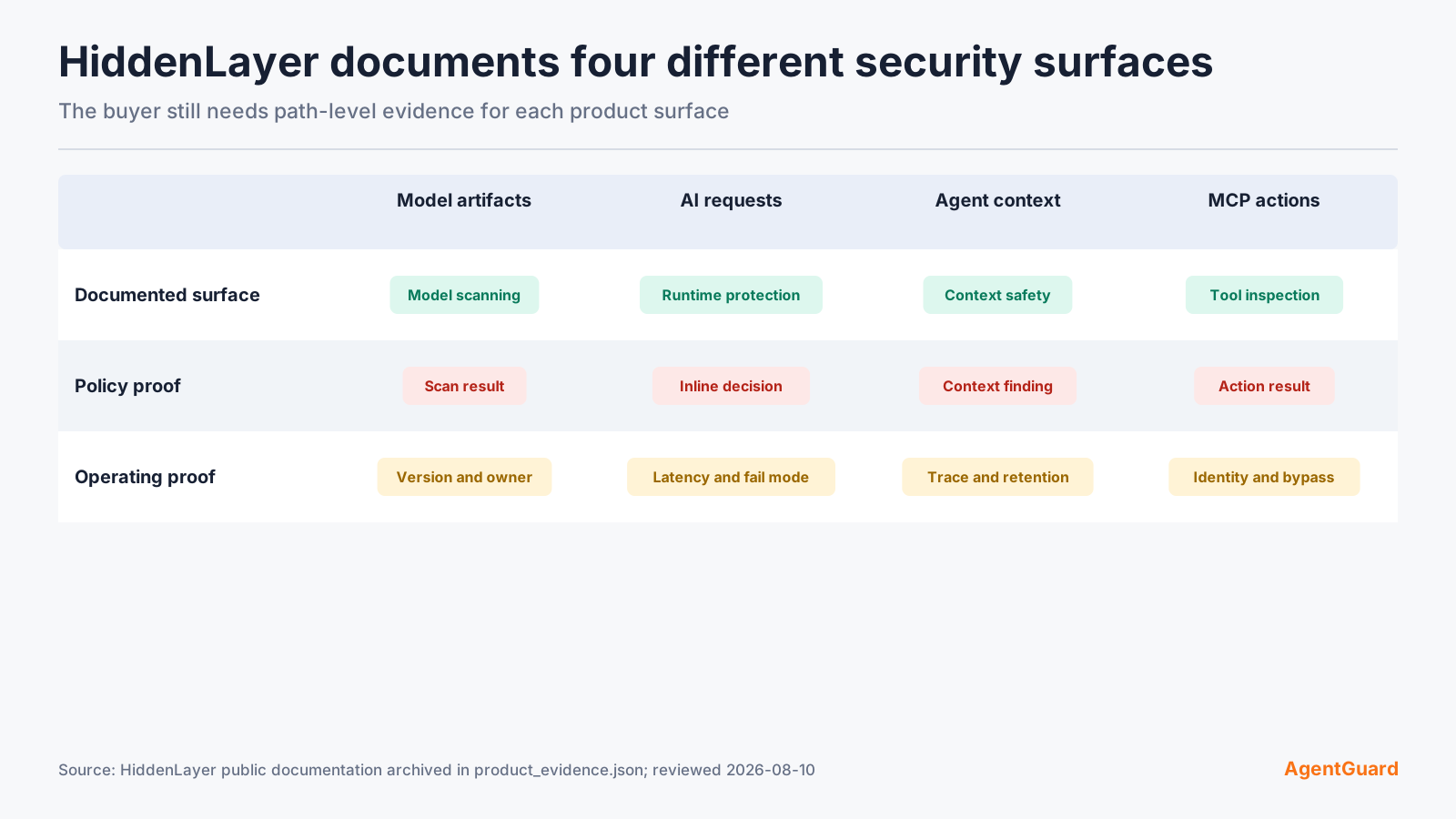
The last boundary is operational evidence. HiddenLayer describes security-operations integration, which is useful only if the resulting record supports investigation. Ask for the event schema, timestamps, actor and session identity, original and transformed content handling, policy version, decision, action result, redaction behavior, retention, and export path. The pilot should show those fields in the system of record instead of stopping at a product demonstration.
The architecture decision is therefore not “Does HiddenLayer have runtime security?” It is “Which of our execution paths can it observe, decide on, and reconstruct with evidence?” That question gives the vendor a fair opportunity to demonstrate coverage without assuming that a page omission proves a product gap.
What buyers should verify before a pilot
A useful pilot starts with unknowns. HiddenLayer does not publish enough current information to make a responsible claim about the price of a buyer-specific deployment, its latency in that deployment, or its detection advantage over another product. Those fields should remain unknown until the vendor and the buyer produce matched evidence.
Use the NIST AI Risk Management Framework as a neutral way to organize the evidence request. The framework does not endorse a vendor. It helps teams connect governance, mapping, measurement, and management work to specific controls and retained records.
| Verification area | Evidence to request | Pass condition |
|---|---|---|
| Deployment boundary | Architecture diagram, integration mode, network dependencies, failure mode, and supported environments | Every in-scope path and out-of-scope path is explicit. |
| Data handling | Field-level data flow, redaction, storage, retention, residency, and support access | Security and privacy owners approve the documented flow. |
| Enforcement | Policy inputs, decision timing, block or redact behavior, approval flow, and fail-open or fail-closed behavior | The expected decision occurs before the protected action and fails as designed. |
| Performance | p50, p95, and p99 latency under representative load, including dependency failure | Results stay inside the team's service budget. |
| Detection | Shared attack corpus, configuration, expected result, false-positive review, and retest method | Results are reproducible and reviewed by the owning team. |
| Evidence | Event schema, policy version, identity, timestamps, decision, action result, and export | An investigator can reconstruct the test without relying on a screenshot. |
| Commercial scope | Quote, modules, usage limits, services, support, renewal terms, and exit terms | Procurement can compare equivalent scope rather than headline price. |
The sequence matters. If the integration point is unclear, latency results are hard to interpret. If the attack corpus differs between vendors, efficacy comparisons are not valid. If an event omits the policy version or action result, a dashboard may look complete while the investigation record remains incomplete.
Enterprise AI agent security best practices should also shape the scope. Include the agent's identity, permissions, external data, memory, model endpoint, MCP servers, tools, code execution, secrets, and downstream systems. A pilot that tests only prompt injection leaves most of the action surface untouched.
Ask the vendor to label every statement as generally available, preview, roadmap, partner-delivered, or custom. Then put only generally available controls into the initial pass criteria. This keeps the purchase decision tied to the product that can be deployed now.
Where AgentGuard changes the shortlist
AgentGuard belongs in the same evaluation when the buyer's immediate problem is a developer agent taking a risky action on a workstation or in a local development environment. Its current public material describes a local-first guard that evaluates observable high-risk actions before execution and can block them or require confirmation based on policy. It also documents scanning for skills, plugins, MCP server code, packages, and agent runtime code.
The onboarding evidence is unusually concrete. The public quickstart includes installation commands, status and doctor checks, policy modes, a deliberate risky test, and dashboard verification. It says policy decisions happen locally and that redacted action metadata is synced to the cloud. The API reference adds action evaluation, policy retrieval, audit ingestion, approvals, cached-policy behavior for offline decisions, and supply-chain scanning endpoints.
That gives AgentGuard a clear advantage for a buyer who wants to reproduce a command-level developer-agent test from public documentation before a sales-led pilot. It also makes the data boundary easier to question because the documentation states where the decision occurs and what is synced. These are documented workflow advantages, not proof that AgentGuard has better detection efficacy or broader enterprise coverage.
HiddenLayer may still cover the same organization through runtime, agent harness, proxy, SDK, gateway, model, and security-operations surfaces. The reviewed pages do not establish a directly equivalent command-level onboarding path, but that is a request for demonstration, not a claim that the product lacks one. A fair shortlist asks HiddenLayer to run the same local developer-agent case and show the decision and evidence trail.
If local action control, MCP component scanning, and a reproducible first test are central to your evaluation, map your runtime controls against AgentGuard's current workflow before reducing the shortlist.
Who should shortlist HiddenLayer
Shortlist HiddenLayer when the program spans several AI security jobs and the team wants to evaluate them as one platform. The strongest fit is an enterprise that needs model and supply-chain security alongside runtime monitoring, attack simulation, AI discovery, and agentic or MCP controls. The security team should have enough architecture access to test the integration and enough operational ownership to validate the resulting evidence.
Keep HiddenLayer as a conditional fit when the main requirement is narrower. A team focused on one agent harness, one local developer workflow, or one MCP component may find a smaller control boundary easier to test and operate. HiddenLayer can still qualify, but platform breadth should not substitute for proof on that narrow path.
Evaluate HiddenLayer and AgentGuard together when model security and developer-agent action control are both first-order requirements. The products' public materials emphasize different starting points. A layered deployment may be reasonable if each product owns a clear decision and the combined latency, failure behavior, evidence, and operating cost remain acceptable.
Do not shortlist on logos, module count, or a generic “comprehensive” claim. Use the path that must be protected, the action that must be controlled, the evidence that must be retained, and the team that must operate the system.
How to run a fair evaluation
Choose one representative workflow before choosing test cases. It should include the same user or service identity, agent, model endpoint, MCP connection, tool permissions, data sources, and downstream action for every vendor. Freeze the configuration and document any product-specific adaptation.
Build the attack set from real LLM agent exploit vectors and the incidents your team already worries about. Include indirect prompt injection through retrieved content, a poisoned MCP response, an unsafe tool call, secret access, destructive shell or file behavior, a malicious or vulnerable component, memory contamination, and a request that should remain allowed. A useful test set contains both attacks and legitimate edge cases.
For each case, record five results: what the product observed, what policy it evaluated, what decision it made, whether the action occurred, and what evidence remained. Capture latency and dependency state at the same time. A block without a reconstructable record is incomplete, while a detailed alert after a destructive action may be too late for that use case.
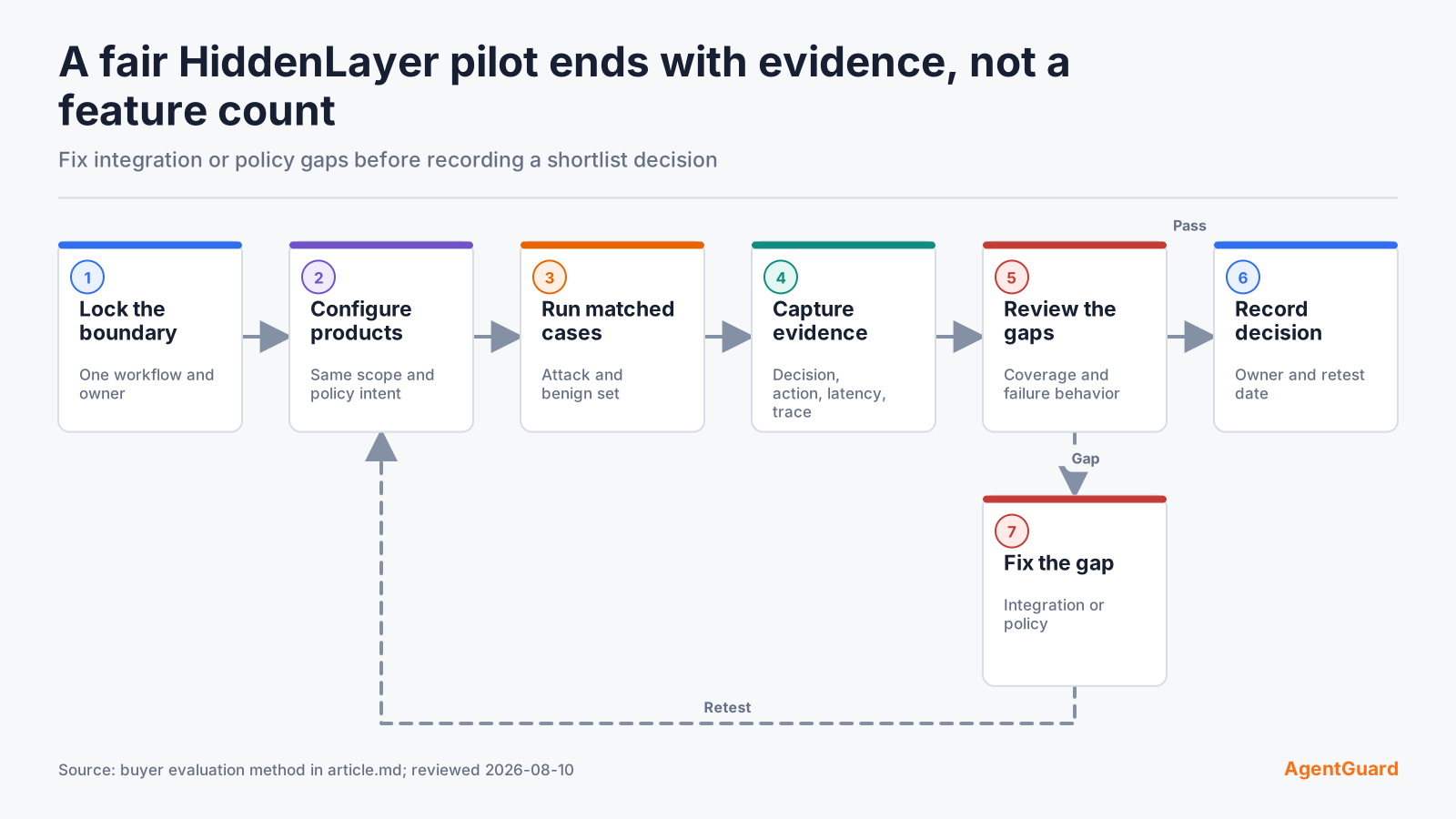
Run the cases again after policy changes and after an integration dependency fails. This exposes stale policy, bypass paths, fail-open behavior, duplicate events, and evidence gaps that a clean demonstration may not reveal. Record every exception and its owner.
Score control fit separately from platform breadth. A product can have more modules and still miss the one path that matters to the current deployment. Another product can win the narrow test while leaving model, discovery, or enterprise operations requirements to other controls.
Finish with a decision record that names the selected control boundary, passed and failed cases, accepted gaps, compensating controls, owner, cost basis, and retest date. That record is more useful than a winner label because it explains what the product is trusted to do.
Frequently Asked Questions
Is HiddenLayer a good AI security platform?
HiddenLayer documents a broad platform across AI discovery, supply-chain security, attack simulation, runtime security, model scanning, and agentic or MCP controls. That makes it a credible enterprise shortlist candidate. Whether it is a good fit depends on a pilot that verifies the exact integration, enforcement behavior, data flow, performance, evidence, and commercial scope.
Does HiddenLayer support MCP security?
HiddenLayer's current Agentic & MCP page says it inspects indirect prompt injection, memory and context, tool use, actions, and MCP or framework traffic through LiteLLM proxy interception, SDK instrumentation, and gateway inspection. Buyers should test the integration mode used in their own stack and confirm which actions are observed or controlled before execution.
How much does HiddenLayer cost?
A current, comparable public price was not verified for this review. Request a quote that names modules, deployment scope, usage limits, implementation services, support, renewal terms, and any separate infrastructure cost. Compare equivalent scope rather than a headline number.
Is AgentGuard a HiddenLayer alternative?
AgentGuard is a relevant alternative when the main requirement is local-first control of developer-agent actions plus scanning for skills, plugins, MCP server code, packages, and agent runtime code. HiddenLayer's public scope is broader across enterprise AI security modules. Test both against the same workflow instead of treating them as interchangeable feature lists.
Compare both products against your own agent workflow before choosing a control boundary.
Book a Demo