
Vertex AI Agent Security: What the Platform Covers and What You Still Need to Test
A boundary-first review of Google's agent platform, with a practical test plan for identity, tools, data, and runtime decisions.
By Agent Guard Team4 min read

Vertex AI Agent Security: What the Platform Covers and What You Still Need to Test
Google now presents much of the former Vertex AI Agent Builder surface under its Gemini Enterprise Agent Platform. The naming shift matters less than the operating boundary: an agent can retrieve enterprise data, call tools, and act through Google Cloud identities. A useful security review asks which identity acts, which data enters context, what a tool may change, and how a reviewer can reconstruct a denied or completed action.
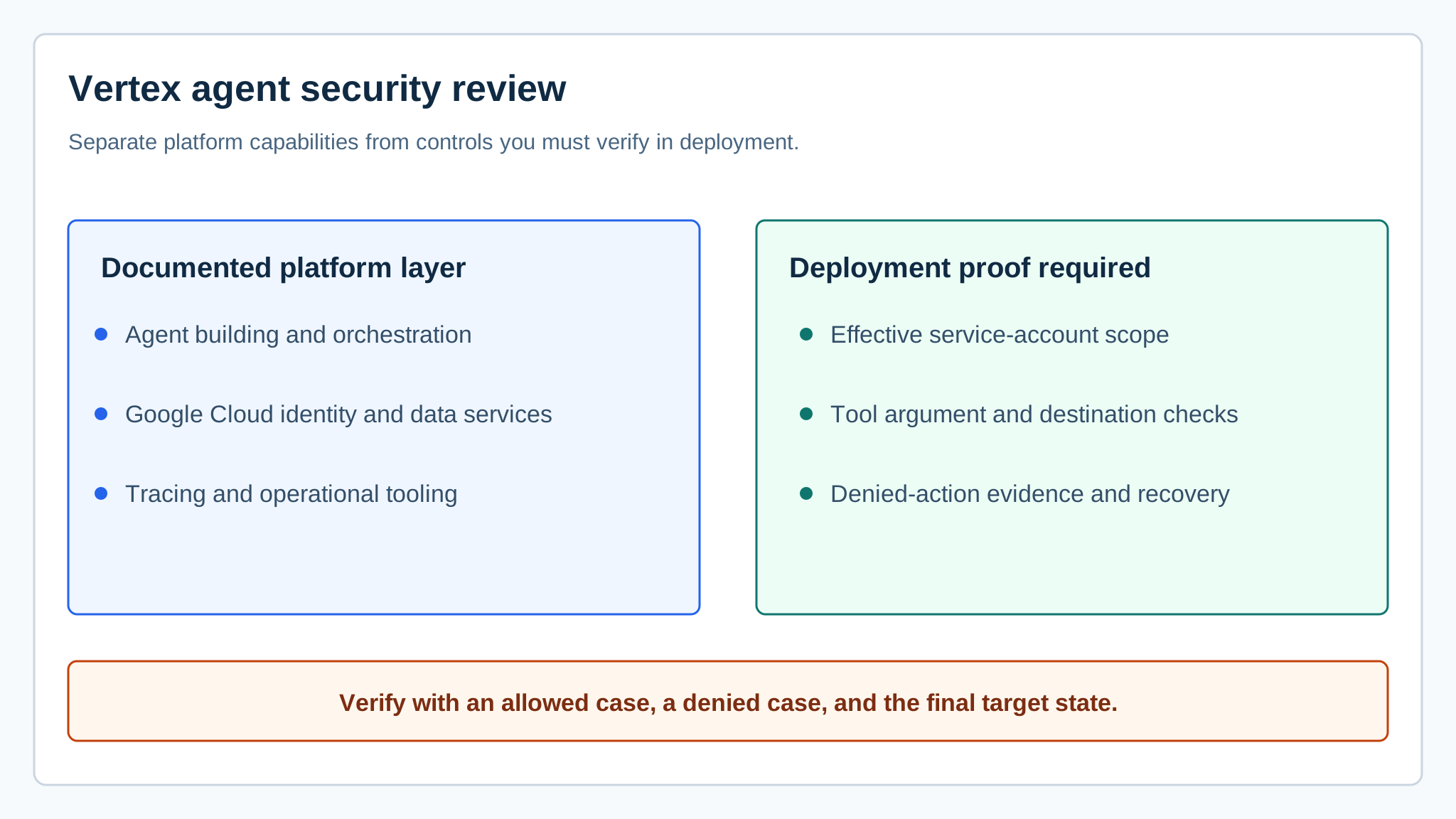
This is a desk review of public documentation, not a penetration test of a configured tenant. Google's pages establish platform scope. They do not prove that a particular deployment has least privilege, safe tool arguments, or complete detection coverage.
Start with the platform boundary
The Gemini Enterprise Agent Platform brings agent building, enterprise search, orchestration, and Google Cloud services into one platform story. That can reduce integration work, but it also makes configuration evidence important. The same agent design can be cautious in one project and over-privileged in another.
Build the review around the deployed path, not the marketing category. Record the agent version, project, region, service account, data stores, extensions, APIs, network destinations, and human approval points. The AI agent threat modeling method is useful here because it follows assets, trust boundaries, and effects instead of listing generic model risks.
Identity is the first control surface
A Vertex agent often reaches other systems through a Google Cloud service account or an application identity. Review both the IAM role and the business permission behind the called tool. A role that permits an API call does not decide whether this user may export these records, send to this recipient, or update this production object.
Google's service account security guidance recommends avoiding overly broad privileges and managing credentials carefully. Apply that guidance to the complete agent chain. Test a permitted resource and a neighboring resource that should be denied. Then check the trace, downstream service, and target state. A refusal message without a corresponding denied target is weak evidence.

Data access needs a provenance rule
Enterprise search and retrieval can put useful documents into context. They can also bring stale permissions, hostile instructions, or data from the wrong tenant into an action plan. Preserve source identity and access context with each retrieved item. Do not merge retrieved text into the authority layer that controls tools.
An AI agent harness should normalize the proposed action before execution. That gives a deterministic policy component a stable object to evaluate: caller, tenant, tool, destination, arguments, data class, and approval token. The model can propose the action; a separately owned rule should decide whether it is allowed.
Tool safety is more than an allowlist
A tool name such as search_customer or create_ticket is too coarse for a production decision. Validate the arguments and the resulting side effect. For a search tool, constrain index, tenant, fields, and result count. For a write tool, constrain target, changed fields, and approval state. For code execution, constrain filesystem, environment variables, network reach, and child processes.
Run at least one prompt-injection case through a retrieved document. The expected result is not simply that the agent declines the embedded instruction. The protected target must stay unchanged, and the trace should show why the proposed action was denied.
Where AgentGuard is useful
AgentGuard's documented scope includes Deep Scan for agent components and Runtime Guard checks for selected proposed actions on supported paths. In a Vertex program, that can help review a tool or MCP component before admission and add a policy decision near an integrated action boundary. It is not a replacement for Google Cloud IAM, VPC controls, data permissions, application authorization, or native logging.
Teams comparing AI agent governance platforms should ask each vendor to demonstrate the exact Vertex integration, the normalized action it sees, and the behavior when the integration is unavailable. Unknown coverage should remain unknown until a proof of concept shows otherwise.
Verdict
Vertex is a strong fit when a team already operates Google Cloud identity, data, and observability controls and wants an agent platform inside that environment. The security case still rests on deployment evidence. Before rollout, reproduce least-privilege access, a denied tool call, a hostile retrieval case, and recovery from an invalid policy change.
If the action boundary remains unclear, book a focused agent control review using one real Vertex workflow and a reversible test target.
Frequently Asked Questions
Is Vertex AI Agent Builder a security product?
No. It is an agent development and deployment platform. Security depends on how identity, data stores, tools, networking, logging, and approvals are configured around each agent.
What should a Vertex agent security review test first?
Start with the service account and one consequential tool. Verify which resources it can reach, which arguments are allowed, what requires approval, and what evidence a denied action leaves.
Does Google Cloud IAM solve tool-level authorization?
IAM can restrict access to Google Cloud resources, but an application still needs controls for business-level arguments, recipients, amounts, records, and downstream side effects.
Where can AgentGuard fit in a Vertex deployment?
AgentGuard can add component review and selected action checks where the integration path is supported. It does not replace Google Cloud IAM, network controls, application authorization, or platform logging.
Test the exact identity, tool, and data boundary around one Vertex agent before rollout.
Test the boundary