
What Is a Model Inversion Attack?
Model inversion extracts information through repeated model interaction; it differs from direct database theft and membership inference.
By Agent Guard Team4 min read

What Is a Model Inversion Attack?
A model inversion attack uses access to a machine-learning model to infer sensitive features or reconstruct information associated with its training data. The attacker may query a prediction API repeatedly or use deeper model access. The result is usually an approximation, not a perfect copy of a stored record, but it can still expose identity, attributes, or recognizable patterns.
How model inversion works
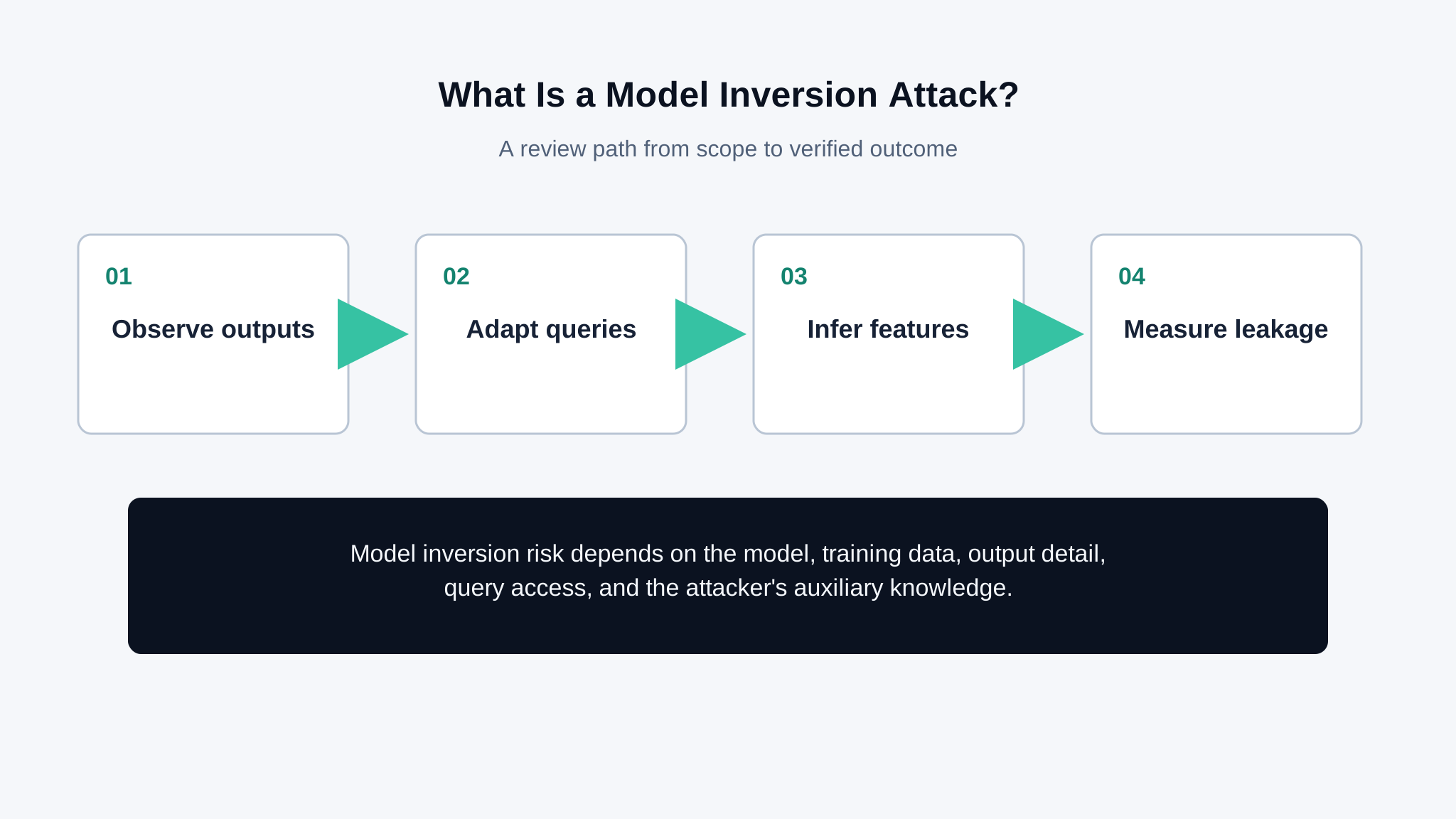
The attacker starts with model outputs and known auxiliary information. Repeated queries reveal how output probabilities change as inputs change. An optimization process can then search for an input or feature set that produces a target output. With white-box access, gradients and internal parameters can provide additional signal.
OWASP's model inversion entry describes the attack within its machine-learning security taxonomy.
Model inversion versus membership inference
Model inversion attempts to reconstruct features or representative data. Membership inference asks whether a particular record was likely part of training. The techniques can overlap, and both can exploit overfitting or overly detailed outputs, but the security questions differ. Avoid labeling every extraction result as a copy of a real individual unless the evidence supports that claim.
Use MITRE ATLAS to place the technique in an adversarial workflow and identify prerequisites such as query access, confidence scores, or model knowledge.
What increases exposure
Risk rises when an API returns detailed confidence scores, permits high-volume adaptive queries, lacks per-identity monitoring, or serves a model that memorizes sensitive training examples. Broad model or gradient access increases the attacker's options. Public APIs and internal research environments need different controls because the expected users and observability differ.
The NIST AI RMF can help assign privacy and measurement ownership, while the technical assessment must test the actual model interface and data assumptions.
Defenses and their trade-offs
Reduce unnecessary output detail, rate-limit adaptive queries, monitor similar query sequences, require identity for sensitive models, and minimize sensitive training data. Regularization, differential privacy, and privacy-preserving training can reduce leakage but may affect utility. Evaluate defenses against the relevant attack and acceptable model performance rather than claiming a universal protection.
The NIST Privacy Framework provides a broader structure for managing data-processing risk. Model-level defenses should sit inside that lifecycle, not replace it.
How to test and respond
Use authorized privacy tests on a controlled model and dataset. Define whether the test measures reconstruction quality, attribute inference, or membership evidence. Compare against a baseline and document query access, auxiliary knowledge, and success criteria. If leakage is confirmed, restrict the interface, rotate exposed model artifacts where relevant, review the training corpus, and retest after remediation.
AI agent threat modeling matters when an agent can query sensitive models or combine outputs with other data sources. AgentGuard can support the review of connected agent paths, while model privacy testing needs its own datasets and evaluation methods. Review the connected path when an agent expands who can query a sensitive model.
Evidence to keep from a privacy test
Record the model and dataset versions, interface, query budget, returned fields, attacker knowledge, reconstruction or inference metric, baseline, and acceptance threshold. Keep representative outputs in a controlled evidence store rather than a general issue tracker. A result without the baseline can exaggerate leakage; a low average score can hide a small class of highly recognizable records.
Retest after changing the model, training set, regularization, privacy mechanism, output precision, or query policy. If a mitigation reduces model utility, report that trade-off with the privacy result so the release owner can make an informed decision instead of optimizing one metric in isolation.
Evaluate subgroups and rare records separately when the dataset permits it. An aggregate reconstruction score can look acceptable while unusual examples remain easier to identify because the model saw few similar cases. Use a held-out reference set and prevent the tester from tuning indefinitely on the same targets. Report uncertainty and failed attack assumptions alongside successful cases. A privacy test should support a bounded release decision; it should not be presented as proof that no future inversion technique can recover information from any individual query sequence.
Frequently Asked Questions
What is a model inversion attack?
It is an attack that uses model access and outputs to infer sensitive attributes or reconstruct information associated with training data.
Is model inversion the same as membership inference?
No. Model inversion seeks features or reconstructions, while membership inference estimates whether a specific record was part of training.
How can organizations reduce model inversion risk?
Minimize sensitive training data, limit output detail and query access, monitor adaptive queries, and evaluate privacy-preserving training against measured utility.
Test the deployed model interface for measurable leakage before expanding query access or output detail.
Review exposure