
What Is a Rogue Agent?
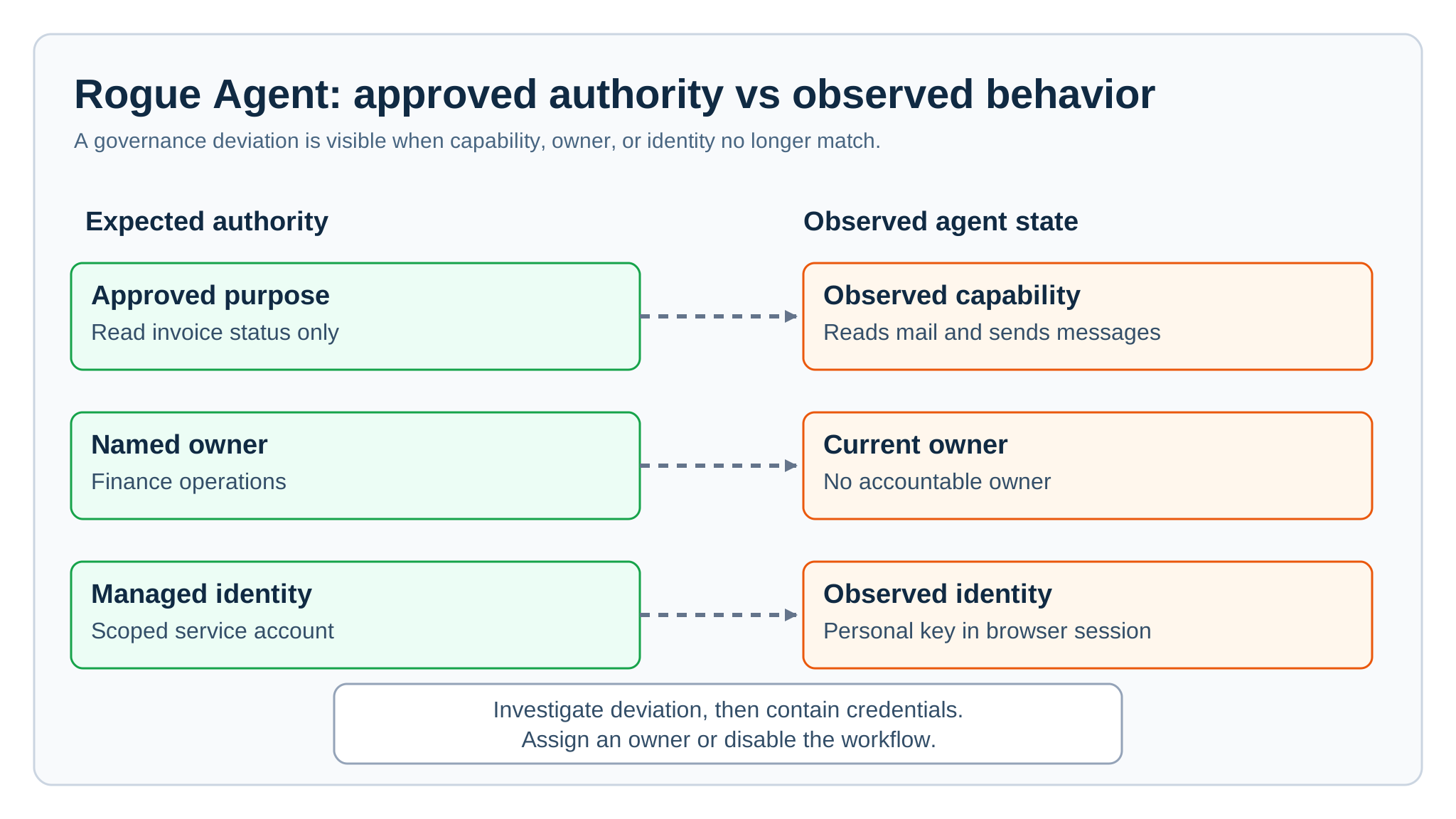
A rogue agent is an AI agent operating outside the organization’s approved ownership, authorization, or governance boundary. The label describes an unmanaged capability. It does not mean that the model is malicious, that an attacker has taken control, or that every unexpected response is an attack.
By Agent Guard Team3 min read
What Is a Rogue Agent?
A rogue agent is an AI agent operating outside the organization’s approved ownership, authorization, or governance boundary. The label describes an unmanaged capability. It does not mean that the model is malicious, that an attacker has taken control, or that every unexpected response is an attack.
How a normal experiment becomes a rogue agent
Rogue agents often start as legitimate experiments. A team connects a copilot to a shared drive, adds an automation token, and leaves it running after the original owner changes roles. Another employee signs into a browser agent with a personal account to solve an operational task. The system may work exactly as configured while no one has accepted responsibility for its data access, tools, or downstream effects.
The change is governance-related: the workflow has authority but no current approval path. That differs from a defective approved service, where an owner and scope exist but the implementation has a flaw.
Signals worth investigating
Look for agents that do not appear in the approved inventory, use unmanaged API keys, invoke tools under a shared identity, access data outside their stated task, or have no named person able to disable them. Review logs for tool calls and target changes, not just chatbot conversations. The relevant question is what the agent can actually reach today.
An AI agent security controls review can identify where component approval, identity issuance, and pre-action policy should apply. It cannot retroactively assign a business owner; that decision belongs to the organization operating the workflow.
Rogue agent versus shadow AI
Shadow AI is broad: people use AI services outside formal procurement or policy. A rogue agent is the higher-risk subset with an action loop, connected data, or credentials. A person pasting a public article into an unapproved chat tool is a policy concern. An unattended agent that can read a mailbox, download files, and send messages is an operational control concern.
The distinction matters for response. Shadow-AI remediation may begin with approved alternatives and clear rules. A rogue agent investigation needs immediate scope: pause the workflow, identify credentials and data paths, preserve relevant evidence, and decide whether the agent can be governed or must be removed.
Why agent identity changes the risk
An agent can inherit a user token, use a service account, or obtain delegated access through a tool connection. Each choice affects revocation, auditability, and blast radius. If the identity is shared, expired, or undocumented, an investigator cannot confidently determine who authorized an action or which other workflow will be interrupted by revocation.
This is especially important for protocol-connected tools. The Model Context Protocol defines the server role and capabilities, but it does not approve a particular connection. Inventory the server, the identity it uses downstream, the exposed tool scopes, and the application that allows the agent to call it.
Containment without overreacting
First stop new high-impact actions while preserving enough evidence to understand the current state. Rotate or revoke unmanaged credentials, identify data and target systems, and notify the accountable business owner. Then decide whether the workflow can be reintroduced with a documented purpose, least privilege, an approval path, and logging.
Do not blame prompt injection without evidence. The prompt injection glossary concerns untrusted instructions changing behavior; rogue status may exist even when every tool call followed the agent’s own configuration. Accurate terminology prevents a security team from fixing the wrong layer.
When to use the term
Use “rogue agent” when the immediate task is to establish ownership and control over an autonomous or semi-autonomous workflow. It is a useful incident and governance category because it directs attention to authority, credentials, and revocation. It should not be used as shorthand for every model hallucination or employee experiment.
For broader governance context, consult the NIST AI RMF.
Frequently Asked Questions
What makes an AI agent rogue?
An agent is rogue when it operates outside the organization's approved ownership, authorization, inventory, or governance boundary. The defining issue is unmanaged authority, not whether the model appears malicious.
Is a rogue agent the same as a compromised agent?
No. A compromised agent has been altered or controlled by an attacker. A rogue agent may be working exactly as configured but lack an approved owner, valid credentials, documented scope, or a current revocation path.
What should a team do first after finding a rogue agent?
Pause new high-impact actions, preserve logs and configuration, identify the identities and systems in scope, rotate or revoke unmanaged credentials, and assign an accountable owner before deciding whether the workflow can return.
Review one agent’s owner, identity, tools, and reachable data before it becomes an exception.
Review access