
AI Governance Best Practices That Hold Up in Production
Effective AI governance assigns owners and decisions to real systems, then checks whether controls still work after change.
By Agent Guard Team4 min read

AI Governance Best Practices That Hold Up in Production
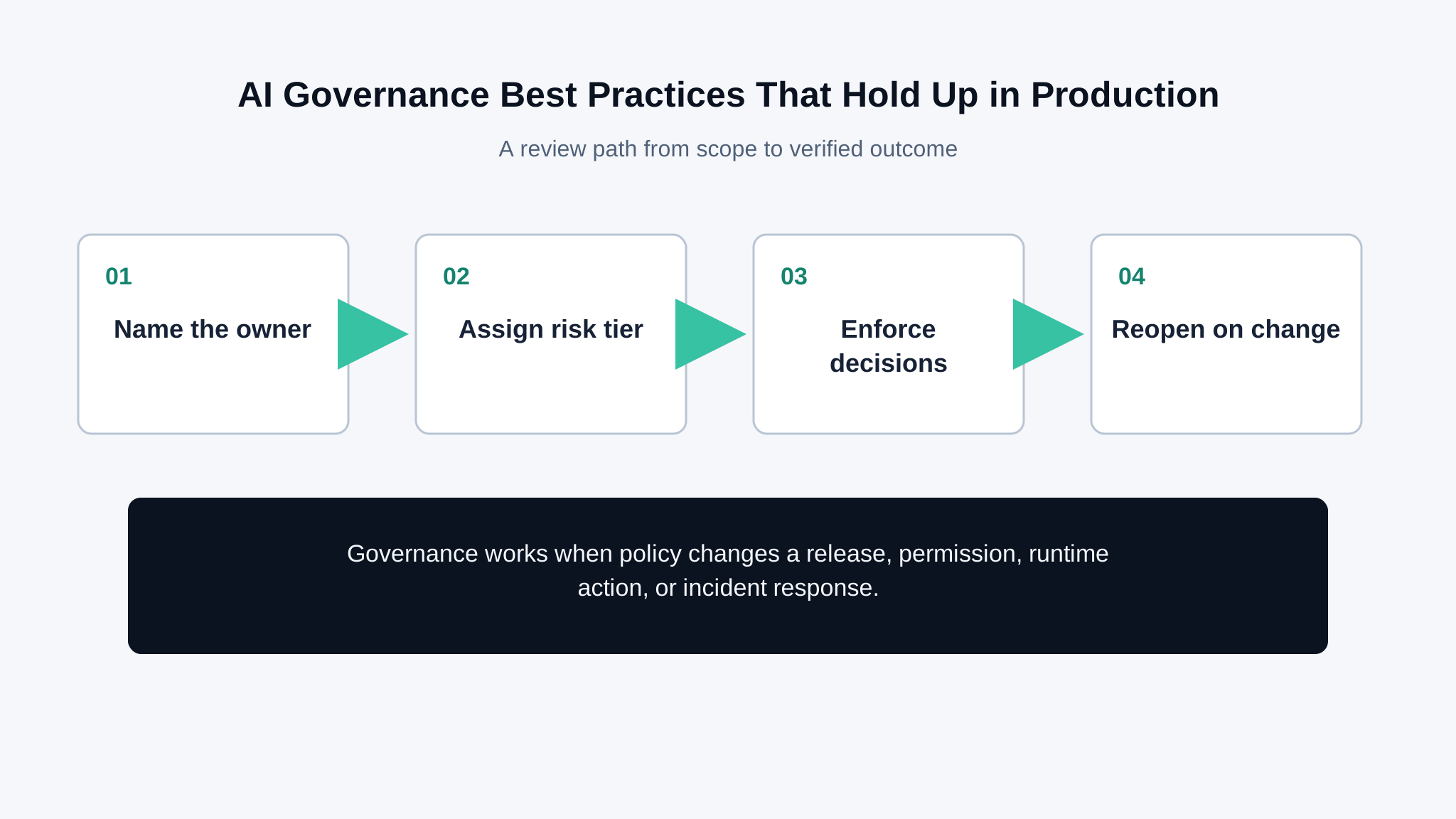
AI governance fails when it produces policy without changing a release, access, or incident decision. The practical unit of governance is a named system with an owner, purpose, data boundary, authority, and current evidence. That unit can be reviewed, restricted, retested, or retired. A generic principle cannot.
Inventory systems by capability and authority
Record more than the model name. An inventory entry should include the application, owner, users, data classes, model and provider, retrieval sources, tools, identities, destinations, risk tier, and revocation path. Update the entry when any of those elements changes. An agent that remains deployed after its owner leaves can become a rogue agent even if its code has not changed.
Keep experiments visible without forcing every prototype through the full production process. Use a low-risk sandbox tier with synthetic data, no external side effects, an expiry date, and a named owner.
Use risk tiers to change the release path
A tier should determine required evidence and approvers. A drafting assistant with public information may need basic privacy and quality checks. An agent that can access customer data or execute transactions needs identity controls, action policy, adversarial tests, rollback, and incident ownership. If every tier has the same checklist, the tiering scheme has no operational value.
The NIST AI RMF gives teams a common risk vocabulary. Translate it into local decisions: who can accept a risk, what blocks release, and what evidence expires after a system change.
Put controls at the decision boundary
Policies should be enforceable where a decision occurs. Check data access before retrieval, tool authorization before execution, destination rules before transfer, and human approval before the defined high-impact action. Model instructions can explain expectations, but they cannot replace deterministic authorization.
Use AI agent threat modeling to identify which boundaries need controls. Keep the model's proposal separate from the policy component's decision so logs can show what was requested, what was allowed, and why.
Govern changes, not just launches
A system can move into a higher risk tier after launch. A new connector may add financial authority; a larger retrieval index may add regulated data; a model update may alter tool selection. Define change triggers that reopen review and select regression tests tied to the changed component.
The OECD AI Principles describe accountable and robust AI at a policy level. Production governance needs an additional layer: a versioned record of the component, decision, test, and outcome.
Make incidents feed the next release
Capture the prompt or event, retrieved sources, model and policy versions, tool arguments, identity, target state, and containment action. Convert confirmed failures into regression fixtures. Track whether the remediation changed prompts, permissions, code, policy, or monitoring; each change needs a different retest.
Databricks' AI governance best-practices overview emphasizes a cross-functional program. The useful test is whether that program can stop or constrain a specific system. Review an enforcement path when a policy requirement has no clear technical decision point.
A compact governance review agenda
For each system, the review should answer six questions without requesting a new presentation: who owns the outcome, what task is approved, which data and identities are in scope, which actions are prohibited, what current evidence supports release, and what change will reopen review. If one answer is missing, record the gap against the responsible owner rather than filling it with a generic policy statement.
Keep the meeting tied to decisions. Approve with stated conditions, restrict the system while evidence is gathered, or block the release. A status such as "under governance review" should not allow an agent to keep acquiring tools or permissions without an expiry date.
Frequently Asked Questions
What are the core AI governance best practices?
Maintain an owned inventory, use risk tiers, require evidence at release, enforce runtime decisions, record incidents, and reopen review after material changes.
Who should own an AI system?
A named business owner should accept the purpose and risk, while technical and control owners remain accountable for implementation and evidence.
How is AI governance different for agents?
Agents add tool use, identities, destinations, and side effects, so governance must cover authorization and runtime action evidence, not only model behavior.
Connect one governance requirement to a release gate or runtime decision that an owner can verify.
Review governance