
Is DeepSeek Safe to Use? A Practical Risk Review
DeepSeek risk changes sharply between a public chat, an API integration, and a locally hosted model with agent tools.
By Agent Guard Team4 min read

Is DeepSeek Safe to Use? A Practical Risk Review
DeepSeek can be used safely for some workloads, but “DeepSeek” is not one risk boundary. A public chat service, an API, a downloaded model, and an agent connected to company tools expose different data and control paths.
The right answer depends on what you send, where inference runs, which logs are retained, who administers the deployment, and whether the model can act on other systems.
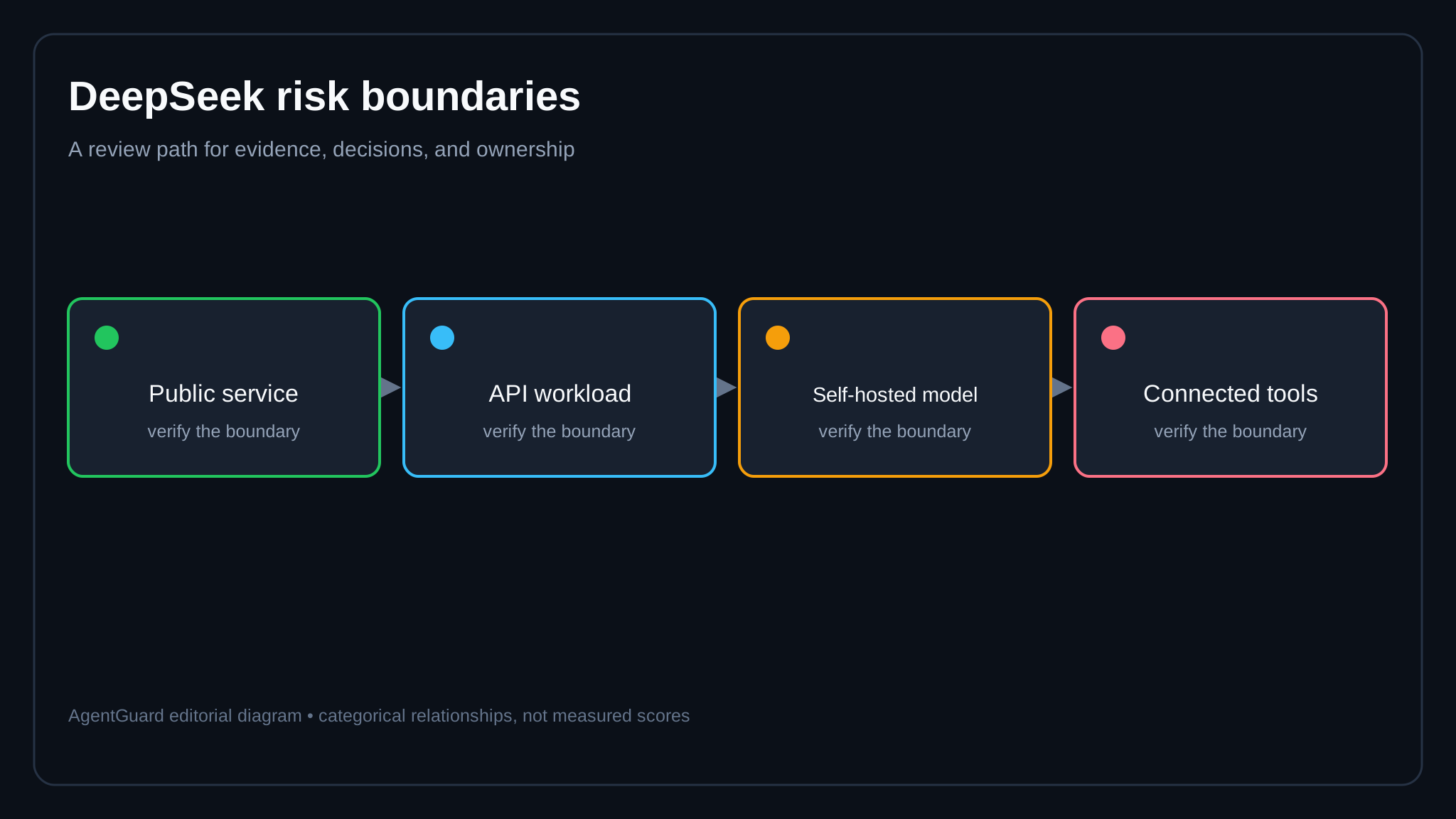
*Model choice is only one part of the review. Deployment and tool access determine the operational boundary.*
Quick verdict
Do not put sensitive company data into a public DeepSeek service until legal, privacy, and security teams have reviewed the applicable terms and technical controls. A locally operated model can reduce external data transfer, but it transfers security responsibility to your organization. Connecting either version to tools raises the risk again because output can become an action.
DeepSeek's published privacy policy should be read for the service and date you actually use. Regulatory guidance such as the UK ICO's AI and data protection guidance helps frame controller, purpose, minimization, and transfer questions. Neither source replaces contract review.
Public service risk
For a hosted chat or consumer service, identify the legal entity, processing locations, data categories, retention, model-improvement settings, account controls, and deletion process. A privacy policy describes terms; it is not proof that your own handling of regulated data is permitted.
Treat prompts, uploads, retrieved passages, and generated exports as part of the data flow. Use AI DLP controls before information reaches the model rather than relying on users to remember every sensitive field.
API risk
An API integration adds application logs, proxy logs, observability tools, retries, caches, and support systems. Map each processor. Confirm how authentication keys are stored and rotated, how tenant separation works, and whether the application can prevent accidental prompt capture.
Test rate limits, error responses, and deletion behavior. Do not infer enterprise protections from a consumer interface or vice versa.
Self-hosted model risk
Running a model in your own environment can keep prompts and outputs inside a chosen boundary. It does not make the model or deployment automatically safe.
Verify model artifacts and dependencies, pin versions, restrict image and package sources, scan the serving stack, control administrator access, and define a patch process. Decide whether telemetry, package downloads, or plugins create outbound connections.
The operator also owns inference logs and backups. A local endpoint with broad internal access may expose more sensitive data than a carefully constrained external workload.

Behavior and output risk
Any model can produce inaccurate, unsafe, or policy-violating output. Evaluate DeepSeek on the languages, tasks, and refusal cases relevant to your deployment. Include ordinary business requests as well as adversarial prompts; a model that refuses too much will be bypassed by users.
Do not use model output as a security decision without independent verification. Code, configurations, legal text, and factual claims need domain review.
Agent and tool risk
The biggest change occurs when a model can call tools. A harmful instruction no longer ends as text; it may reach files, email, databases, cloud resources, or payment systems.
Use a distinct service identity, narrow tool schemas, argument validation, destination restrictions, approvals for high-impact actions, and an audit record. The AI acceptable use policy should name prohibited data and actions, while technical controls enforce them.
AgentGuard is relevant only where its supported scan or runtime integration observes that path. Its public documentation describes component scanning and decisions around commands, files, network requests, secrets, and sensitive writes. It does not certify DeepSeek or remove the need to review the service and hosting environment.
A defensible approval process
Classify the workload first: public information, internal business data, confidential data, or regulated data. Choose hosted, API, or self-hosted deployment based on that classification. Then run a proof with synthetic data and deliberately constrained tools.
Record owner, model and deployment version, approved data classes, connected systems, retention, incident path, and re-review trigger. The same structure can sit inside a broader evaluation of AI agent governance platforms.
DeepSeek is not simply safe or unsafe. The testable question is whether one defined workload operates inside a reviewed data and action boundary. Book a deployment-path review before connecting it to sensitive systems.
Frequently Asked Questions
Is DeepSeek safe for confidential company data?
Do not assume so. Review the exact service, contract, retention terms, region, account controls, and data path before entering confidential or regulated information.
Is running a DeepSeek model locally safer?
Local hosting can reduce third-party data transfer, but the operator then owns model provenance, infrastructure security, logging, access control, patching, and any connected tools.
Can DeepSeek safely control tools?
Only after each tool, credential, resource, and side effect is independently constrained. Model choice does not replace runtime authorization.
Map model, data, tools, and destinations before approving DeepSeek for business use.
Review the Path