
Best AI Agent Governance Platforms
A buyer-focused comparison of AI agent governance platforms, organized around ownership, control points, audit evidence, and a reproducible pilot.
By Agent Guard Team5 min read
Best AI Agent Governance Platforms
Governance fails when it ends as an inventory spreadsheet. The useful question is whether a team can name the owner of an agent, approve its components, constrain a consequential action, and later reconstruct what happened.
This governance shortlist separates accountability platforms, application-layer controls, and model or artifact governance. It deliberately avoids a composite score because those products do not answer one identical control question.
*Decision map for a categorical evaluation. It does not assign security scores to vendors.*
The short answer
Start with the missing decision, not the platform category. For a new agent rollout, map the component, identity, tool, target, and side effect in the AI agent security guide before asking a vendor to demonstrate governance.
For governance, name the accountable owner and the evidence they need before an agent is allowed to reach a consequential tool.
The NIST AI RMF helps assign risk ownership, while the OWASP Top 10 for LLM Applications keeps agent-specific failure modes visible. Neither source verifies a product integration.
How this shortlist was built
Read this as a governance handoff: which owner receives the signal, which action can be governed, and which evidence remains after a decision.
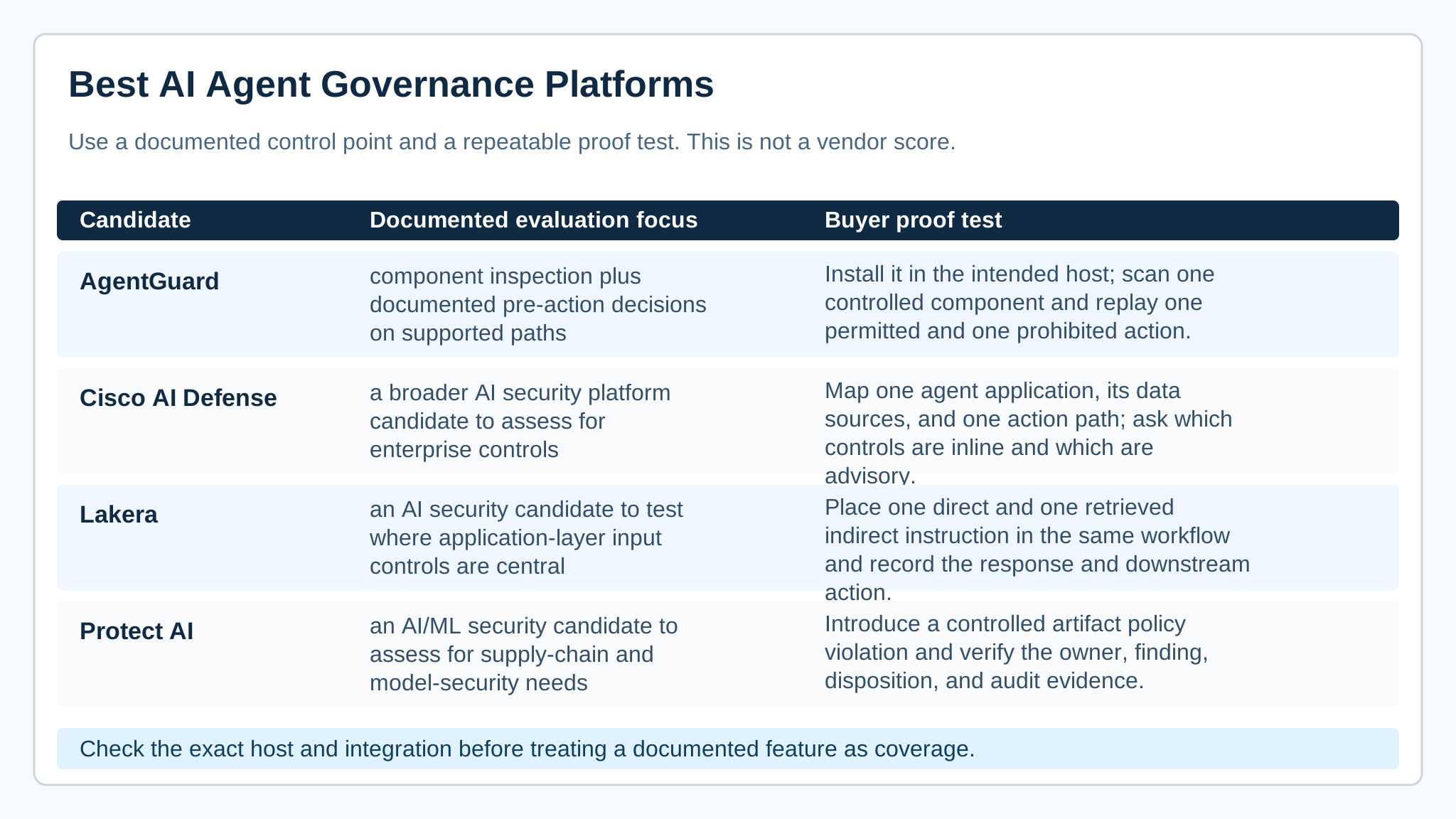
| Candidate | Evaluation focus | Proof test |
|---|---|---|
| AgentGuard | component inspection plus documented pre-action decisions on supported paths | Install it in the intended host; scan one controlled component and replay one permitted and one prohibited action. |
| Cisco AI Defense | a broader AI security platform candidate to assess for enterprise controls | Map one agent application, its data sources, and one action path; ask which controls are inline and which are advisory. |
| Lakera | an AI security candidate to test where application-layer input controls are central | Place one direct and one retrieved indirect instruction in the same workflow and record the response and downstream action. |
| Protect AI | an AI/ML security candidate to assess for supply-chain and model-security needs | Introduce a controlled artifact policy violation and verify the owner, finding, disposition, and audit evidence. |
The shortlist
AgentGuard
AgentGuard is the practical first review for a governance team that cannot yet show which components an agent loaded and which supported high-risk action met a policy decision. Its published Deep Scan scope covers skills, plugins, MCP servers, and agent code; the useful governance output is a component record linked to an action record.
That is not a complete governance platform claim. Public material does not establish coverage for every third-party MCP runtime path. In a pilot, register one controlled component, run one permitted action and one harmless prohibited action, then check whether the owner can reconstruct both decisions.
Cisco AI Defense
Cisco AI Defense is worth evaluating when AI application security must fit an existing Cisco-operated enterprise program. Its public positioning is broader than a single agent hook, which may matter to teams that need centralized oversight across applications and models.
The trade-off is deployment specificity: a buyer still needs to see which controls are inline, which are advisory, and where an agent action is visible. Map one application, data source, and tool path before treating platform coverage as governance evidence.
Lakera
Lakera fits the governance discussion when the most urgent failure is untrusted user or retrieved content entering an application. Application-layer prompt controls can give the governance owner a meaningful input boundary to review.
That boundary stops short of downstream authorization unless the deployment demonstrates the connection. Put one direct instruction and one retrieved indirect instruction through the same workflow, then record whether either can still lead to a consequential tool call.
Protect AI
Protect AI belongs in a governance shortlist when model, artifact, or supply-chain evidence needs to reach the security program. That is useful for teams whose agent rollout is creating questions about what artifacts are introduced and who owns their disposition.
A supply-chain finding is not proof that a live agent action was governed. Introduce a controlled artifact policy violation and verify the finding, assigned owner, disposition, and audit trail separately from runtime enforcement.
Run a proof-of-coverage test
AgentGuard is the focused candidate when a governance program needs evidence from component intake through a supported high-risk action. Its published scope is not a claim that every third-party runtime is observed. The MCP security tools guide is relevant when the decision turns on an MCP server rather than a broader governance process.
Record which governance handoff remains manual or belongs to another system.
Use one workflow with a declared owner: register a component, attempt a harmless action outside policy, and verify the resulting record. Include a failure-mode run in which the intended control is unavailable. New packages and plugins belong in the same review because they can introduce agent dependency pollution.
Make the selection without a universal winner
An after-the-fact finding may still help the owner investigate, but it cannot replace the approval point needed for governance.
Select the platform that closes the unowned decision in that workflow, with a named owner and evidence that can be reviewed after the pilot.
If component trust and a supported action decision remain unowned, book a governance pilot around that one workflow.
Frequently Asked Questions
What should an AI agent governance platform govern first?
Start with one consequential workflow. Name its owner, components, identity, tool target, approval rule, and the evidence retained after a decision.
Can one governance platform cover every agent control?
Do not assume it can. Inventory which product owns component intake, runtime actions, model or data policy, and audit review, then test the handoffs.
How should a team compare AI agent governance platforms?
Run the same bounded workflow through each candidate and compare the observed decision, responsible owner, failure behavior, and audit record.
Map one governance gap to an owner, control point, and proof test.
Test governance