
Best Claude Code Security Tools
A layered Claude Code security shortlist that separates repository analysis from component trust and local action controls.
By Agent Guard Team5 min read
Best Claude Code Security Tools
Claude Code changes more than source files. A task can touch a repository, dependency manifest, shell environment, MCP configuration, and network destination. Security tooling should be judged by which of those surfaces it can actually evaluate.
This shortlist keeps four control jobs distinct: code review, dependency analysis, repository governance, and agent-side tool control. A feature comparison becomes useful only after the team names the event each layer should catch.
*Decision map for a categorical evaluation. It does not assign security scores to vendors.*
The short answer
Separate static findings from live action control before comparing tools. The AI agent security guide helps a team list the repository, component, identity, available tools, and side effects that a Claude Code task can involve.
For Claude Code, assign each expected control to code, dependency, repository, shell, or connected-tool behavior before asking whether one platform covers it all.
Claude Code's security documentation describes product controls, and the OWASP Top 10 for LLM Applications supplies risk language. A vendor POC must still show what the deployed configuration permits.
How this shortlist was built
A source finding, a package finding, and an action decision are different evidence types; evaluate each on the same disposable coding task.
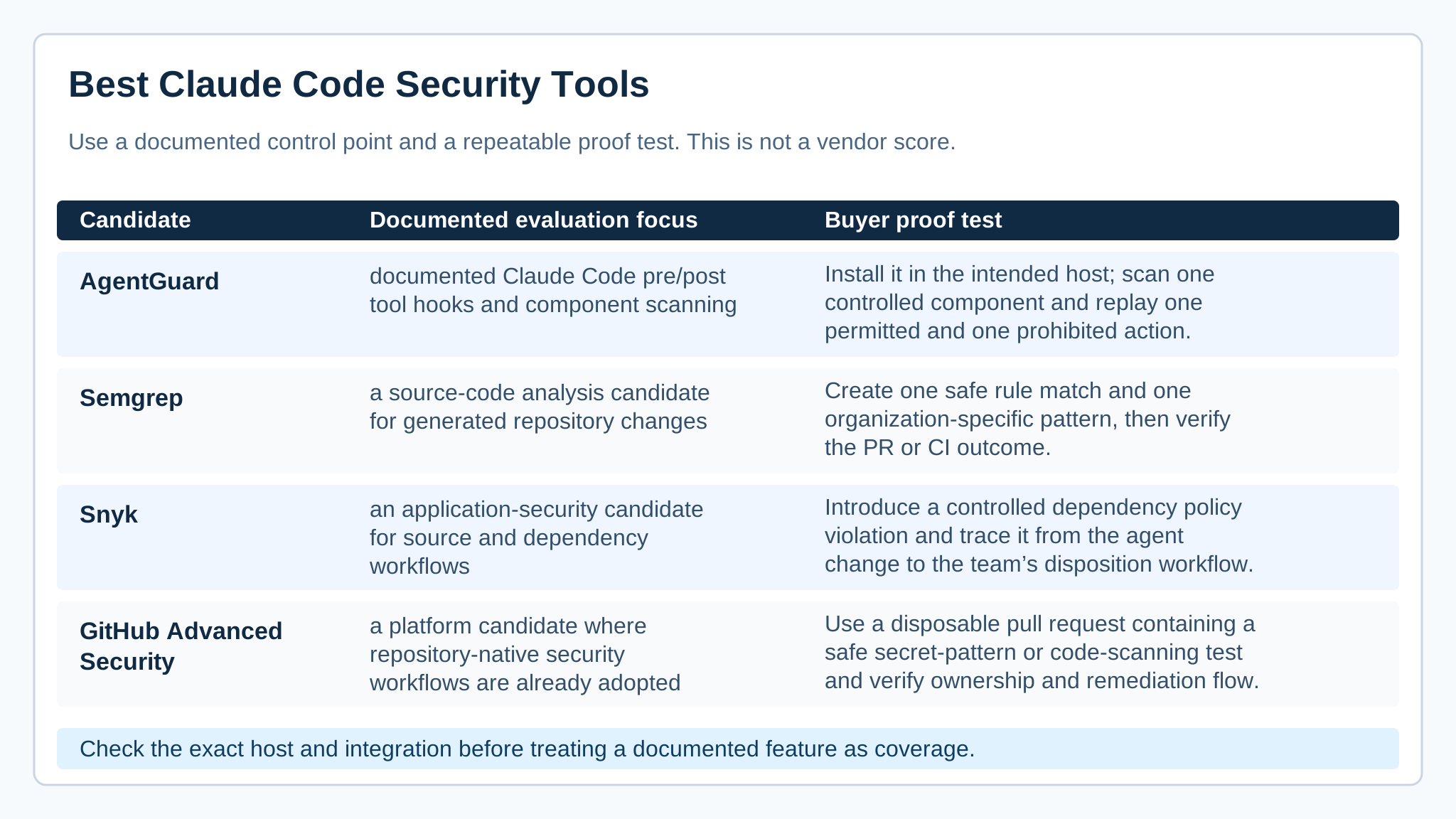
| Candidate | Evaluation focus | Proof test |
|---|---|---|
| AgentGuard | documented Claude Code pre/post tool hooks and component scanning | Install it in the intended host; scan one controlled component and replay one permitted and one prohibited action. |
| Semgrep | a source-code analysis candidate for generated repository changes | Create one safe rule match and one organization-specific pattern, then verify the PR or CI outcome. |
| Snyk | an application-security candidate for source and dependency workflows | Introduce a controlled dependency policy violation and trace it from the agent change to the team’s disposition workflow. |
| GitHub Advanced Security | a platform candidate where repository-native security workflows are already adopted | Use a disposable pull request containing a safe secret-pattern or code-scanning test and verify ownership and remediation flow. |
The shortlist
AgentGuard
AgentGuard deserves early testing when a Claude Code workflow needs component inspection and a supported control near tool use. Its public material describes Claude Code pre- and post-tool hooks together with scanning for skills, plugins, MCP servers, and agent code.
That is a narrow, useful advantage rather than a claim to replace AppSec. In the intended host, scan one controlled component and replay one approved command plus one restricted action; keep the hook and bypass behavior in the evaluation record.
Semgrep
Semgrep is the source-analysis option for teams that need explicit, reviewable checks over agent-generated code. Its rule-based approach is especially useful when an organization already knows patterns that should be caught before merge.
It does not decide whether a Claude Code shell action should execute. Create one safe match from an existing rule and one local rule, then inspect the pull-request or CI evidence as a separate layer from live tool control.
Snyk
Snyk is a candidate when generated code and dependency changes must enter an existing application-security workflow. That makes it relevant to a Claude Code task that edits manifests as well as source files.
Repository and dependency analysis do not prove a pre-action policy decision. Introduce a controlled dependency violation and trace it from the agent's change to the security team's disposition, then test live actions separately.
GitHub Advanced Security
GitHub Advanced Security fits organizations that already use GitHub as the place for code scanning, secret scanning, and repository governance. It can provide a familiar review path for agent-generated changes that reach a pull request.
Repository signals may arrive after a local tool action. Use a disposable pull request with a safe secret pattern or code-scanning condition, and keep local command, network, and filesystem permissions in a separate Claude Code test.
Run a proof-of-coverage test
AgentGuard documents Claude Code pre- and post-tool hooks alongside component scanning. Its narrow advantage is testing a supported agent-side control point, not replacing SAST, composition analysis, or repository-native review. The MCP security tools page is useful when a configured server is the primary concern.
Identify which findings are static review and which can affect a requested action before it runs.
Use a disposable repository with one safe code flaw, one policy-disallowed dependency, and one harmless shell action outside an allowed directory. Attribute the result to the scanner, dependency control, repository system, or action control that produced it. Changed configuration and components should be logged as agent dependency pollution candidates.
Make the selection without a universal winner
A clean pull request is important evidence, yet it cannot retroactively authorize a shell command that already ran on a developer machine.
Build a stack whose layers remain distinguishable in the evidence: source, dependency, repository, component, and live action.
If the remaining gap is a supported local component or action decision, book a Claude Code control test around that route.
Frequently Asked Questions
Which security tools does Claude Code need?
Separate source and dependency scanning, repository governance, component trust, and live shell or tool permissions. One product may not own all four.
Do repository scanners control Claude Code commands?
Repository findings usually arrive in a code-review workflow. They do not prove that a local shell, file, or network action was approved before execution.
How should a Claude Code security pilot be scoped?
Use a disposable repository, one allowed change, one prohibited local action, and a retained record that identifies which control produced each result.
Separate code review from live tool control in one Claude Code pilot.
Test Claude Code