
AI Agent Guardrails Worth Testing: Six Options by Control Layer
A practical shortlist that separates model-output filters, application rules, and controls over real agent actions.
By Agent Guard Team5 min read

AI Agent Guardrails Worth Testing: Six Options by Control Layer
The best AI agent guardrail is the one that can make the decision you actually need. A response validator can reject malformed output. It cannot stop a shell command after the application has already approved it. A runtime control may block that command, but it will not repair a weak retrieval policy.
This shortlist separates six products by control layer, then gives each one a proof test. There is no unsupported number-one ranking.
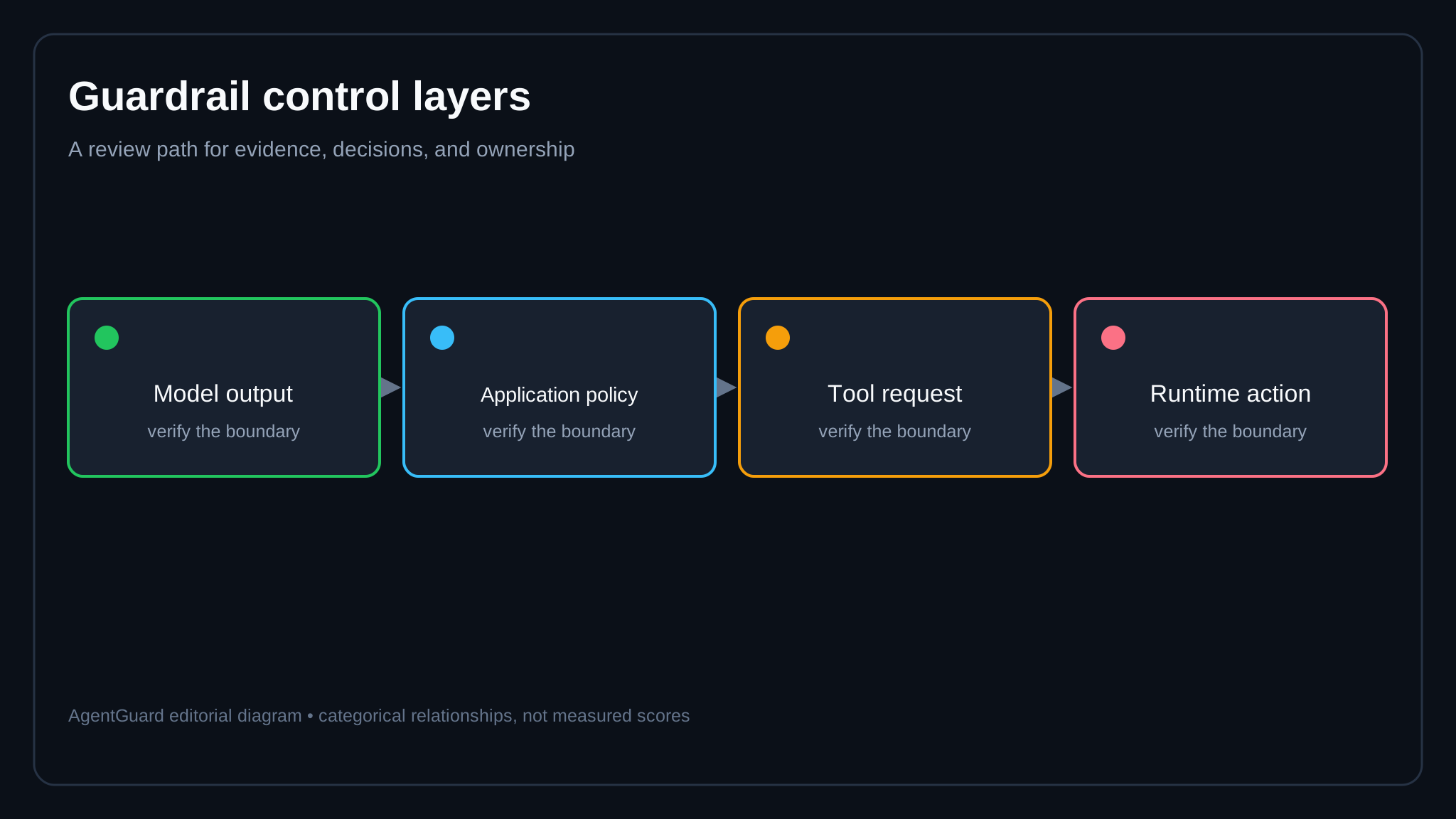
*Compare candidates at the model, application, tool-request, and runtime-action layers before comparing feature counts.*
The short answer
Start with the action you need to govern. Choose Guardrails AI or NeMo Guardrails when the main job is validating model interactions and conversation flows. AWS Bedrock Guardrails and Azure AI Content Safety fit teams already building inside their respective clouds. Lakera Guard is aimed at prompt-injection and content-risk detection around LLM applications. AgentGuard is the candidate to test when an agent can reach local tools, files, commands, secrets, or network destinations.
That last layer is easy to miss in a broad list of AI agent governance platforms. Governance can define ownership and policy; the proof still has to show where a requested action is evaluated.
How the six options were selected
We used four questions: what event reaches the control, when the decision happens, which outcomes it supports, and what evidence remains. Marketing categories were not treated as interchangeable.
| Option | Best-fit control job | Proof test |
|---|---|---|
| AgentGuard | supported component scanning and agent-side action decisions | Replay one allowed and one prohibited tool action in the intended host. |
| Guardrails AI | structured validation and configurable checks around LLM applications | Submit malformed, unsafe, and valid outputs; inspect which validators fire. |
| NVIDIA NeMo Guardrails | programmable conversational rails and dialog control | Trigger an off-topic flow and a permitted flow through the same app. |
| AWS Bedrock Guardrails | managed safeguards for Bedrock application inputs and outputs | Apply a policy to a test inference path and retain the assessment result. |
| Azure AI Content Safety | managed content and prompt-risk analysis in an Azure stack | Test representative content in the same region and configuration planned for production. |
| Lakera Guard | detection around prompt injection and unsafe LLM traffic | Run a small injection corpus and inspect false positives as well as detections. |
AWS documents how to create guardrails for AI agents, while NVIDIA documents the programmable rails available in NeMo Guardrails. Those sources describe their own products. They do not establish comparative efficacy.

AgentGuard: test the path from request to action
AgentGuard is relevant when the agent can do more than return text. Its public documentation describes Runtime Guard decisions around shell commands, file access, tool actions, network requests, secret access, and sensitive writes. It also describes scanning for skills, plugins, MCP servers, and agent code.
The useful distinction is proximity to execution. Test it in a supported integration with a disposable workspace. Request one normal read, one harmless write outside an approved directory, and one network destination outside policy. Confirm the decision and audit evidence. Do not infer identical hook depth across every supported client; the published integration modes differ.
Guardrails AI and NeMo Guardrails: shape model behavior
Guardrails AI is a framework-oriented choice when a team needs validators, structured outputs, or checks composed into an LLM application. NeMo Guardrails gives developers programmable control over conversational behavior and flows. Both deserve evaluation close to the application and model interaction.
Neither product should be credited with blocking an operating-system action unless the deployed architecture sends that action through an enforceable control. That is a policy enforcement question, not a naming question.
AWS and Azure: managed controls inside a cloud stack
Bedrock Guardrails and Azure AI Content Safety reduce integration work for teams already committed to those platforms. The advantage is operational fit: identity, deployment, and monitoring can remain within a known cloud boundary.
The test must use the exact service path planned for production. A policy configured in a console is not evidence that every model call, retrieval path, or tool execution passes through it. Trace one request end to end and record bypass routes.
Lakera Guard: inspect injection and content risk
Lakera Guard belongs on a shortlist when prompt injection and unsafe LLM traffic are the immediate problem. Use a representative corpus, not a few dramatic strings copied from social media. Include legitimate content that resembles attacks, because false positives determine whether a guard remains enabled.
Prompt detection is one layer. File, credential, network, and command permissions still need their own controls.
Pick a stack, not a label
Write an AI acceptable use policy that names prohibited outcomes, then map each outcome to an enforceable point. A customer-support agent may need output and data-access controls. A coding agent may also need command, filesystem, dependency, and network decisions.
Run the same proof cases against every shortlisted product. Record allow, warn, approve, block, latency, bypass path, and retained evidence. A tool belongs in the stack only if its result closes a named gap.
For a supported agent-side path, run a controlled AgentGuard test with one permitted action and one harmless policy violation.
Frequently Asked Questions
What is an AI agent guardrail?
An AI agent guardrail is a control that constrains or evaluates a model output, tool request, data access, or resulting action against an explicit rule.
Can one guardrail product secure an entire agent?
Usually not. Output validation, identity, application authorization, tool permissions, and runtime enforcement are different control jobs and should be tested separately.
How should teams compare AI agent guardrails?
Use the same harmless failure cases for every candidate and record where each control acts, whether it can block, and what evidence it retains.
Test your agent's highest-risk actions against an explicit runtime policy.
Run a Test