
Best Prompt Injection Testing Tools
A test-focused shortlist of prompt injection tools for teams that need reproducible cases, explicit pass conditions, and evidence they can retest.
By Agent Guard Team5 min read
Best Prompt Injection Testing Tools
A prompt-injection test tool earns its place when a failure can be replayed. A large prompt library without versioned expected outcomes usually produces noise, not a release decision.
The shortlist includes a test harness, a scanner, a red-team framework, and a control-validation layer. They are complementary when a team needs both attack discovery and evidence that a configured control changed the outcome.
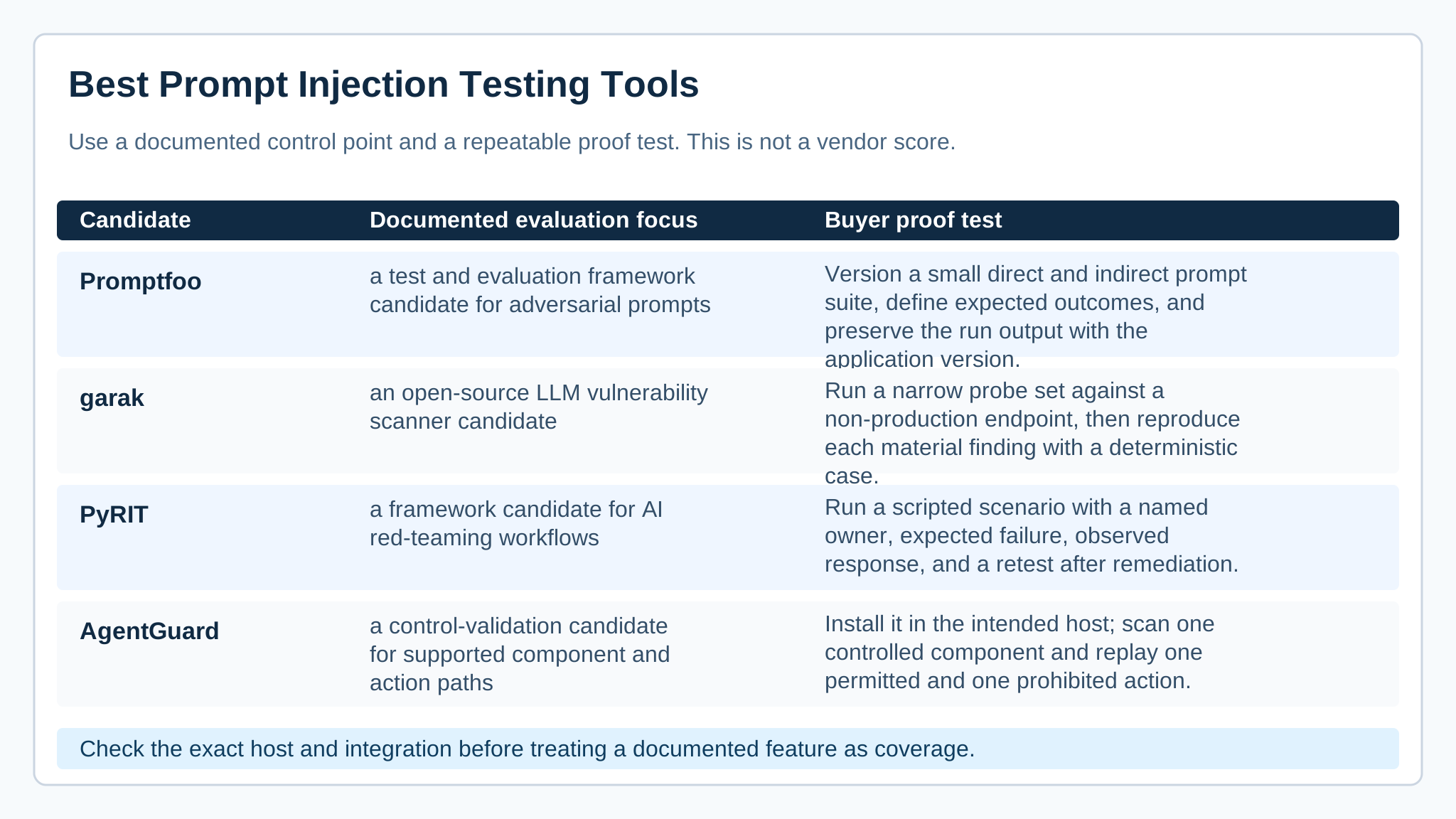
*Decision map for a categorical evaluation. It does not assign security scores to vendors.*
The short answer
Model the application first: system instructions, retrieval source, model, enabled tools, identity, and a reversible target. The AI agent security guide is a practical inventory for setting up that test harness.
For test tooling, define the pass or fail condition before choosing a corpus generator, scanner, framework, or runtime validation layer.
OWASP's prompt injection material helps separate direct from indirect attacks, and Microsoft PyRIT documents one red-teaming framework. The decisive evidence is still the recorded outcome in your versioned workflow.
How this shortlist was built
Treat the table as a test-design map: choose the tool that produces the artifact your release owner can review and rerun.
| Candidate | Evaluation focus | Proof test |
|---|---|---|
| Promptfoo | a test and evaluation framework candidate for adversarial prompts | Version a small direct and indirect prompt suite, define expected outcomes, and preserve the run output with the application version. |
| garak | an open-source LLM vulnerability scanner candidate | Run a narrow probe set against a non-production endpoint, then reproduce each material finding with a deterministic case. |
| PyRIT | a framework candidate for AI red-teaming workflows | Run a scripted scenario with a named owner, expected failure, observed response, and a retest after remediation. |
| AgentGuard | a control-validation candidate for supported component and action paths | Install it in the intended host; scan one controlled component and replay one permitted and one prohibited action. |
The shortlist
Promptfoo
Promptfoo is a good first choice for an engineering team that needs a repeatable adversarial prompt suite in CI or a local evaluation harness. Its contribution is a versioned way to express cases and expected outcomes, which is more useful than an untracked collection of attack strings.
A failing evaluation does not prove a production control intervened. Keep direct and indirect cases in a small suite, specify the expected result, and preserve the output alongside the application version that was tested.
garak
garak is useful for exploratory vulnerability probing when a team wants broad probe families before it knows which tests should become release gates. It can help surface conditions worth turning into narrower, deterministic cases.
Probe coverage is not automatically application coverage. Run a limited set against a non-production endpoint, then reproduce every material finding with a stable prompt, configuration, expected response, and named owner.
PyRIT
PyRIT fits a security team building a governed red-teaming program rather than a one-off test run. Its value is the framework around risk identification and repeatable adversarial workflows.
The application owner still has to define pass or fail. Use a scripted scenario with an expected failure, observed response, remediation owner, and a retest after the mitigation changes.
AgentGuard
AgentGuard is a control-validation candidate, not a replacement for a test corpus or red-team framework. It is relevant when the test program must verify a documented component scan or a supported decision before a local action.
The boundary is the supported integration, not every runtime path. Pair a compact injection corpus with one benign action that should be allowed and one reversible action that should be denied or require approval, then retain both results.
Run a proof-of-coverage test
AgentGuard is not a generic corpus generator. It is worth testing when the evaluation needs to validate component scanning or a supported decision before a local action. Keep that control-validation question separate from test generation, and use the MCP security tools category if a server is in scope.
Document whether the candidate discovers attacks, runs a corpus, or verifies a configured control.
Version a compact corpus with one direct override, one poisoned retrieved document, and one tool-result instruction. For each case, state whether the expected result is refusal, safe completion, approval, or denial. Record component changes too, since a modified skill can introduce agent dependency pollution.
After the corpus exposes a stable case, validate the control response on the supported component or action route.
Make the selection without a universal winner
A high volume of generated attack strings does not prove that a release decision can be reproduced or acted on.
Choose the tool that turns the relevant attack path into a stable release decision, not the one that produces the longest list of probes.
Frequently Asked Questions
What makes a prompt injection test reproducible?
Pin the application version, model and tool configuration, attack input, expected result, and retained run output so another reviewer can replay the case.
Should I use a scanner or a red-team framework?
Use a scanner for broad exploration and a framework when you need scripted scenarios, ownership, and retesting. Convert material discoveries into deterministic release tests.
How many prompt injection cases belong in a release gate?
Prefer a small set tied to real application paths over a large generic corpus. Each case needs an expected decision and a named remediation owner.
Turn one prompt injection case into a repeatable release test with retained evidence.
Build the test