
Best MCP Security Scanners
A practical MCP scanner shortlist for teams deciding what to inspect before registration and how to prove that a server trust decision works.
By Agent Guard Team5 min read
Best MCP Security Scanners
An MCP scanner is not just a vulnerability report generator. It has to help an operator answer what server code will run, which tools it exposes, which configuration created that access, and how the finding changes the trust decision.
The products below sit at different points in MCP operations: component admission, agent-risk review, and protocol inspection. Their output becomes useful only when someone can decide whether the server is allowed to register.
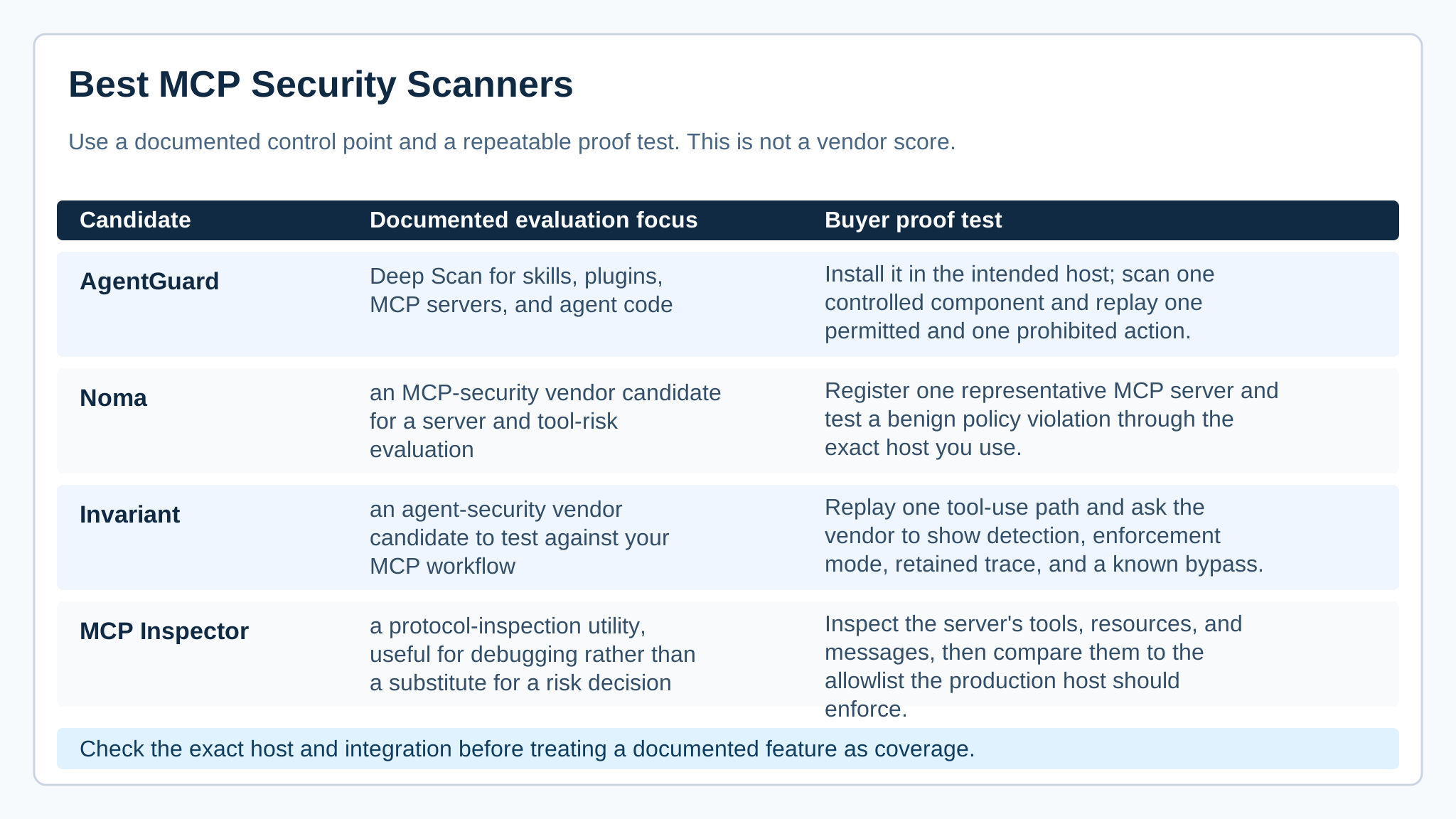
*Decision map for a categorical evaluation. It does not assign security scores to vendors.*
The short answer
Begin with the server you intend to register, its package source, and its declared capabilities. The AI agent security guide gives the inventory fields that make a scan result useful to an operator rather than just a developer.
For MCP intake, decide who can admit a server and what evidence will cause registration to be blocked, delayed, or approved.
The MCP specification describes protocol behavior, while the OWASP MCP Top 10 points to common failure categories. Neither source measures a scanner's detection rate in your host.
How this shortlist was built
The proof column asks what happens before trust is granted, not whether a product's marketing category sounds relevant.
| Candidate | Evaluation focus | Proof test |
|---|---|---|
| AgentGuard | Deep Scan for skills, plugins, MCP servers, and agent code | Install it in the intended host; scan one controlled component and replay one permitted and one prohibited action. |
| Noma | an MCP-security vendor candidate for a server and tool-risk evaluation | Register one representative MCP server and test a benign policy violation through the exact host you use. |
| Invariant | an agent-security vendor candidate to test against your MCP workflow | Replay one tool-use path and ask the vendor to show detection, enforcement mode, retained trace, and a known bypass. |
| MCP Inspector | a protocol-inspection utility, useful for debugging rather than a substitute for a risk decision | Inspect the server's tools, resources, and messages, then compare them to the allowlist the production host should enforce. |
The shortlist
AgentGuard
AgentGuard is the strongest fit here when the host needs a component-trust decision before an MCP server, skill, plugin, or related agent code is accepted. Its documented Deep Scan surface is oriented to inspecting those inputs before a local workflow relies on them.
The limitation is important: public documentation does not establish complete observation of every third-party MCP runtime path. Use a representative server registration, alter one benign configuration value, and confirm that the result is visible before the server is trusted.
Noma
Noma is a relevant candidate for a team evaluating security around MCP-enabled application workflows. Its public positioning makes it reasonable to include in a server and tool-risk evaluation rather than treat it as a generic protocol debugger.
Do not infer exact host coverage from positioning. Register one representative server through the environment you operate, introduce a benign policy violation, and ask the vendor to show the resulting decision and retained trace.
Invariant
Invariant is useful to assess when the buyer wants an agent-security candidate informed by threat modeling and research. That can be a better starting point than a narrow parser when the concern includes how tool use changes the risk of a server integration.
Research scope is not an observed enforcement result. Replay a real tool-use path and require a demonstration of detection mode, enforcement behavior, retained evidence, and a bypass the product does not claim to cover.
MCP Inspector
MCP Inspector is appropriate for developers who need to inspect a server's tools, resources, and messages while diagnosing protocol behavior. It can clarify what the server is offering before a separate security decision is designed.
It should not be presented as a policy engine. Compare the inspected capabilities with the production allowlist, then test whether the host actually prevents an unexpected tool from being trusted or invoked.
Run a proof-of-coverage test
AgentGuard belongs in this list because its published Deep Scan scope includes MCP servers, skills, plugins, and agent code. It is most relevant when the buyer needs a component-trust decision before the host accepts the server. Use the MCP security tools page to keep server inspection separate from live tool authorization.
State separately whether the result covers registration, protocol debugging, or live tool authorization.
Create a disposable server registration with one expected tool and one deliberately unexpected configuration change. Record whether the scanner identifies the changed component, how the operator sees the reason, and what happens before the server is trusted. Track package provenance because it is a direct route to agent dependency pollution.
Once the registration case is fixed, scan the server path in AgentGuard and retain the component result beside the host decision.
Make the selection without a universal winner
A scanner report that arrives after the server is trusted can still inform remediation, but it is not an admission control.
A debugging utility may be enough for protocol investigation; it is not automatically a trust gate. Select the tool whose result changes the admission decision you defined.
Frequently Asked Questions
What should an MCP security scanner inspect?
It should identify the server package, configuration, declared tools, and material changes that affect whether the host should trust the server.
Is MCP Inspector a security scanner?
MCP Inspector is useful for examining protocol behavior. Treat it as a debugging and inspection utility unless a separate control enforces the resulting trust decision.
When should an MCP scan run?
Run it before registration and again after package or configuration changes. Keep the exact artifact and result so the operator can reproduce the decision.
Test one MCP server before your host accepts its package, tools, and configuration.
Scan a server