
Best Prompt Injection Prevention Tools
A layered guide to prompt injection prevention tools, with clear fit boundaries and tests for direct, retrieved, and action-level attack paths.
By Agent Guard Team5 min read
Best Prompt Injection Prevention Tools
Prompt injection prevention is a layered problem. A filter can inspect text, a retrieval pipeline can constrain what reaches the model, and an action policy can stop a tool call. Treating those layers as interchangeable creates a false sense of coverage.
This list compares instruction screening, framework configuration, traffic controls, and an agent-side decision point. The right first test depends on whether untrusted text arrives through a chat turn, retrieval system, or tool response.
*Decision map for a categorical evaluation. It does not assign security scores to vendors.*
The short answer
Pick the layer that sees the attack path you actually operate. The AI agent security guide helps identify whether untrusted text can reach a model, alter a plan, or trigger a tool with side effects.
For injection prevention, identify the untrusted channel first, then state which layer is expected to stop the instruction from reaching an action.
Use OWASP's prompt injection guidance to frame direct and indirect cases, then use the NIST adversarial ML taxonomy for a more precise description of the test condition. These references guide the corpus; they do not rank products.
How this shortlist was built
A candidate passes only its own test: a prompt-defense tool need not claim action authorization, and an action control need not claim content classification.
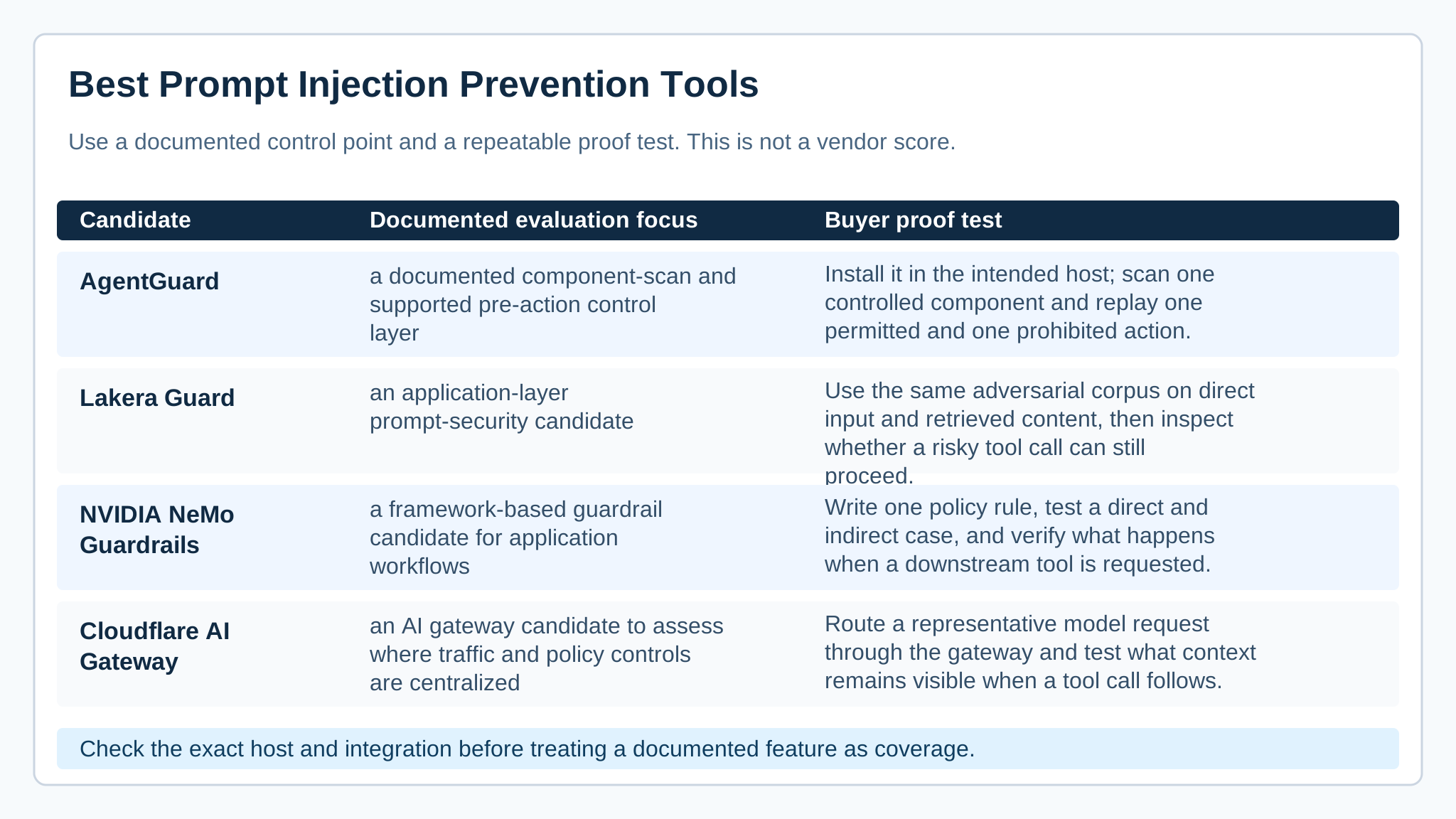
| Candidate | Evaluation focus | Proof test |
|---|---|---|
| AgentGuard | a documented component-scan and supported pre-action control layer | Install it in the intended host; scan one controlled component and replay one permitted and one prohibited action. |
| Lakera Guard | an application-layer prompt-security candidate | Use the same adversarial corpus on direct input and retrieved content, then inspect whether a risky tool call can still proceed. |
| NVIDIA NeMo Guardrails | a framework-based guardrail candidate for application workflows | Write one policy rule, test a direct and indirect case, and verify what happens when a downstream tool is requested. |
| Cloudflare AI Gateway | an AI gateway candidate to assess where traffic and policy controls are centralized | Route a representative model request through the gateway and test what context remains visible when a tool call follows. |
The shortlist
AgentGuard
AgentGuard is relevant to prompt-injection prevention only where the attack path also involves components or supported high-risk local actions. Deep Scan can add a component-trust check, and its documented pre-action decisions can add a separate control point near the action.
That does not make it an application-layer prompt filter. Test the actual host and tool route, including an unavailable-control case, and keep input screening or retrieval controls in the design where those channels carry the attack.
Lakera Guard
Lakera Guard is the direct candidate when an application team needs to evaluate prompt-security controls at the input and output boundary. It is most relevant where user text, retrieved content, or other application context needs a dedicated screening decision.
A prompt decision is still incomplete if a downstream tool can act without authorization. Run the same adversarial corpus through direct input and retrieved content, then inspect whether a risky tool call remains possible after the screening result.
NVIDIA NeMo Guardrails
NeMo Guardrails fits teams that want to define guardrail behavior in their own application stack rather than purchase a separate screening service. A framework can be valuable when policy logic needs to live close to the application's orchestration.
Configuration is not evidence of end-to-end coverage. Write one rule, test both a direct and indirect instruction, and capture what happens when the application then requests a downstream tool action.
Cloudflare AI Gateway
Cloudflare AI Gateway is worth assessing when AI traffic already passes through a central gateway and the team needs a consolidated visibility or policy surface. That placement can be useful for model-request context that local components do not see.
Gateway visibility does not automatically authorize a filesystem or local agent tool action. Route a representative request through the gateway, follow it through a tool call, and determine which context and decision remain available at each boundary.
Run a proof-of-coverage test
AgentGuard is a complementary candidate when the workflow also needs component scanning or a supported pre-action decision near a high-risk local tool path. That is different from application-layer screening. The MCP security tools page helps isolate whether an untrusted server component is part of the route.
Keep a separate note for channels that bypass the selected prevention layer.
Run the same harmless instruction in three places: direct user input, a retrieved document, and a tool response. Preserve the model input, the selected tool, any policy result, and the side effect. Add a changed plugin or package to expose agent dependency pollution as a separate issue.
Where the injected plan reaches a supported local action, test the supported action path with both permitted and denied outcomes.
Make the selection without a universal winner
A refusal after a model has already planned an action is useful evidence, but it does not show which authorization layer held the tool boundary.
Choose the control that sees the real attack channel and leaves the fewest unowned routes to a consequential action.
Frequently Asked Questions
Which prompt injection prevention layer should I test first?
Test the layer that sees your untrusted channel, whether that is direct input, retrieved content, a gateway request, or the action requested by the agent.
Can prompt filtering stop indirect prompt injection?
Only if the filter sees the indirect content and its decision survives the rest of the workflow. Reproduce a retrieved-document case and inspect the downstream action.
Do agent permissions still matter when a prompt guard is enabled?
Yes. A prompt decision and an action authorization answer different questions. Keep least privilege and an independent decision for consequential tool use.
Trace one injection path from untrusted text to the action it could trigger.
Test the path