
What Anthropic's SOC 2 Status Does and Doesn't Prove
A buyer's guide to the evidence Anthropic provides and the customer controls auditors will still expect.
By Agent Guard Team4 min read

What Anthropic's SOC 2 Status Does and Doesn't Prove
Anthropic's SOC 2 evidence is relevant to vendor due diligence. It does not make a customer's Claude deployment compliant on its own.
The report should be read for its exact service scope, review period, control criteria, exceptions, subservice organizations, and complementary customer controls. A badge or certification page cannot answer those questions by itself.
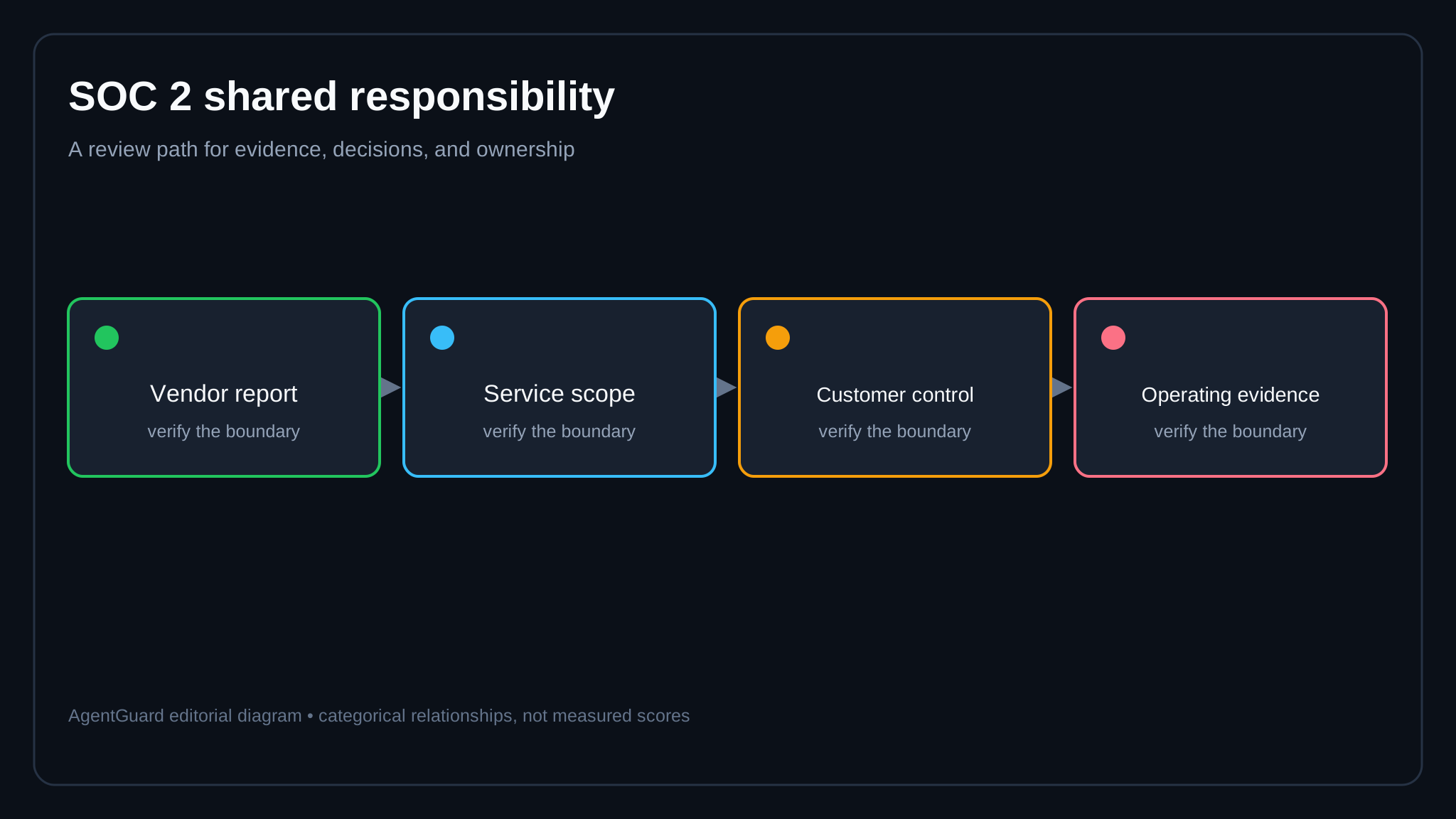
*Vendor evidence covers one side of the control boundary; the customer still has to operate and prove its own controls.*
What is publicly verifiable
Anthropic maintains a Trust Center for security and compliance evidence. Its Privacy Center certification article distinguishes commercial products from consumer products and lists current certifications.
Those are the right starting points because certification status, report periods, and product scope can change. Ask for the current report that applies to the service you plan to use: Claude for Work, the Anthropic API, or another named offering.
What to inspect in the report
Check the legal entity and service description first. Then confirm whether the report is Type I or Type II, which Trust Services Criteria are included, the period covered, and whether the auditor identified exceptions.
Read the system boundaries and subservice organizations. Cloud infrastructure, support systems, identity providers, and subprocessors may be handled through different methods. Note every complementary user entity control; those are tasks your organization is expected to perform.
Do not reduce the review to “SOC 2: yes.” The useful output is a control matrix with report section, covered service, evidence date, customer dependency, owner, and follow-up.
What the report does not prove
SOC 2 does not prove that a model output is correct, that prompt injection cannot occur, or that every agent tool call is authorized. It does not approve your data classification, retention settings, API-key handling, application code, plugins, or connected systems.
It also does not prove that controls outside the review period operated effectively. Track the report end date, bridge letters or updates, and material service changes.
The broader management-system questions in ISO/IEC 42001 can complement a service-control review, but the two artifacts serve different purposes.

Customer controls for Claude and the API
Assign a named owner for the vendor relationship and a separate technical owner for the implementation. Enforce SSO and lifecycle management where supported. Store API keys in a managed secret system, scope their use, rotate them, and prevent keys from reaching prompts or repositories.
Classify prompt, file, and retrieval data. Configure retention and model-improvement settings for the applicable plan. Decide which logs are required and which content must be redacted. Review integrations and tools before use, then monitor changes.
For agents, authorize side effects independently from the model. A vendor report cannot decide whether your agent should read a production database, modify a file, or call an external service.
Turn evidence into an audit-ready test
Choose one representative workflow. Trace user identity, application identity, model endpoint, data sources, tools, logs, and administrators. For each relevant SOC 2 control, identify the vendor evidence and your own operating evidence.
Test one access grant, one removal, one API-key rotation, one prohibited data path, and one incident escalation. Retain timestamps and ownership. If evidence lives only in a diagram or policy document, it has not yet shown operation.
Use the NIST AI RMF to organize AI-specific risks that sit outside a traditional service-control report. A review of AI agent governance platforms may help when several agent systems need consistent ownership and policy evidence.
Where AgentGuard can contribute
AgentGuard's public documentation describes component scanning and runtime decisions around supported agent actions. That evidence may support customer-operated controls for change review, policy decisions, and audit events where the integration applies.
It is not an auditor and does not extend Anthropic's attestation scope. Treat its output as one evidence source within your own control design.
Map the shared-responsibility controls for one Claude workflow before treating vendor certification as deployment approval.
Frequently Asked Questions
Does Anthropic have SOC 2 compliance?
Anthropic publishes current certification information through its Trust Center and Privacy Center. Buyers should obtain the applicable report and verify scope, period, service, and subservice commitments.
Can anyone download Anthropic's SOC 2 report?
Access conditions can change. Use Anthropic's Trust Center to request the current evidence rather than relying on an old copy or a third-party summary.
Does Anthropic's SOC 2 cover a customer's Claude implementation?
No. Vendor controls do not replace customer IAM, data classification, key management, application logging, tool authorization, change management, or incident response.
Turn vendor evidence into a scoped control matrix for your Claude deployment.
Map Controls