
AgentGuard vs General Analysis: What Are You Trying to Control?
Compare AgentGuard's local component and action controls with General Analysis's broader security workflow, public evidence, and matched proof of concept.
By Agent Guard Team11 min read
AgentGuard vs General Analysis: What Are You Trying to Control?
AgentGuard and General Analysis both address AI-agent risk, but they start at different control points. AgentGuard gives developers a public path to scan components and check supported high-risk actions locally; General Analysis describes a broader program across inventory, red teaming, runtime guardrails, and response.
TL;DR: Start with AgentGuard when the immediate job is a reproducible local control test around agent components and actions; put General Analysis in the proof of concept when you need broader discovery, system-level testing, and security-operations coverage.
AgentGuard publishes this comparison using public General Analysis materials, not an authenticated workspace or a matched benchmark.
The short answer
AgentGuard is the stronger first evaluation for a developer or platform team that wants to inspect agent components, apply a policy before supported high-risk actions, and reproduce the first allow-or-block decision from public instructions. The product documents a local policy path, a deliberate test action, dashboard verification, and an open-source CLI.
General Analysis describes a wider security operating model. Its public pages cover AI asset discovery, automated red teaming, runtime guardrails, and detection and response. That breadth can fit a security organization trying to manage several AI systems through one program. It also creates a larger proof burden: a pilot must show that discovery, testing, policy, and response stay connected on the buyer's actual systems.
Neither description establishes an overall winner. It does establish where to begin.
| Buying question | AgentGuard | General Analysis |
|---|---|---|
| Best first job | Scan agent components and test supported action-time policy locally | Evaluate a broader inventory, testing, runtime, and response workflow |
| Public starting point | Command-level Quickstart, API documentation, and open-source CLI | Product pages for asset management, red teaming, runtime security, and detection and response |
| Documented control scope | Skills, plugins, tools, MCP servers, agent code, and supported high-risk actions | Models, applications, agents, MCP servers, tools, prompts, context, responses, endpoints, and response actions |
| Strongest public evidence | Reproducible installation and policy-test path | Broad first-party workflow and coverage descriptions |
| Main trial question | Does the supported hook see and stop the actions that matter? | Do the discovery, test, policy, and response handoffs work across the real estate? |
The real difference is the operating model
Feature tables make these products look closer than they are. The useful comparison is the work each product asks the team to do first.
AgentGuard starts close to the developer's agent environment. A team can scan a component, run a local guard, set a policy mode, trigger a deliberate action, and inspect the result. The first question is narrow: did this component or action cross the policy boundary?
General Analysis starts with a program view. Its public material describes finding AI assets and their relationships, testing systems in context, applying runtime controls, and sending evidence into detection and response. The first question is broader: can the security team see and govern the relevant AI estate as a connected system?
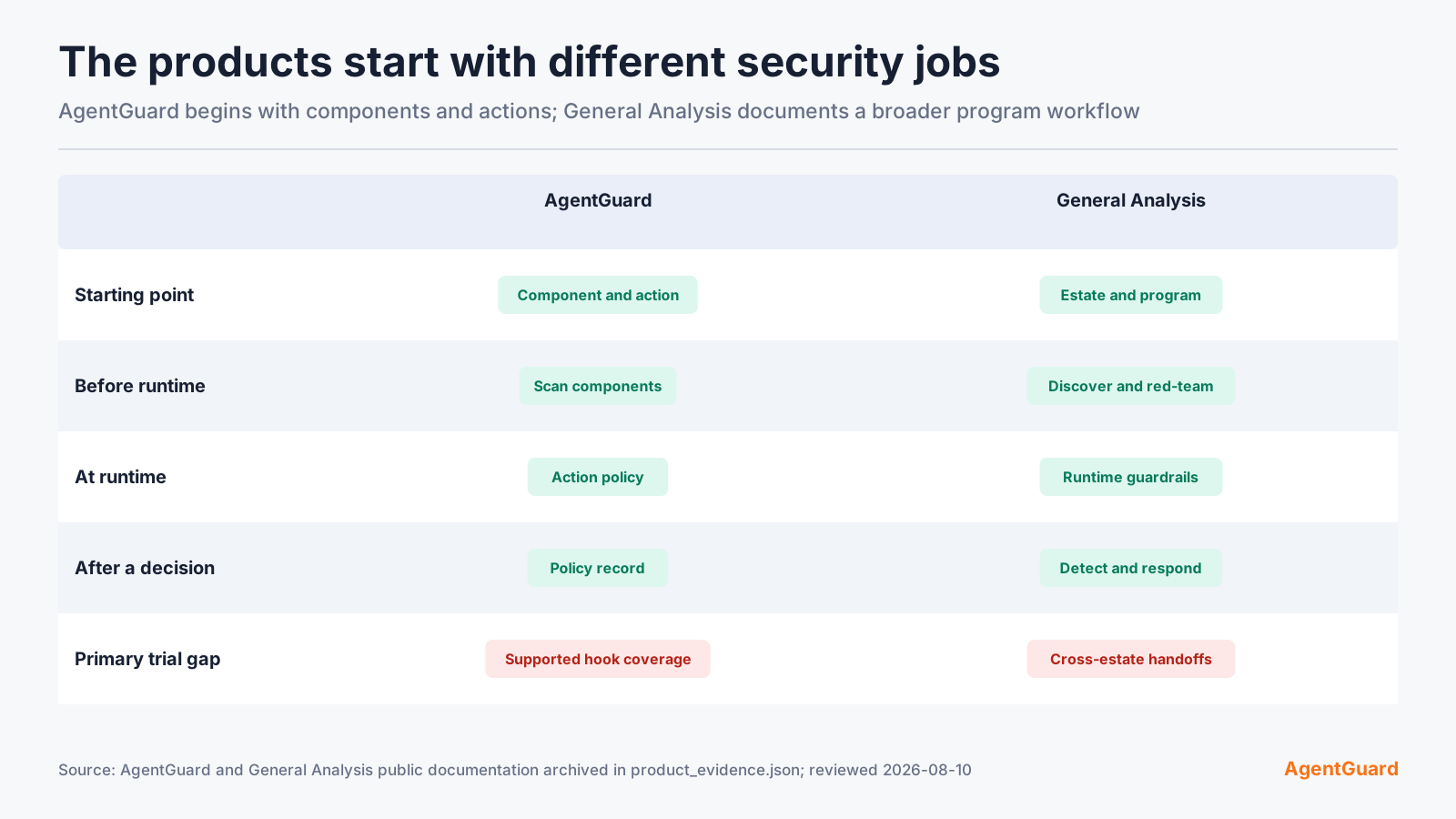
The matrix shows documented starting points, not equivalent implementation depth. A buyer still needs deployment evidence for every claimed control.
AgentGuard starts with component and action checks
AgentGuard's public API material names skills, plugins, tools, MCP servers, and agent code as scan targets. Its runtime surface covers supported checks before shell commands, file changes, tool calls, network requests, secret access, and write actions. The public Quickstart then turns that description into an observable sequence: install, check status, run diagnostics, choose a policy mode, trigger a test, and inspect the decision.
That sequence can fail in public. A team can find a missing hook, a policy mismatch, an incomplete event, or different offline behavior. Each result is inspectable.
The boundary matters too. AgentGuard states that it cannot fully monitor or block every third-party MCP server runtime call. It combines component scans, reputation, a trust registry, and supported hook-layer blocking. The buyer should map each critical action to an actual supported interception point rather than assume that installing a guard creates universal coverage.
General Analysis starts with a broader security program
General Analysis publicly organizes its platform around four connected jobs. Asset management describes discovery of models, endpoints, knowledge bases, MCP servers, tools, permissions, and shadow AI. Red teaming describes attacks against LLM applications, RAG systems, MCP servers, coding agents, and production agents. Runtime security describes inspection of prompts, retrieved context, responses, tool arguments, and streamed output. Detection and response extends the story to local agents, browser copilots, IDE assistants, terminals, and response actions.
The trade-off is proof complexity. A demo can show each surface separately and still leave the important handoffs untested. The pilot should start with a known agent path and ask whether its owner, components, permissions, adversarial trace, runtime decision, and incident evidence remain connected from start to finish.
Before runtime: admission versus discovery and red teaming
AgentGuard's pre-runtime value begins with component admission. A team can inspect an agent skill, plugin, MCP server, tool, or code package before trusting it. That supports a practical control: block or investigate a risky dependency before it joins the workflow. The open-source CLI also gives technical evaluators code and command behavior to inspect directly.
This approach fits teams that already know which repositories and agent environments they own. It can be folded into enterprise AI agent security practices as a component review and release check. It does not, by itself, prove that the organization has found every AI asset or every shadow deployment.
General Analysis addresses that wider discovery problem. Its asset-management page says the product continuously discovers AI assets, relationships, permissions, ownership, and changes across cloud accounts, repositories, endpoints, and agent infrastructure.
Its Automated AI Red Teaming page then describes tests for prompt injection, tool misuse, data leakage, unsafe autonomy, privilege escalation, and multi-step attacks, with traces that can feed remediation and regression testing.
Those two jobs are not substitutes. Discovery asks whether the program knows what exists. Admission asks whether a known component should be trusted. Red teaming asks whether a connected system can be pushed into an unsafe sequence. A mature program may need all three, but the evaluation should give each one a denominator.
For discovery, provide a known inventory. For admission, use clean and malicious samples with expected findings. For red teaming, fix the attack paths and require a reproducible trace. Do not score raw asset or attack counts without a denominator.
At runtime: where can each product change the outcome?
AI agent runtime security only matters when the control sits on the path of a meaningful action. A detection that arrives after a secret leaves the environment has a different job from a policy check that can stop the read before it happens.
AgentGuard documents local checks before supported high-risk actions. The policy result can allow, block, or require handling at the hook layer, while redacted action metadata can be synchronized for visibility. Cached policy is described as supporting offline decisions.
The same discipline should shape an MCP evaluation. A list of MCP security tools is only the beginning.
For each server and client, identify whether the control reviews the component before use, observes live request and response traffic, checks tool arguments, or intercepts the final side effect. AgentGuard's stated limitation on some third-party runtime calls belongs in that map.
General Analysis's AI Runtime Security page describes a broader set of inspected surfaces: prompts, retrieved context, model responses, tool arguments, and streamed output. It also describes policy controls, approvals, and production traces. Its detection-and-response material adds endpoint visibility and response actions such as block, approval, redaction, pause, and quarantine.
The public descriptions are useful for designing a trial, but they do not establish the exact interception point for the buyer's stack. Ask General Analysis to trace one action from prompt through tool call to side effect. Mark where policy runs, which identity and permissions reach the decision, what happens on timeout, and which evidence reaches the incident record. If a claimed control cannot be placed on that path, it is not yet comparable.
What you can verify before a sales call
AgentGuard currently has the clearer public first-test path. The Quickstart exposes installation, health checks, policy mode, a deliberate action, and dashboard verification. The API documentation names scan and runtime objects. The public repository lets an evaluator inspect the CLI's stated license and implementation surface. None of that proves enterprise scale or better detection, but it lowers the cost of finding the first technical mismatch.
A useful first AgentGuard session should produce four artifacts: the component scan result, the active policy, the action decision, and the event shown to the operator. Repeat the action while offline. Then change one policy input and confirm that the outcome changes for the reason you expected.
General Analysis publishes much more product breadth than public setup detail on the pages reviewed here. That does not mean a setup path or deployment option is absent. It means the buyer should ask the vendor to demonstrate the same four artifacts for a known workflow, then add an inventory record, a red-team trace, and a response action. The result should make every handoff visible.
If the immediate goal is to run the narrower test now, Open AgentGuard and use a non-production agent workflow with an intentionally high-risk action.
Keep these cells unknown until tested
Several comparison rows cannot be filled honestly from current public material. Leave them blank in the scorecard until both products answer the same question under the same conditions.
- Price and contract scope. The reviewed General Analysis pages did not expose comparable plans, and no equivalent current package was verified for both products.
- Detection quality and false positives. First-party coverage language is not a matched test result.
- Added latency. Measure the same action at the same percentile and load. Do not combine vendor numbers from different tests.
- Deployment and data handling. Verify regions, retention, fields, redaction, connectors, local processing, and behavior during a cloud outage.
- Complete component and runtime coverage. Neither a public list nor a missing page proves that every path is controlled.
- Operating cost. Include policy maintenance, investigation work, connector upkeep, exception handling, and evidence export, not just license price.
Unknown does not favor either vendor. It tells the evaluation team what to test next.
Run one matched proof of concept
A fair proof of concept uses one workflow and one denominator. Pick an agent that reads context, calls an MCP tool, and attempts a protected side effect. Document the expected components, identities, actions, and evidence before installation.
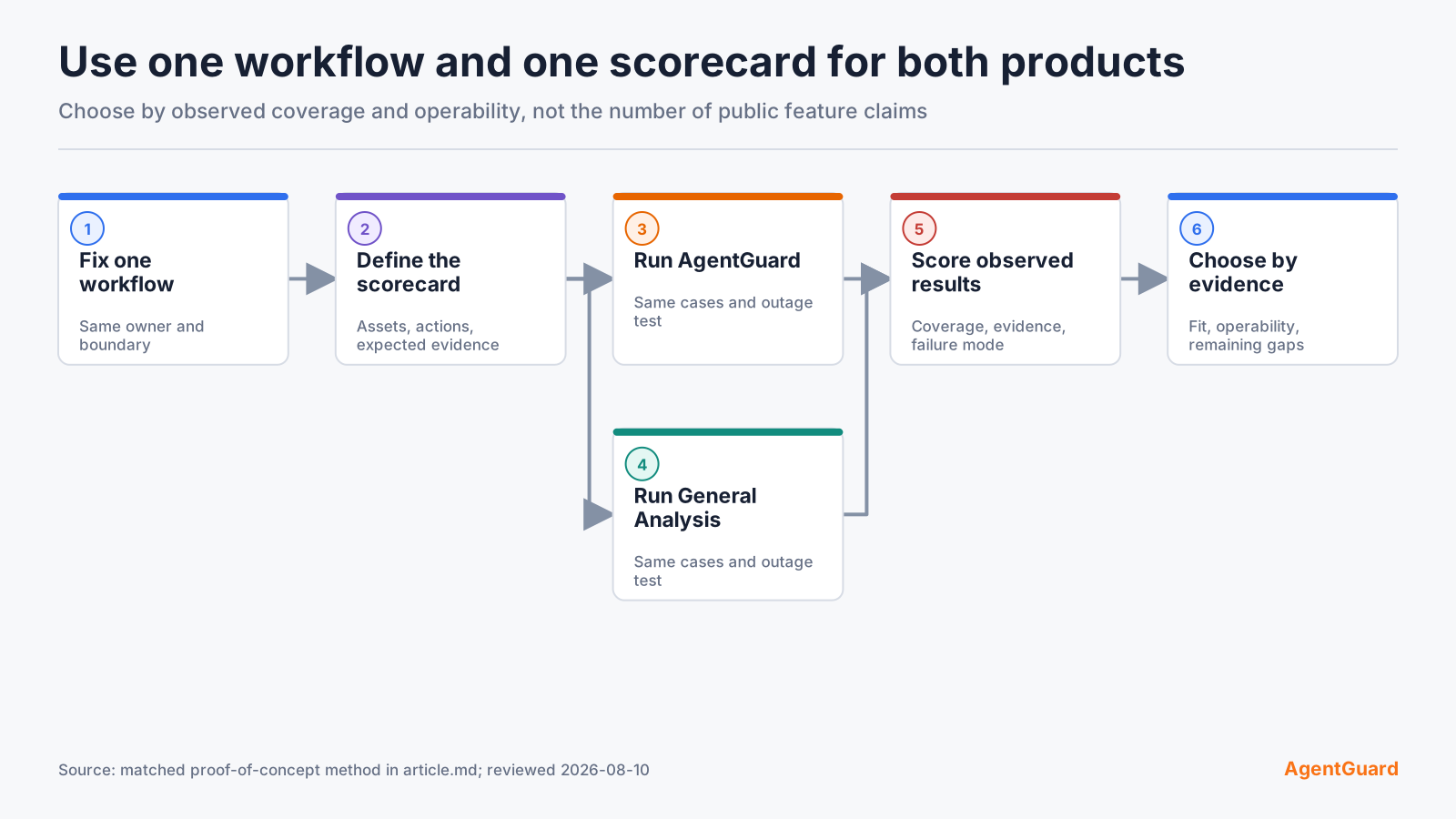
Pick one workflow and define the denominator
Start with the system you can observe most completely, not the most impressive demo. List its repository, model endpoint, knowledge source, MCP server, tools, secrets, users, and final side effects. Select two LLM agent exploit vectors that cross components, such as indirect prompt injection followed by a privileged tool call, and one ordinary action that must remain allowed.
Run the clean action first. Then run each adversarial path. For every step, record whether the product discovered the asset, scanned the component, preserved the attack trace, reached the policy point, changed the outcome, and produced evidence an operator could use. Repeat a critical action when the vendor cloud or network link is unavailable.
Use the same payloads, identities, permissions, time limits, and evidence requirements. Record unmatched integrations as deployment findings instead of quietly adjusting the score.
Choose by the evidence you can operate
Choose AgentGuard when the test shows that its local component and supported action controls cover the paths your developer team needs, and the public setup model matches how that team works. Its advantage is not a longer feature list. It is the short path from installation to an inspectable policy decision.
Choose General Analysis when the pilot proves that its broader inventory, red-team, runtime, and response workflow covers your estate and preserves evidence across those handoffs. That is the job its public material is built around.
Some teams may use both layers. Make that decision only if the matched test shows distinct coverage and the combined event flow is operable. Duplicate alerts and unclear policy ownership are costs, not defense in depth by default.
For a guided evaluation of AgentGuard against this scorecard, book an AgentGuard demo with the workflow, failure cases, and required evidence already defined.
Frequently Asked Questions
Is General Analysis an AgentGuard alternative?
Yes, for buyers comparing agentic AI security platforms, but the products are not identical substitutes. AgentGuard's public evidence is strongest around a local developer-facing component and action control path. General Analysis publicly describes a broader workflow across asset discovery, red teaming, runtime guardrails, and detection and response. The relevant alternative depends on the first control problem.
Which product is better for MCP security?
There is no supported universal answer. AgentGuard names MCP servers in its component-scanning scope and documents supported hook-layer action checks, while also stating that it cannot fully monitor or block every third-party MCP runtime call. General Analysis describes MCP discovery, red-team coverage, runtime inspection, and endpoint visibility. Test the exact server, client, traffic path, and side effect you need to control.
Does AgentGuard monitor every third-party MCP runtime call?
No. AgentGuard's public FAQ states that it cannot fully monitor or block all third-party MCP server runtime calls. Its documented approach combines scans, reputation, a trust registry, and supported hook-layer blocking. A POC should map every critical MCP action to a real interception point.
Does General Analysis support local-only or offline decisions?
The reviewed public product pages do not establish a complete deployment, data-flow, or outage-behavior matrix. That is not evidence that a mode is unavailable. Ask General Analysis to demonstrate where each decision runs, which fields leave the environment, what is cached, and what happens when its cloud path is unavailable.
How should I compare AgentGuard and General Analysis pricing?
Fix the scope first. Price the same protected workflows, assets, environments, evidence retention, support level, and expected event volume. Add implementation and operating work. Current comparable public pricing was not verified for both products, so any numeric winner would be invented.
Test AgentGuard against one real workflow and collect every policy decision.
Book Demo