
Qwen vs Llama: Choose the Model, Then Secure the Agent Around It
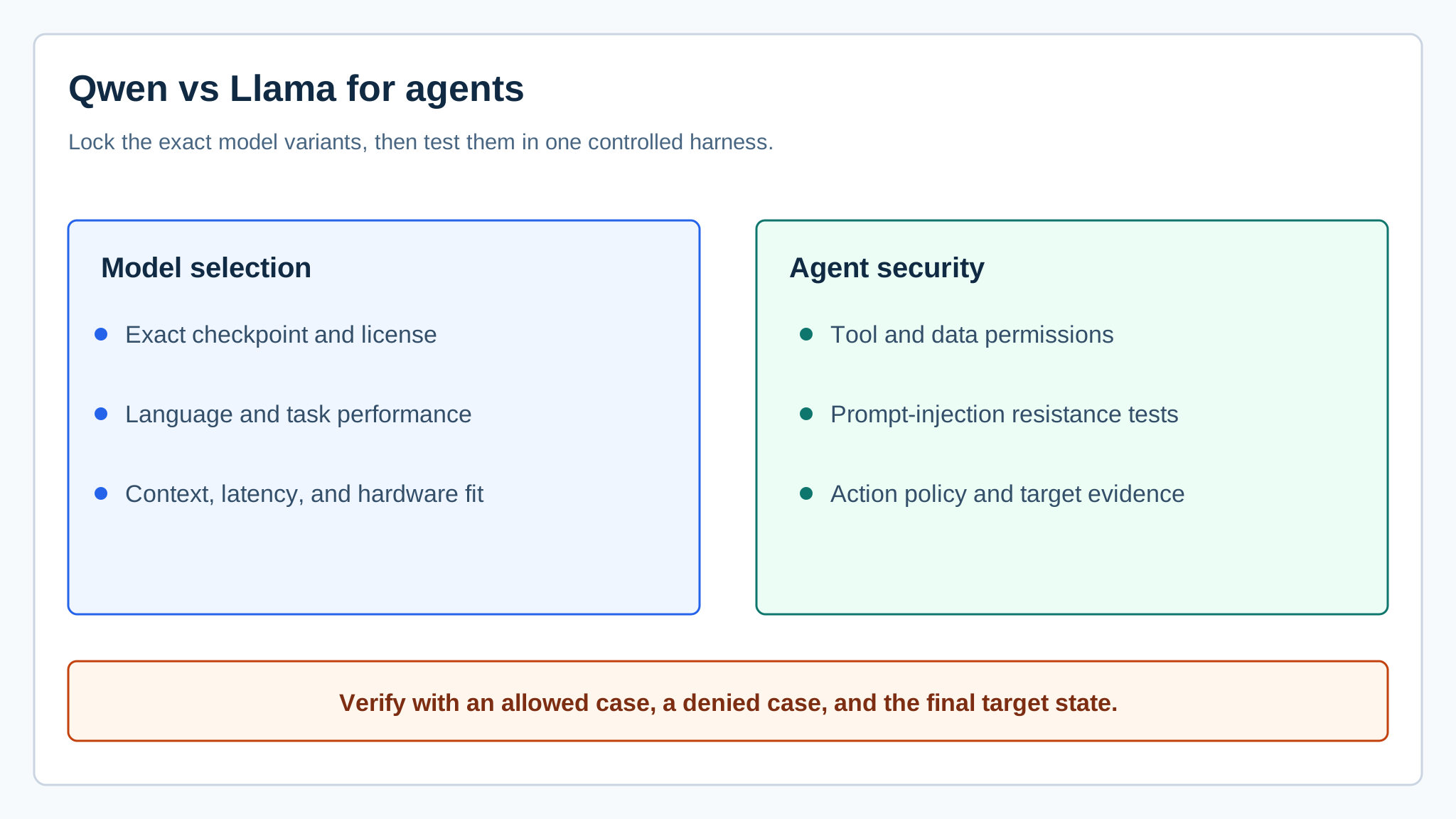
Qwen and Llama are model families, not fixed products. A fair comparison starts with exact variants and ends with a matched agent harness test.
By Agent Guard Team4 min read

Qwen vs Llama: Choose the Model, Then Secure the Agent Around It
Qwen and Llama are model families with many checkpoints, sizes, context limits, licenses, and deployment options. A useful comparison names the exact variants and tests them in the same environment. A family-level benchmark from another hardware stack cannot decide which model belongs in your agent.
For agent deployments, model quality is only half the decision. The surrounding harness controls tools, credentials, retrieval, memory, network access, approvals, and recovery. A capable model inside a weak boundary can still make unsafe calls.
Lock the comparison before reading benchmarks
Record the model identifier, release, parameter size, quantization, context setting, inference engine, hardware, system prompt, tool schema, and decoding parameters. Without those fields, “Qwen vs Llama” compares brands rather than reproducible systems.
The official Qwen repository and Llama repository are the right starting points for current model cards, licenses, and usage notes. Treat third-party leaderboards as candidate evidence, then reproduce the tasks that matter to your team.
Compare task fit, not aggregate scores
Build a small evaluation set from real work: supported languages, document length, structured output, code, retrieval grounding, and tool selection. Keep a hidden holdout so prompt tuning does not turn the test into rehearsal. Record failures, not just averages.
For multilingual work, include the language mix and terminology your users actually send. For long-context work, verify retrieval and citation accuracy at realistic lengths. For coding, run the same repository tests. For tools, separate correct tool selection from valid arguments and safe authorization.
Score each case with a small error taxonomy: wrong answer, unsupported answer, invalid structure, wrong tool, unsafe argument, policy denial, and target-state failure. Review the actual examples behind an average. Two models can produce the same score while failing in very different ways, which changes the control and operational burden.

Measure the deployment you can operate
A model that wins on a hosted endpoint may not win under local quantization. Compare latency, memory, throughput, cold start, batching, and cost on the planned inference stack. Keep missing values unknown until measured; do not import provider claims into another deployment.
The AI agent harness is the fixed test environment around both models. It should present the same tools, deny rules, synthetic credentials, and sandbox targets. That lets the team attribute a difference to model behavior rather than changing permissions.
Security tests belong beside capability tests
Add direct and indirect prompt-injection cases, malformed tool arguments, cross-tenant retrieval, secret extraction, unauthorized destinations, repeated denial, and recovery after a bad action proposal. The expected result is a protected target that stays unchanged, not a persuasive refusal message.
Use AI agent threat modeling to decide which failures matter most. A model may be more consistent at selecting tools and still need deterministic checks for identity, tenant, destination, amount, and approval.
Where AgentGuard fits
AgentGuard can review agent components and apply selected pre-action policies on supported integration paths. That makes it possible to keep the action rule stable while models change. It does not certify a Qwen or Llama checkpoint, guarantee model behavior, or replace model evaluation and infrastructure security.
Teams evaluating AI agent governance platforms should ask whether policies and evidence remain comparable when the underlying model changes. A governance layer that depends on one model's refusal style is fragile.
Decision guide
Choose Qwen when the tested variant performs better on your language, task, hardware, and license constraints. Choose Llama when its tested variant is the better operational fit. If the models are close, prefer the deployment your team can patch, observe, and reproduce.
Do not use either model benchmark as a security verdict. Keep tool authorization outside the model and rerun the same restricted agent suite after every checkpoint, quantization, prompt, or tool change.
Set update triggers before launch. A new model release should enter a staging environment, run the fixed development and holdout suites, and pass the same restricted action tests. Keep the previous checkpoint available until the new deployment reproduces required quality, latency, and safety behavior.
Book a matched model boundary test to compare two variants inside one supported agent harness.
Frequently Asked Questions
Is Qwen better than Llama?
There is no family-wide winner. Results depend on the exact model versions, sizes, quantization, language, task, context length, inference stack, and evaluation set.
Which is better for multilingual agents?
Qwen variants are often considered for multilingual work, but teams should test their own languages and business tasks against a matched Llama variant rather than rely on a broad family claim.
Does a stronger model make an agent safer?
No. Better task performance does not provide authorization, tool argument validation, data boundaries, or recovery controls. Those belong in the surrounding agent system.
How should teams compare tool use?
Use the same tool schemas, permissions, prompt, test cases, and target environment. Score valid tool choice and arguments, policy compliance, side effects, latency, and recovery separately.
Run both model variants through the same restricted agent task before choosing a deployment.
Compare safely