
AI Governance vs AI Agent Governance: Policy Is Not Runtime Control
AI governance sets organization-wide rules. Agent governance turns those rules into controls for identities, tools, actions, and runtime evidence.
By Agent Guard Team4 min read

AI Governance vs AI Agent Governance: Policy Is Not Runtime Control
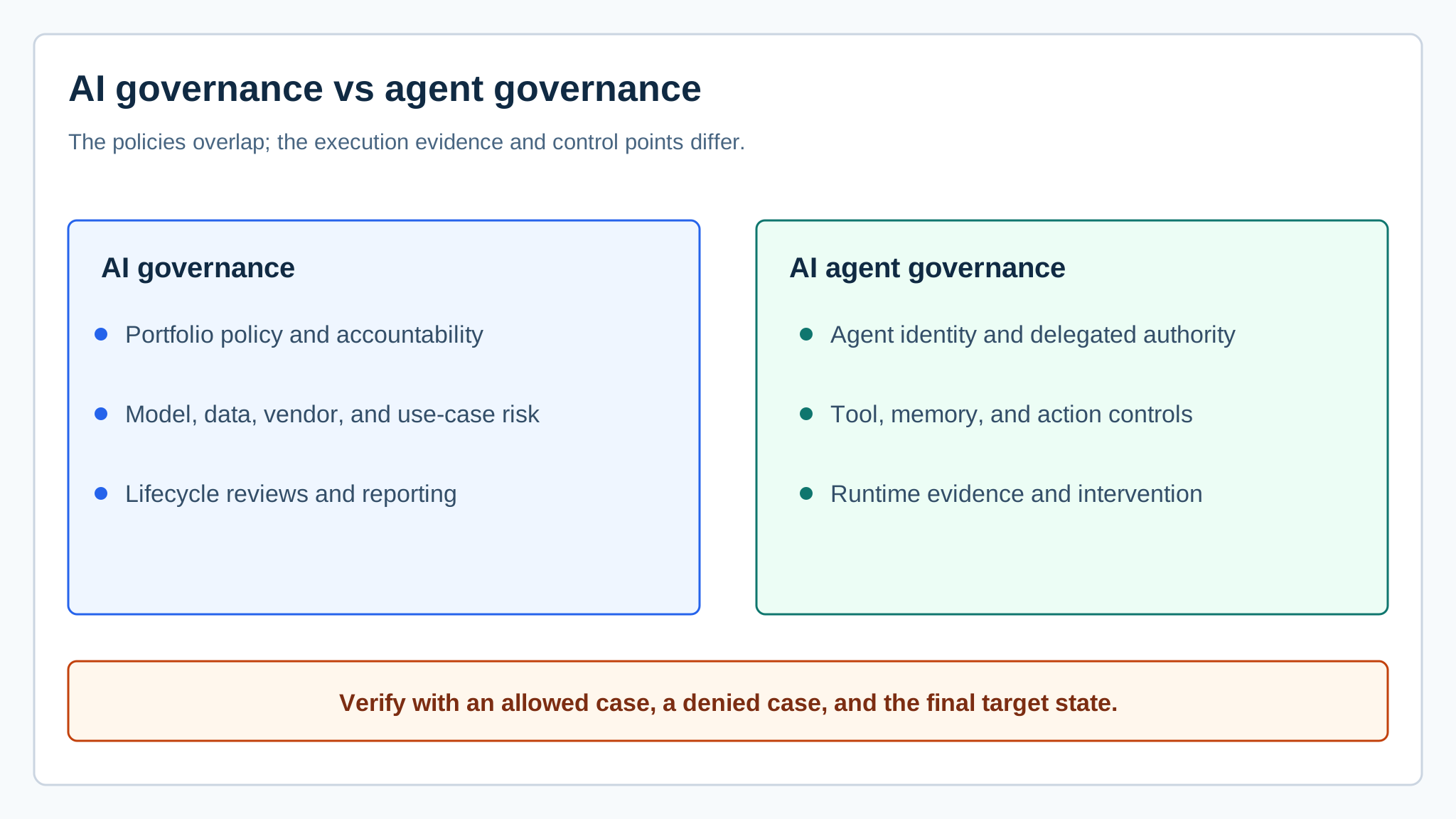
AI governance manages how an organization selects, builds, buys, evaluates, deploys, monitors, and retires AI. AI agent governance applies that system to software that can observe, plan, use tools, retain context, and change external state. The second is not a replacement for the first. It adds an execution layer.
The practical gap appears when a policy says “human oversight” or “least privilege” but no control decides whether this agent may call this tool with these arguments now.
Scope and ownership
AI governance spans the portfolio: approved use cases, model and data risk, vendors, legal obligations, evaluation, accountability, incidents, and reporting. Owners often include product, risk, legal, security, data, and business leadership.
Agent governance narrows the lens to deployed autonomy. It assigns owners for the agent identity, prompts, memory, retrieval, tools, credentials, action policy, approval flow, telemetry, and recovery. The NIST AI Risk Management Framework is useful at both levels because its Govern, Map, Measure, and Manage functions can connect policy to operational evidence.
The artifact changes
A general AI inventory may record model, vendor, purpose, data class, owner, and risk tier. An agent inventory needs more: delegated identity, enabled components, reachable tools, network destinations, maximum action scope, approval thresholds, memory retention, and stop mechanism.
The policy enforcement layer converts a requirement into a decision over a normalized action. “Protect customer data” becomes rules for tenant, fields, recipient, destination, export size, and approval. That is testable in a way a policy sentence is not.
Runtime evidence matters
Traditional governance often relies on design review and periodic assessment. Agents also need evidence while they operate: proposed tool call, caller, arguments, matched policy, approval, actual result, and changed target. The record should show what happened without storing unnecessary sensitive content.
OWASP's AI Agent Security Cheat Sheet recommends threat modeling, least privilege, validation, human oversight for high-impact actions, monitoring, and incident response. Those controls provide a useful bridge from governance language to implementation.

Human oversight becomes a timing decision
An AI policy may require human oversight. Agent governance decides where the pause sits, what the reviewer sees, how long approval remains valid, and whether changed arguments invalidate it. Low-risk steps can run under supervision, while money movement, access changes, deletion, and external publication may require pre-action approval.
Use the rogue agent failure model to test whether an agent can expand its own authority, repeat a denied action, switch tools, or continue after its stop condition. A dashboard without tested intervention is not operational oversight.
Incident response must include the target
An agent incident is not finished when a process stops. Revoke exposed credentials, disable risky tools, preserve the action evidence, inspect downstream effects, restore affected targets, and add the case to regression testing. Update both the agent control and the portfolio risk record.
Define the escalation path before launch. The runtime owner should know when to stop the agent, the business owner should decide whether operations can resume, and the governance owner should record whether the incident changes the system's risk classification.
This is why AI agent threat modeling belongs before release. It identifies the asset and effect that recovery must address, not merely the prompt that triggered the problem.
Where AgentGuard fits
AgentGuard can provide component evidence and selected runtime policy decisions on supported paths. It helps turn some agent governance requirements into checks near the action. It does not own the enterprise AI inventory, legal accountability, model validation, business approval, or every third-party execution path.
Decision guide
Use AI governance to set common accountability, risk categories, lifecycle requirements, and reporting. Add agent governance when software receives delegated authority to call tools or change state. Keep one control map so agent-specific evidence rolls up to the enterprise program.
Book a governance-to-control mapping for one supported agent action and its policy owner.
Frequently Asked Questions
What is AI governance?
AI governance is the organization-wide system of policies, roles, processes, and evidence used to manage AI across its lifecycle and portfolio.
What makes AI agent governance different?
Agent governance adds controls for delegated identities, tools, memory, action arguments, approvals, runtime monitoring, interruption, and recovery.
Does an AI governance program need a separate agent framework?
It needs an agent-specific operating layer, but that layer should map back to the same enterprise risk, compliance, security, and accountability system rather than become an isolated program.
What should teams govern first?
Start with the agent's highest-consequence action and prove identity, authorization, approval, target state, evidence, and recovery before broadening scope.
Translate one AI policy requirement into a testable control on an agent action.
Map the control