
Human-in-the-Loop or Human-on-the-Loop? Put the Pause Where Failure Costs More
The choice is about when a human can stop an action and what evidence they have, not whether a dashboard includes an approval button.
By Agent Guard Team4 min read

Human-in-the-Loop or Human-on-the-Loop? Put the Pause Where Failure Costs More
Human-in-the-loop (HITL) means a person participates before a decision or action completes. Human-on-the-loop (HOTL) means the system acts under supervision and a person can intervene. The useful distinction is timing: does the workflow pause before the effect, or does oversight happen while or after actions continue?
Choose by consequence and interruption speed. A payment, privilege change, public message, or destructive operation often needs HITL. High-volume, reversible classification may suit HOTL when monitoring is reliable and the operator can stop the system quickly.
The comparison in one table
| Decision question | Human-in-the-loop | Human-on-the-loop |
|---|---|---|
| When does the person act? | Before the selected decision or side effect | During operation, when monitoring triggers or judgment is needed |
| Default system behavior | Wait for approval | Continue within policy limits |
| Main strength | Prevents a costly action before it happens | Preserves speed for repeated, lower-risk work |
| Main failure | Approval becomes routine or lacks context | Intervention arrives after the damage |
| Required evidence | Clear proposal and approval record | Continuous signals, alerts, intervention, and recovery record |
The NIST AI Risk Management Framework does not prescribe one universal approval pattern. It asks organizations to govern, map, measure, and manage risk. That supports a consequence-based choice rather than adding a human checkpoint everywhere.
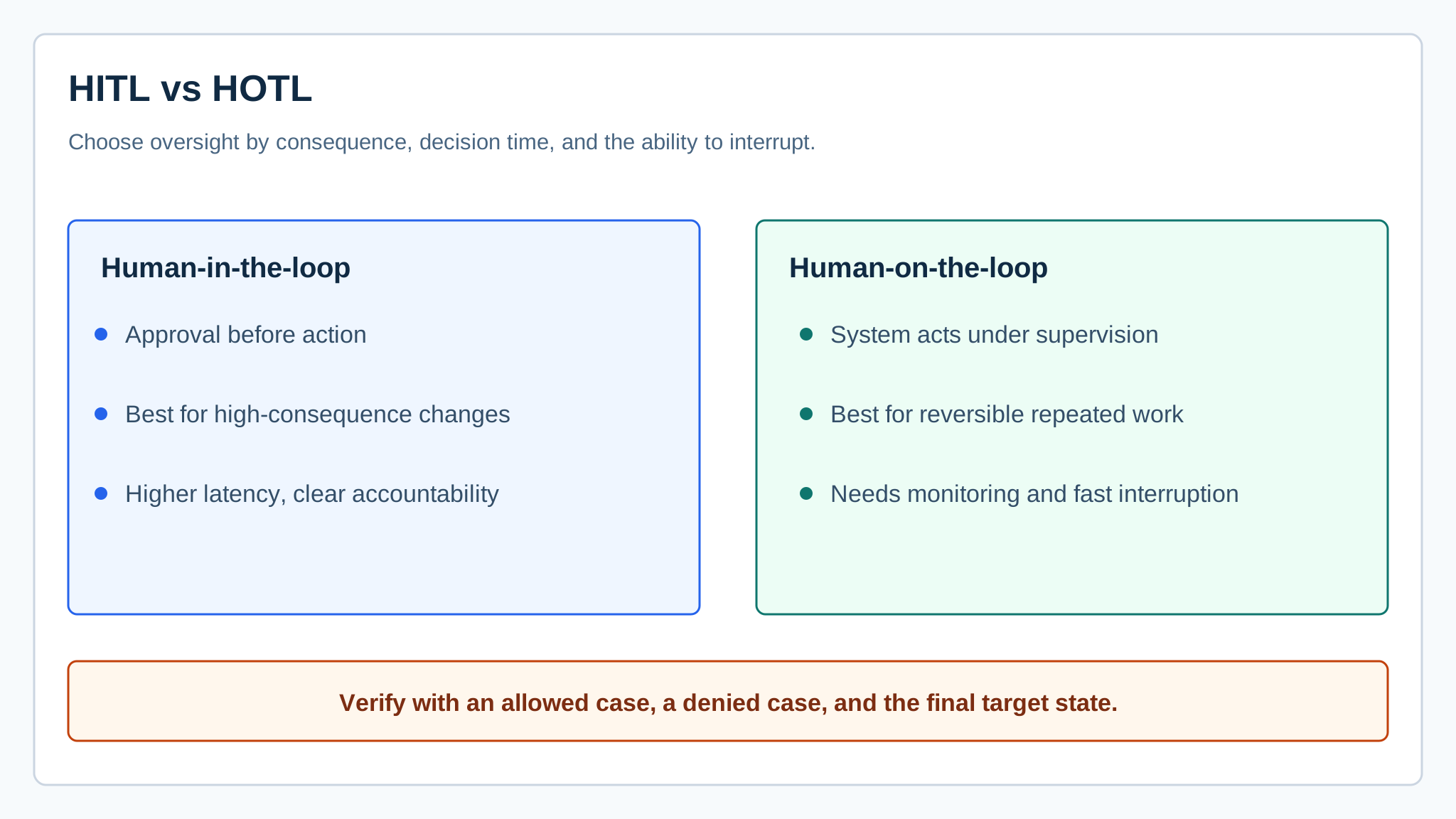
Use HITL when the effect is hard to reverse
Put a pre-action pause before external communication, financial transfer, credential change, deletion, production deployment, or access to sensitive records. The reviewer needs the actual proposal: who initiated it, which target is affected, which arguments matter, what policy matched, and what the expected effect is.
A checkbox with no context is not meaningful oversight. Design the approval so a reviewer can distinguish routine work from a hidden escalation. The policy enforcement boundary should reject expired approvals, changed arguments, and attempts to reuse a decision for another target.

Use HOTL when monitoring can outrun harm
HOTL works when actions are bounded, observable, and recoverable. Examples include ranking non-sensitive tickets, drafting internal summaries, or routing requests among approved queues. The operator needs a live view of volume, anomalies, denied actions, and target outcomes, plus a tested stop control.
Ask a direct question: if the alert arrives 30 seconds late, what can the system change in that time? If the answer includes money movement, mass deletion, or external publication, supervision may be too slow. Move that effect to a HITL gate.
Combine both inside one workflow
A mature agent rarely uses one oversight model for every step. It can retrieve documents and classify intent under HOTL, then pause for HITL before sending a message or changing a record. After approval, HOTL can watch execution and trigger recovery when the actual effect diverges from the proposal.
This layered design also limits a rogue agent. The system can continue ordinary work inside narrow limits without gaining silent authority over the most consequential action.
Test the human path
Measure approval latency, rejection rate, changed proposals, expired decisions, alert delay, intervention time, and recovery success. Include one case where the action changes after approval. The correct result is a new decision, not silent execution under the old approval.
The EU AI Act's Article 14 human oversight requirements stress that oversight measures must enable people to understand limitations, monitor operation, interpret outputs, and intervene where applicable. A nominal reviewer who lacks time, context, or authority does not meet the practical goal.
Where AgentGuard fits
AgentGuard can apply selected pre-action decisions on supported paths and record component or policy evidence. It can support a HITL gate or a HOTL monitoring design, but it cannot make an inattentive reviewer effective or guarantee interception of every third-party runtime path.
Use AI agent threat modeling to find where the workflow should switch modes. Put the pause before the first unacceptable effect, then test denial, expiry, argument changes, and recovery.
Decision rule
Use HITL when a wrong action is hard to reverse or when detection would arrive too late. Use HOTL when actions are bounded, evidence is immediate, and intervention reliably prevents escalation. Combine them when one workflow crosses both risk levels.
Book an oversight mapping session to locate the enforceable pause in a supported agent path.
Frequently Asked Questions
What is the main difference between HITL and HOTL?
Human-in-the-loop requires a person to participate in or approve a decision before action. Human-on-the-loop allows the system to act while a person supervises and can intervene.
Is human-on-the-loop suitable for high-risk actions?
It can be, but only when detection and interruption are fast enough to prevent unacceptable harm. Irreversible or high-consequence actions often need a pre-action approval.
Can one workflow use both models?
Yes. A workflow can use HOTL for low-risk, reversible steps and switch to HITL when the action crosses a money, data, privilege, or external-communication threshold.
What evidence should an approval show?
Show the initiating identity, proposed action, affected target, critical arguments, policy result, expected effect, and the information the approver needs to decide.
Place one enforceable pause before the highest-cost action in your agent workflow.
Map the pause