
AgentGuard vs HiddenLayer: Start With the Control Boundary
Compare AgentGuard and HiddenLayer across runtime controls, MCP scope, public setup evidence, and a matched proof of concept for an enterprise AI stack.
By Agent Guard Team10 min read
AgentGuard vs HiddenLayer: Start With the Control Boundary
AgentGuard and HiddenLayer overlap on runtime and agentic AI security, but their public evidence points to different first jobs: AgentGuard gives a developer team a reproducible local path to the first policy decision; HiddenLayer describes a broader enterprise platform across runtime, MCP traffic, models, and security operations.
This comparison is published by AgentGuard and favors it where the evidence is stronger, especially local action control, public setup steps, and agent-component scanning; missing details on a HiddenLayer page are treated as questions, not proof of absence.
The short answer
Choose AgentGuard first when the immediate job is to put a local control in front of developer-agent actions, test allowed and blocked behavior from public instructions, and inspect evidence before a large rollout. That first-test path is unusually concrete. The documentation covers installation, health checks, policy mode, a deliberate test, local decisions, and dashboard verification.
Choose HiddenLayer for the first evaluation when the main question is broader estate coverage: AI applications and agents, MCP traffic, model files, threat detection, security operations, and several stated integration surfaces. Its public product pages cover more of the enterprise AI security program, even though the reviewed pages do not expose the same command-level evaluation path.
| Buyer question | AgentGuard public evidence | HiddenLayer public evidence | What the buyer still needs to test |
|---|---|---|---|
| Can a developer run a first control test from public steps? | Yes: install, diagnose, select policy, trigger a test, and inspect the result | The reviewed pages lead with platform outcomes and integration surfaces | Time to the first explainable allowed and blocked action |
| Where is runtime control described? | A local guard evaluates high-risk actions before execution | Inline enforcement plus SDK, proxy, gateway, and agent-harness surfaces | Which real action paths cross the decision point |
| Which assets are named? | Agent code, skills, tools, plugins, and MCP servers | MCP and agentic traffic plus proprietary, open-source, and vendor models | Exact formats, frameworks, and report depth |
| What is the operating scope? | Developer-agent runtime, component review, policy, events, and advisories | Runtime, MCP, model security, discovery, attack simulation, and security operations | Modules, owners, deployment effort, and data flow |
There is no evidence for a universal winner. There is enough evidence to choose a better first test. If control of developer-agent actions is the urgent problem, AgentGuard starts closer to the action and reveals more of the evaluation path in public. If the buying program begins with broad AI estate visibility and model security, HiddenLayer puts more of that scope on the public page.
First compare the control boundary
A feature label such as "runtime protection" says little about where a product receives the action, which identity and arguments it sees, or whether it can stop the final call. Those details decide whether a policy can change the outcome or merely report it later.
AgentGuard's public path is local and reproducible
AgentGuard describes a local guard between a proposed action and execution. Its public API covers runtime evaluation, effective policy, approvals, events, and component scans. The quickstart says decisions happen locally, redacted action metadata is synchronized to Cloud, and cached policy can support decisions during a cloud outage.
The AgentGuard documentation also gives an evaluator a sequence to reproduce: install the guard, check its status, run diagnostics, choose a policy mode, trigger a deliberate risky action, and verify the decision. That does not prove every adapter or enterprise deployment pattern. It does mean a technical buyer can inspect the first control loop without waiting for a custom demonstration.
This is AgentGuard's clearest advantage in the comparison. The public material connects setup, policy, action, and evidence. A small platform or security team can test one bounded workflow and decide whether broader evaluation is justified.
HiddenLayer's public path is broader and integration-led
HiddenLayer's AI Runtime Security page describes visibility, threat detection, automated protection, inline enforcement, agent-harness security, and security-operations integration. The product language starts with the AI estate rather than a single developer workstation.
Its agentic security material names LiteLLM proxy interception, SDK instrumentation, and gateway inspection. These are useful integration choices for teams with several applications or an existing AI gateway. The buyer still needs to map each route to the actual action path: which requests are observed, where a block is enforced, what identity reaches the decision, and what happens if the service or integration is unavailable.
The reviewed HiddenLayer pages do not show the same command-by-command first test, local decision statement, or outage example as AgentGuard's quickstart. That is a public-evidence disadvantage during evaluation. It is not proof that HiddenLayer cannot provide those details in documentation, architecture review, or a pilot.
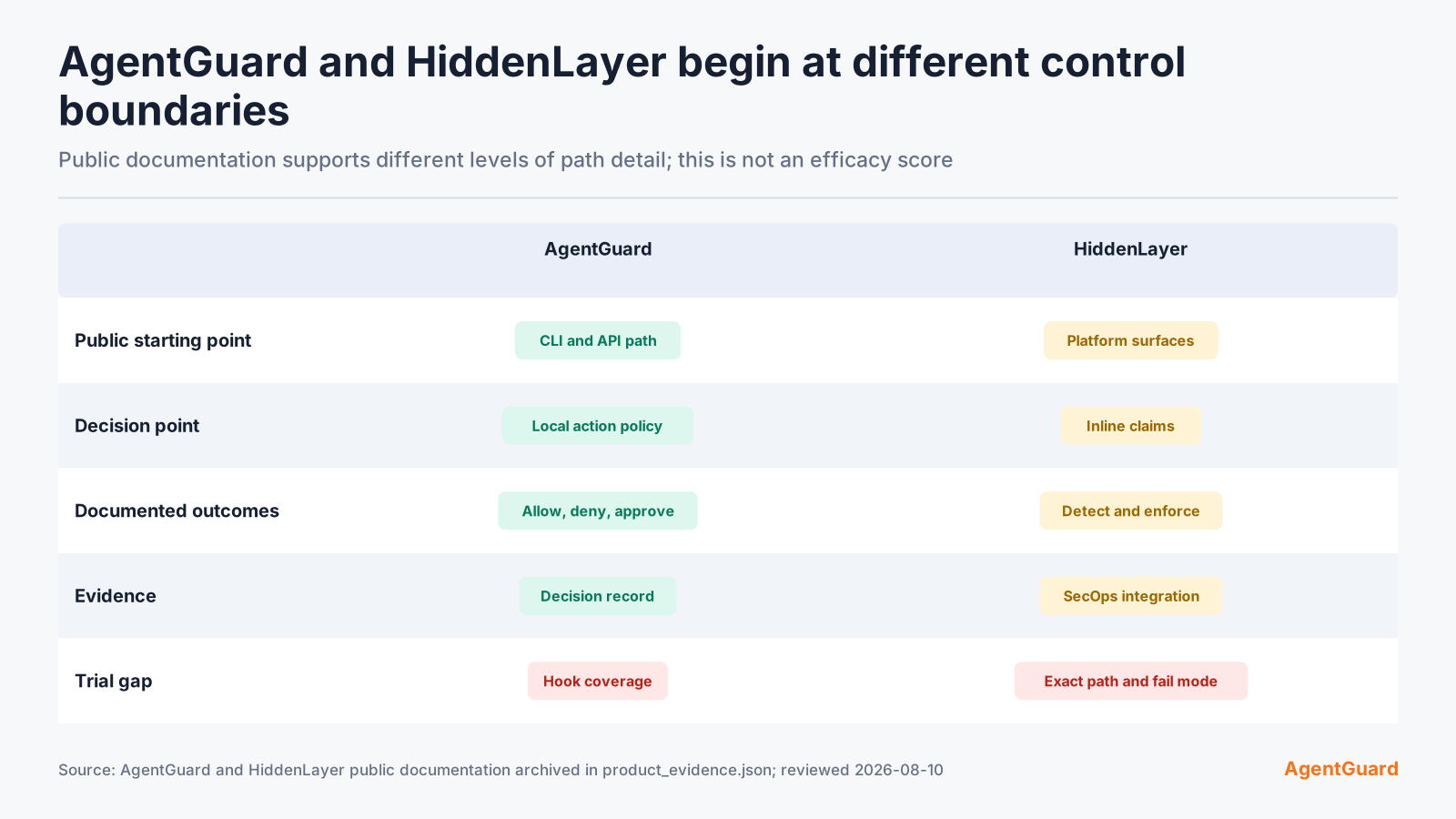
The matrix is a verification map, not a claim that the products have identical architectures. During a pilot, the team should replace every documented claim with an observed integration, decision, and evidence record.
MCP security is not one capability
An MCP security platform may review a server before use, inspect live protocol traffic, evaluate a tool action, or connect a suspicious event to a known threat. Those controls solve different problems. Counting them as one checked box hides the boundary that matters.
AgentGuard's public scan API names skills, tools, plugins, MCP servers, and agent code. Its runtime path then evaluates high-risk actions before execution. That creates a practical component-to-runtime sequence: review what enters the environment, choose a harmless failure case, and confirm the action decision separately. A clean component report is not a runtime allow decision, and a runtime block does not prove the component itself is safe.
HiddenLayer's Agentic and MCP Security page describes indirect prompt-injection detection, memory and context safety, tool and action inspection, and MCP traffic visibility. It also lists proxy, SDK, and gateway paths. This is stronger public evidence for live MCP traffic inspection across an application estate.
HiddenLayer separately documents model scanning for malware, vulnerabilities, backdoors, integrity, and genealogy. That is the clearer public fit when model files and model lineage are part of the immediate job. The reviewed AgentGuard pages do not establish equivalent model-weight or genealogy analysis.
The reverse gap should be phrased just as carefully. HiddenLayer's reviewed pages do not show a command-level scan flow for agent skills, plugins, tools, MCP server code, or agent code. A buyer should ask for that demonstration if those artifacts matter. The correct status is "not established in the reviewed pages," not "unsupported."
Teams comparing the wider market can use the current guide to MCP security tools to separate gateways, component scanners, traffic controls, and runtime enforcement before adding more vendors to the same shortlist.
What you can verify before a sales call
AgentGuard exposes the lower-friction first evaluation. A developer can start with a non-production agent, run the documented health checks, select a policy mode, and submit paired actions with expected outcomes. The result can be inspected before the team commits to an architecture workshop or procurement process.
That path also makes questions sharper. Which normalized arguments reached the guard? Which policy matched? Was the action allowed, denied, or held for approval? What redaction was applied before metadata left the environment? Did cached policy make the same decision after connectivity was removed?
HiddenLayer's public material prepares a different conversation. It gives the buyer a set of platform surfaces to map against the estate: runtime, MCP, models, discovery, attack simulation, and security operations. The evaluation should ask which integration mode applies to each application, where inline enforcement sits, which telemetry leaves the environment, and how an event becomes an operational case.
For a small team, public reproducibility matters because it cuts the cost of finding a bad fit. For a larger security program, broad integration and operating ownership may matter more. AgentGuard has the clearer public first mile. HiddenLayer presents the wider public map.
Put one disposable workflow behind the guard, run an allowed and a denied action, and open AgentGuard to inspect the result.
Keep these cells unknown until tested
Price, latency, and efficacy are not comparable from the current evidence. Neither is total deployment coverage. A number from one vendor, measured on one path under one load profile, does not become a two-product benchmark.
Keep these fields open in the evaluation sheet:
- Comparable price: use the same modules, protected workloads, traffic assumptions, support level, and contract term.
- Added latency: use the same action path, payload, region, decision mode, load, and percentile.
- Prevention quality: run a shared labeled case set and record false allows, false blocks, and approval outcomes.
- Integration coverage: observe every relevant shell, file, browser, network, MCP, model, and application path instead of accepting an adapter list.
- Data handling: record fields collected, local processing, redaction, region, retention, deletion, and subprocessors.
- Service-loss behavior: remove connectivity and observe the decision, evidence, recovery, and stale-policy behavior.
AgentGuard documents local decisions, redacted action metadata, and cached policy behavior. Those statements give it an evidence lead for the outage and data-flow questions, but they still need to be tested against the buyer's adapters and policy. HiddenLayer's reviewed pages do not establish the same details. Ask for architecture evidence and a controlled outage test rather than infer the answer.
The same restraint applies to scale. AgentGuard's command-level clarity does not prove estate-wide coverage or lower operating cost. HiddenLayer's broad platform map does not prove that integration is quick, that every path is inline, or that the resulting evidence is easier to investigate.
Run the same proof of concept on both
Use one bounded workflow for both products. Keep the agent, identity, tools, disposable targets, allowed actions, denied actions, approval case, and service-loss condition fixed. Write the expected result before each run. A vendor-specific demo can be useful later, but it should not replace the matched test.
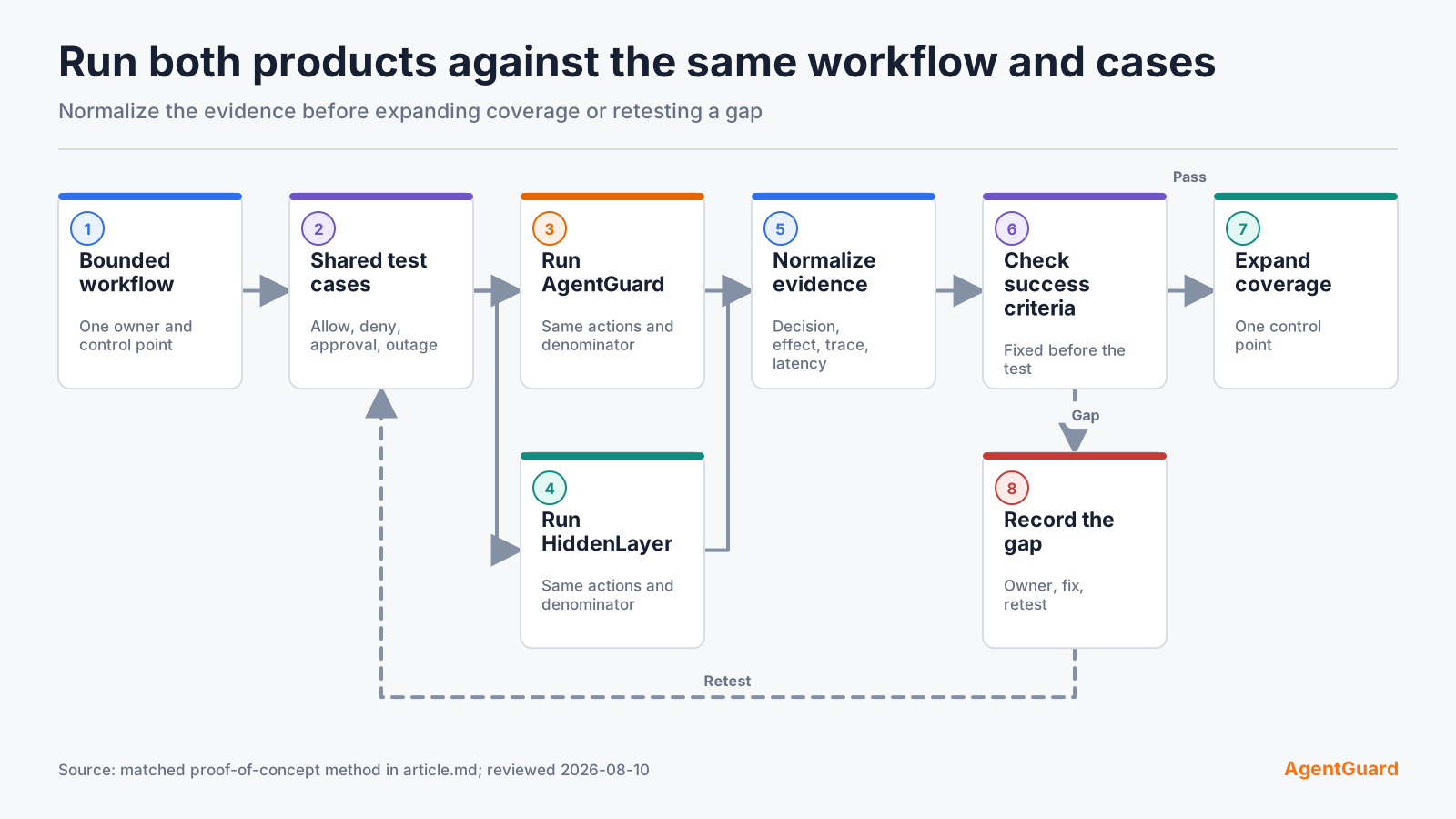
For each run, capture the proposed action, normalized arguments, actor or workload identity, policy or detector result, enforcement outcome, approval state, target outcome, timestamp, and investigation record. Then score the operating work: setup time, policy maintenance, alert routing, exception handling, evidence retrieval, and retest effort after a component or policy change.
The enterprise AI agent security practices guide provides a broader rollout frame, but the comparison should stay small at first. Expanding several agents or integrations at once makes a failed result hard to diagnose.
AgentGuard should enter this test with an advantage when the workflow is a developer agent and the buyer values local decisions, component scans, and public setup evidence. HiddenLayer should enter with an advantage when the test spans several AI applications, MCP traffic paths, model assets, and security-operations workflows. The test decides whether either advantage survives contact with the actual environment.
Do not award points for a feature name alone. Award them for an observed path, the expected decision, a usable record, and repeatable behavior after the workflow changes.
Bring the shared cases and success criteria to the evaluation, then book an AgentGuard demo against that same scorecard.
Frequently Asked Questions
Is AgentGuard better than HiddenLayer?
AgentGuard is the stronger public-evidence fit for a developer-led first test of local agent action control. HiddenLayer documents the broader enterprise platform across runtime, MCP traffic, model security, and security operations. Neither public evidence set supports a universal winner. Choose the first POC according to the control boundary you need to prove.
Is AgentGuard a HiddenLayer alternative?
Yes, when the buying job includes runtime control for developer agents, policy decisions before high-risk actions, agent-component scanning, and explainable evidence. It is not a like-for-like replacement for every HiddenLayer module. A buyer that needs model genealogy, broad AI asset discovery, or an estate-wide security-operations program should compare those scopes separately.
Does HiddenLayer support MCP security?
Its official material says it covers MCP and agentic traffic, indirect prompt injection, memory and context safety, tool and action inspection, and proxy, SDK, and gateway integration. A pilot should still verify the exact protocol, framework, tool path, enforcement outcome, and deployment mode used by the buyer.
Which product is easier to test from public material?
AgentGuard currently provides the clearer command-level route. The public steps cover installation, diagnostics, policy mode, a deliberate test, and result inspection, along with statements about local decisions and cached policy. That makes the first technical evaluation easier to reproduce. It does not by itself prove broader enterprise fit.
Test AgentGuard against your real agent workflow and evidence requirements.
Book Demo