
AgentGuard vs Noma Security: Compare the Control Boundary
Compare AgentGuard and Noma Security across component review, AI posture, runtime controls, evidence, deployment, and a matched proof of concept.
By Agent Guard Team13 min read
AgentGuard vs Noma Security: Compare the Control Boundary
AgentGuard and Noma Security document different ways to reduce risk in AI systems. The practical choice depends on whether your first priority is developer-level component and action control, broader AI asset posture, agent access governance, or an operating model that combines several of those jobs.
AgentGuard Team prepared this vendor-authored review from public product material checked on August 10, 2026. Every unsupported field remains unknown, and each vendor is evaluated through the same bounded workflow test.
Decision Snapshot
Start with the workflow you need to control. AgentGuard publicly documents a local guard for selected agent actions, a command-level setup path, and Deep Scan for skills, tools, plugins, MCP servers, and agent code. That makes it a concrete starting point for a developer or AppSec team that wants to inspect a component and test a pre-execution decision in a bounded agent workflow.
Noma Security publicly presents a wider enterprise AI security surface. Its AI Agent Security material describes discovery, posture management, access control, and runtime protection for AI agents. That makes Noma a relevant evaluation path when the immediate problem includes identifying AI assets, managing agent identities and access, and connecting agent risk to a broader security program.
| Evaluation need | AgentGuard public evidence | Noma Security public evidence | POC question |
|---|---|---|---|
| Developer-led first test | Public install, status, policy, test, and review flow | Public solution material; implementation details need confirmation | How quickly can the team produce one explainable allow and deny decision? |
| Component review | Skills, tools, plugins, MCP servers, and agent code are named | AI-SPM and agent discovery are described | Which artifacts and relationships appear in the result? |
| Runtime action control | Selected shell, file, tool, network, secret, write, and browser actions are named | Runtime protection and agentic access control are described | Which exact execution paths cross an enforcement point? |
| Estate visibility | OpenClaw Patrol is documented within a bounded workspace scope | Broader AI asset discovery and posture are documented | Which assets, owners, identities, and dependencies can be inventoried? |
| Price, latency, and efficacy | Unknown on an equivalent basis | Unknown on an equivalent basis | Can both vendors test the same scope and measurement method? |
Public documentation can define the first test. It cannot settle production fit without architecture, data-flow, operating-effort, and coverage evidence from the buyer's environment.
Evidence Rules for This Comparison
The comparison uses equivalent questions for both products: what is protected, where a decision occurs, how a control is deployed, what evidence it returns, what data crosses a boundary, and which limitations are explicit. AgentGuard sources include its homepage, Quickstart, API reference, and AgentGuard implementation documentation. Noma sources include its AI Agent Security, AI-SPM, Agentic Access Control, and Runtime Protection pages.
An empty public field is recorded as unknown. It does not mean the product lacks the capability. Pricing, coverage rate, added latency, false-positive rate, data retention, support scope, and roadmap are excluded unless the vendors provide comparable, current evidence.
Feature labels are also excluded from scoring. Two vendors can use the same phrase for controls placed at different points in a workflow. The test must trace the request from the agent through the integration and policy decision to the downstream effect.
Public-Evidence Matrix
| Field | AgentGuard | Noma Security | Evidence status |
|---|---|---|---|
| Primary documented object | Developer-agent components and selected proposed actions | AI assets, agents, identities, access, and runtime activity | Publicly documented at different scopes |
| Pre-runtime surface | Deep Scan for named agent component types | AI-SPM and agent discovery/posture | Similar lifecycle stage, different documented objects |
| Runtime entry | Local guard and runtime evaluation API | Agentic access control and runtime protection | Exact adapter coverage requires testing |
| Decision outcomes | Public material describes policy decisions before selected actions | Public material describes access and runtime controls | Normalize allow, deny, approval, and evidence in the POC |
| Operating evidence | Activity and audit-oriented metadata are described | Posture, access, and runtime visibility are described | Field-level parity is unknown |
| Data boundary | Local decisions, redacted metadata synchronization, and cached policy are documented | Deployment, collection, retention, and residency details require matched review | Incomplete public parity |
| Explicit limit | Host depth varies; universal third-party MCP interception is not documented | Public pages do not establish every integration or action path | Test every required path |
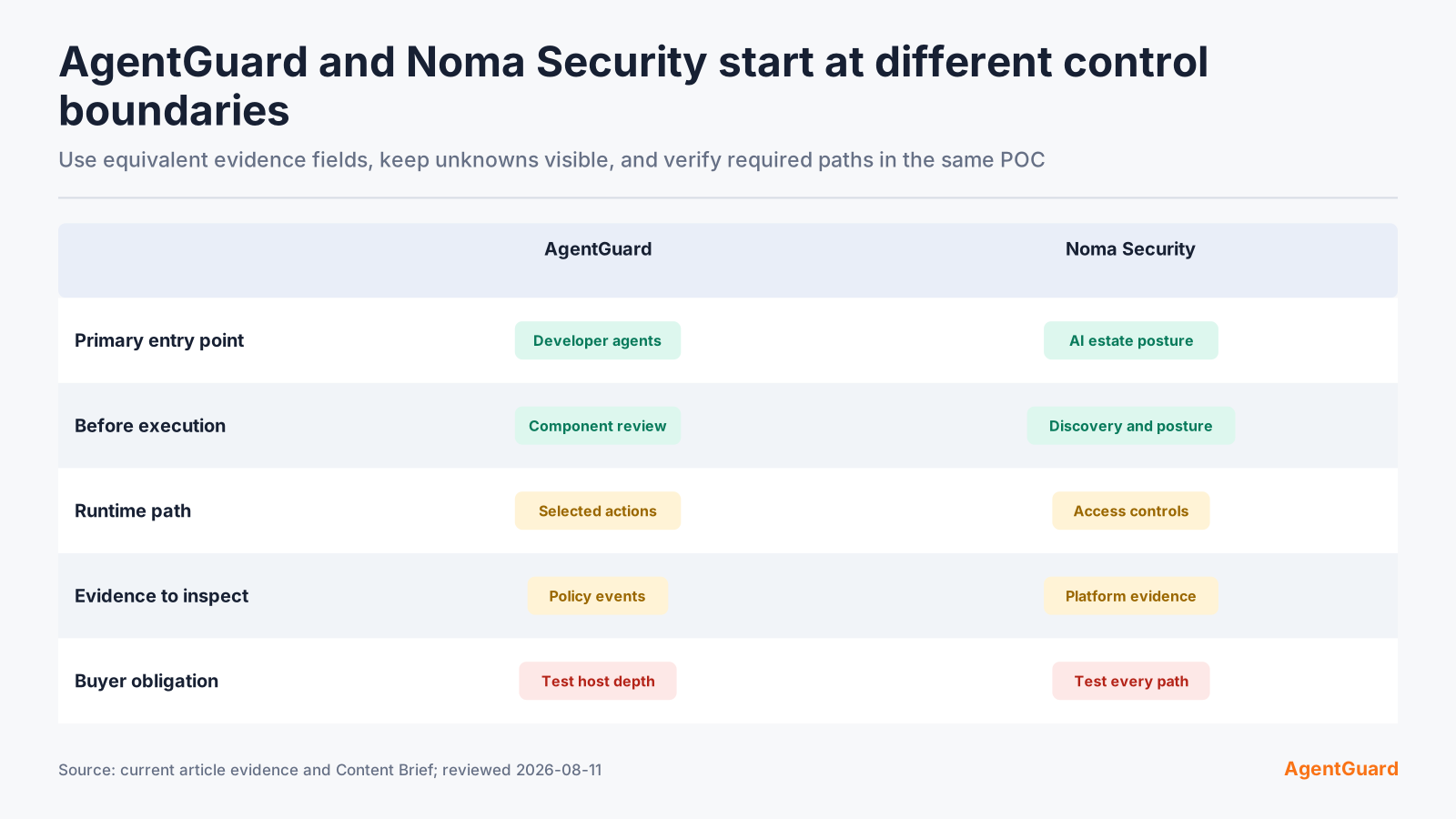
This matrix is a map of current public evidence. It should become a buyer-maintained evidence sheet during procurement, with source dates and links attached to each cell.
Compare What Happens Before Execution
Components and supply-chain inputs
AgentGuard Deep Scan is described as examining skills, tools, plugins, MCP servers, and agent code for risks such as malicious tools, prompt injection, credential exposure, and backdoors. That is useful at admission time: before a component enters a trusted agent environment, a team can inspect it and decide whether to allow, remediate, isolate, or reject it.
A component result does not prove runtime safety. Configuration, credentials, arguments, retrieved content, and downstream permissions can change after admission. Treat scan evidence as one input to the release decision and pair it with action-time tests.
AI asset and posture visibility
Noma's public AI-SPM and agent security positioning addresses the broader problem of discovering AI assets and relationships, identifying posture issues, and bringing agents into security oversight. This can matter when no single development team has a complete inventory of models, applications, agents, identities, and services.
The buyer should ask what creates an asset record, how ownership is inferred, how stale assets are handled, and which cloud, SaaS, development, and runtime sources are supported. Discovery quality should be tested against a known inventory rather than judged by a dashboard count.
What neither public source proves
Public pages do not prove complete coverage of a specific estate. Run a seeded discovery test with known assets and known blind spots. For components, submit the same harmless skill, plugin, or MCP server and compare the evidence returned. For posture, verify whether the result identifies the owner, environment, identity, dependency, and remediation path the operating team actually needs.
Trace Runtime Control and Access
Decision entry point
AgentGuard describes a local guard that evaluates selected high-risk actions before execution. Its public surfaces name shell commands, file access, tool actions, network requests, secret access, sensitive writes, webhook exfiltration, and browser actions. The important qualifier is integration depth: every host and adapter must be verified, because an action that bypasses the instrumented path cannot be stopped by that decision point.
Noma describes Agentic Access Control and Runtime Protection. Its Runtime Protection page should be read as the vendor's current first-party scope statement, then tested against the buyer's actual agent, identity, tool, and target. Ask whether the decision is inline, which context reaches it, and which side effects can still occur through alternate paths.
Policy and approval
Normalize policy tests around outcomes. Use a low-impact allowed action, an unauthorized destination, a high-impact but harmless analogue, and an approval case. Record the effective identity, normalized arguments, policy version, decision, reason, approval state, and final target state.
A policy console is not proof of enforcement. The denied case passes only when the downstream side effect did not occur and the evidence shows that policy caused the stop.
Evidence after the decision
An investigator should be able to answer who initiated the action, which agent and tool were involved, what target and arguments were evaluated, which rule applied, what decision was made, and whether execution happened. Compare field completeness, redaction, searchability, export, retention, and correlation with existing systems.
Residual paths
Map direct API calls, shell wrappers, browser automation, MCP tools, SDK adapters, background jobs, and human fallbacks. A business action may have several technical paths. Coverage is established per path, and every uncovered path needs a compensating control or an accepted risk owner.
Evaluate Deployment and Operating Fit
Deployment model
AgentGuard's public quickstart supports a developer-led evaluation and describes local decision-making. Verify supported host depth, policy distribution, upgrade behavior, offline behavior, and the effort to operate the guard across teams.
For Noma, request an architecture specific to the target environment. Confirm which connectors, collectors, gateways, or agents are required; where each component runs; and which product modules are necessary for discovery, access control, and runtime protection.
Data path and retention
AgentGuard states that local mode does not upload full code, prompts, secrets, or file contents, and that cloud-connected operation may synchronize sanitized or redacted action metadata and audit events. These statements still require field-level validation, retention terms, region, deletion behavior, and legal review.
Ask Noma the same questions with the same sample event. Compare raw inputs, transformed fields, sensitive values, storage locations, retention, access controls, subprocessors, deletion, and incident response.
Policy administration
Measure ownership and maintenance. Determine who writes policy, who approves exceptions, how versions are rolled back, how stale approvals expire, and how changes are tested. A control that depends on one specialist for every update may not fit a fast-moving agent program.
Pricing and support
Comparable public pricing is unknown. Request quotes against the same agents, assets, environments, events, modules, retention, support, and contract term. Keep professional services and integration effort visible instead of folding them into an undefined platform price.
Unknowns the Buyer Must Resolve
Neither public evidence set supports a universal winner. The following fields require direct confirmation: complete adapter coverage, discovery recall, policy decision accuracy, added latency, retention and residency, scale behavior, bypass handling, support response, and total cost.
AgentGuard should not be presented as organization-wide AI asset discovery based on its current public material. Noma should not be credited with a specific developer-level interception path merely because a broad runtime capability is named. Preserve both boundaries in the final evaluation record.
Build a Noma-versus-AgentGuard POC
Map the integration
Choose one non-production agent workflow with a real identity pattern and disposable targets. Draw every path to files, shell, browser, network, SaaS, MCP, and internal APIs. Mark where each product observes, evaluates, blocks, approves, and records the action.
Execute common cases
Run at least six cases: a known-safe action, malformed arguments, unauthorized data access, a blocked destination, a consequential action requiring approval, and an alternate-path bypass attempt. Write the expected decision and target state before execution.
Inspect evidence
For every case, retain setup time, decision result, policy reason, actor and agent identity, normalized action, approval state, target outcome, data sent outside the environment, and troubleshooting effort. Repeat a case after a policy or component change to measure retest cost.
Record gaps and effort
Use pass, partial, fail, and unknown. Do not convert unknowns to zero. Record uncovered paths, missing fields, manual steps, false decisions, operating owners, and remediation commitments with dates.
Define acceptance criteria before vendor access
Write mandatory criteria before either vendor configures the environment. This prevents a polished demo from redefining success. Mandatory criteria might include interception of every production-relevant adapter, an approval path that binds to exact arguments, a documented data boundary, and an event that correlates with the target outcome. Desirable criteria might include a specific dashboard view or a shorter setup time.
For discovery and posture, seed the environment with known objects: an approved agent, an unregistered test agent, a stale service identity, a reviewed MCP server, and a harmless component change. Record which objects should be found and what relationship or owner should appear. A count without a known denominator cannot establish discovery quality.
For runtime control, define a paired case for each required action class. The safe case should complete under the intended identity. The risky analogue should be stopped or parked before the disposable target changes. Include one request with valid syntax but an unauthorized target, because schema validation alone cannot detect that boundary.
Set stop conditions. End the POC if either product requires production credentials for a basic test, sends prohibited data outside the environment, cannot prevent a mandatory high-impact path, or cannot produce enough evidence to distinguish enforcement from tool failure. A stop condition is more useful than averaging a critical failure into a score.
Compare operating evidence over time
Repeat the test after changing a component, policy, identity, and integration. Measure whether the platform detects or receives the change, whether previous approvals remain valid, which cases must be rerun, and how investigators compare the old and new decisions.
Run an outage case as well. Disconnect the cloud-facing service or simulate an unavailable control dependency in a vendor-supported way. Observe whether policy continues from cache, fails closed, fails open, queues work, or loses only central visibility. Record recovery behavior and event reconciliation after connectivity returns.
The final POC record should include architecture, versions, policies, sample inputs, expected results, observed results, screenshots where useful, machine-readable events, target-state evidence, data-flow notes, uncovered paths, operating time, and vendor responses. This package lets another reviewer reproduce the decision after the demo team has left.
Book an AgentGuard Demo for the same bounded workflow, then require the equivalent Noma test against the shared scorecard.
Match the Product to the Workflow
AgentGuard offers a concrete public starting point for teams focused on named agent components and selected pre-execution actions. Noma presents a broader public story around AI discovery, posture, agent access, and runtime protection. Those starting points narrow the shortlist; the shared POC establishes fit.
Refresh every first-party source before a purchasing decision. Product scope changes quickly, and a current architecture or demonstration may resolve an unknown that public pages leave open.
Procurement should carry the evidence into contract review. Define the covered assets and adapters, required data handling, support expectations, incident notification, retention and deletion, change notice, and the acceptance test for renewal. Marketing terms such as "runtime protection" or "AI agent security" should not replace the tested workflow and documented responsibility.
Use AI agent security control layers to explain the decision internally: component admission, identity, execution permission, action policy, downstream authorization, and evidence. Then map AI CISO platform responsibilities to the teams that will operate discovery, assessment, control, investigation, governance, and retesting. These two views prevent procurement from treating platform breadth as a substitute for an effective control on the required path.
Before rollout, review the result with developers, platform owners, security operations, identity, data governance, and the business owner. Confirm who maintains integrations, who approves policy exceptions, who investigates events, and who accepts each uncovered path. Repeat the POC with an operator outside the vendor-assisted team; a result that only specialists can reproduce may be difficult to sustain.
The final decision can be conditional. A buyer may select one product for a bounded developer workflow while continuing a separate evaluation for estate discovery or workforce AI use. Record the boundary explicitly so a successful pilot does not become an unsupported claim of organization-wide coverage.
Schedule a source and evidence refresh before renewal. Confirm that the tested integrations, data terms, policy behavior, product modules, and support commitments still match production. Rerun the cases affected by change and update each accepted residual risk with a current owner.
Keep the unsuccessful cases too. A failed integration, missing identity, uncovered path, or ambiguous event is evidence about implementation risk and operating cost. Preserve the original expectation, vendor explanation, remediation, and recheck result so later reviewers can distinguish a closed issue from one removed from the final presentation.
The defensible choice is the product whose verified boundary matches the required workflow and whose remaining gaps have explicit owners. Revisit that choice when the workflow expands beyond the tested assets, identities, or actions.
Frequently Asked Questions
Is this an independent AgentGuard and Noma Security comparison?
No. AgentGuard publishes it. The method uses equivalent fields, first-party sources, explicit dates, visible unknowns, and a common POC so readers can verify the conclusions.
Do AgentGuard and Noma Security cover the same AI security surface?
Their public materials overlap in agent security but describe different scope and entry points. Compare the exact assets, identities, actions, integrations, and evidence required by your workflow.
Does unknown mean a capability is missing?
No. It means the reviewed evidence does not establish the field. Ask the vendor for current documentation or prove it in the POC.
Which deployment and data questions should buyers ask?
Ask where controls run, what data they receive, which fields leave the environment, where data is stored, how long it is retained, how deletion works, and what happens during service loss.
What makes a fair AI agent security POC?
Use the same bounded workflow, identities, targets, allowed and risky cases, expected outcomes, data questions, and evidence scorecard for both products.
Compare AgentGuard and Noma Security against one control boundary with a matched workflow demonstration.
Book a Demo