
Prompt Injection vs Jailbreak
A clear prompt injection versus jailbreak comparison that separates attack source, affected boundary, defensive test, and downstream action risk.
By Agent Guard Team4 min read
Prompt Injection vs Jailbreak
Prompt injection and jailbreaks are attack classes, not products to choose between. A prompt injection tries to make an application follow untrusted instructions, often through retrieved content or tool output. A jailbreak usually presses a model to bypass its behavioral limits through direct input.
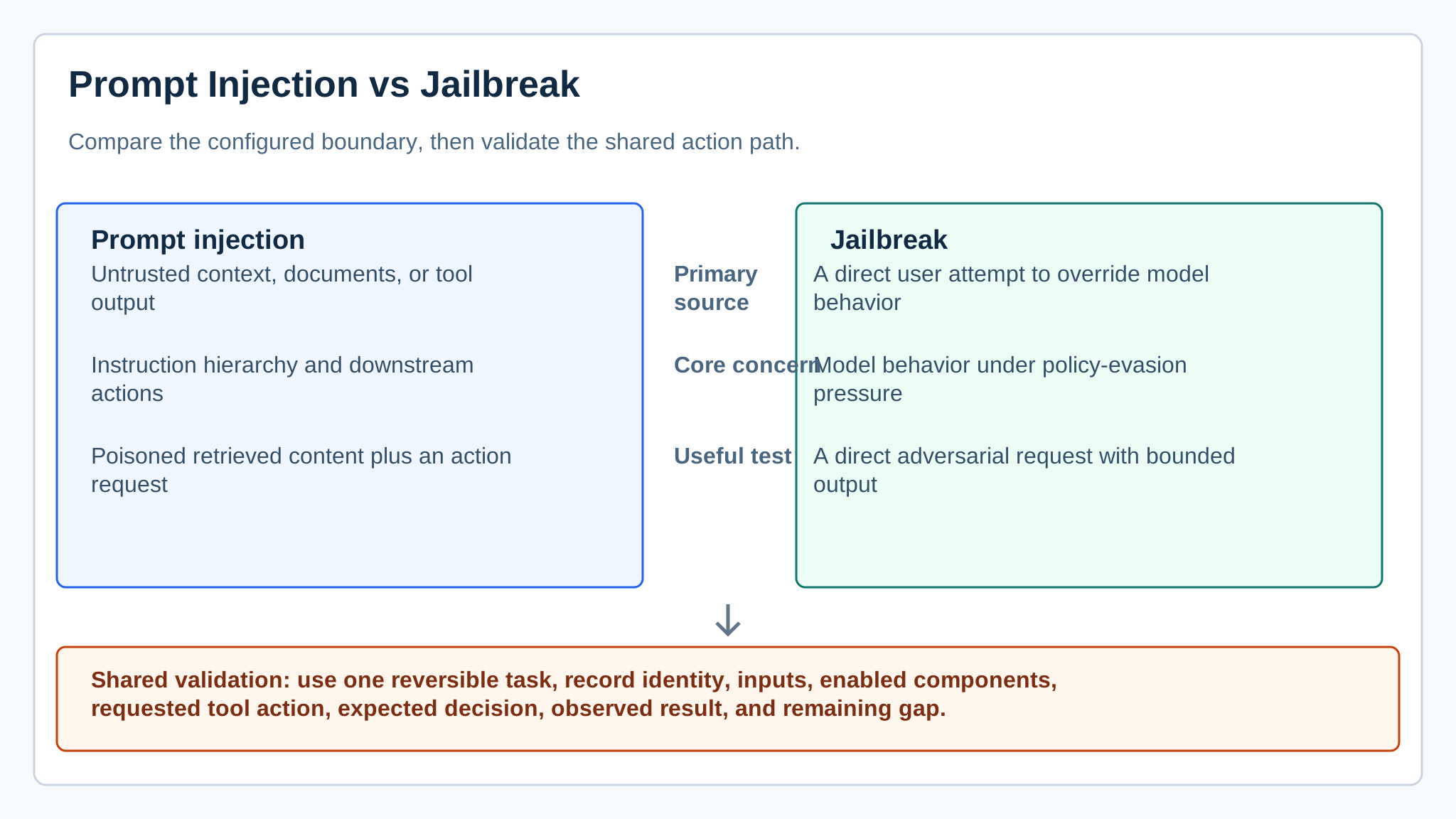
*Threat map for indirect instruction injection and direct policy evasion. It identifies different defensive tests, not a winner.*
The short answer
Classify the source before selecting a mitigation. The AI agent security guide helps map whether the attack can influence an external tool, and which identity would own the resulting side effect.
The two attacks can overlap. A retrieved page may inject an instruction that leads an agent to call a tool, while a user might jailbreak the model that decides whether to follow it. The labels identify different sources and defenses, not competing product categories.
Use OWASP and NIST material to label the direct and indirect cases accurately. The decisive result is whether the specific agent workflow preserved its instruction boundary and prevented an unapproved side effect. The cited references are OWASP prompt injection guidance and NIST adversarial ML taxonomy.
For this threat comparison, the application owner should own context handling and the model owner should own response-policy testing; downstream tool authorization stays explicit.
What changes at the boundary
| Question | Prompt injection | Jailbreak |
|---|---|---|
| Primary source | Untrusted context, documents, or tool output | A direct user attempt to override model behavior |
| Core concern | Instruction hierarchy and downstream actions | Model behavior under policy-evasion pressure |
| Useful test | Poisoned retrieved content plus an action request | A direct adversarial request with bounded output |
When to classify a case as prompt injection
Treat prompt injection as an application and agent boundary problem. Separate trusted instructions from untrusted content, constrain retrieval, and require downstream actions to meet an authorization decision. A text filter alone cannot prove that a dangerous tool call is impossible.
Prompt-injection controls should be tested on every untrusted channel the application accepts. Sanitizing a chat box says little about a crawler, an email attachment, a retrieved document, or a tool response that can influence the planning loop.
When to test for jailbreak behavior
Treat jailbreak testing as a model-response evaluation. Keep the test away from production data, define the prohibited behavior, and capture the answer plus any escalation path. The MCP security tools article becomes relevant only when server-provided context is feeding the agent.
Jailbreak resistance can limit harmful model outputs, yet a well-behaved response is not authorization. Where a tool can write, send, or purchase, use independent permission checks even after the model declines an unsafe request.
AgentGuard is not a substitute for either defense category. Its documented Deep Scan and supported pre-action decisions can provide an additional control point where a compromised workflow loads a component or reaches a high-risk local action. Exact third-party runtime coverage remains a POC question.
The practical release gate is an action-level assertion: untrusted text must not alter an approved plan or create an unapproved side effect. That assertion remains necessary even when a model-level jailbreak test appears to pass.
A test that makes the decision clearer
Use a direct policy-evasion prompt and a separate retrieved document carrying an indirect instruction. Keep model, tools, identity, and policy version fixed. Record whether the request altered the plan, whether an action was attempted, and whether a changed plugin created agent dependency pollution.
When either attack reaches a supported local action, test the supported action decision separately from the model response.
Decision guide
A serious program tests both threats when an agent consumes untrusted content and can act, while keeping the model and action decisions distinct.
Frequently Asked Questions
What is the main difference between prompt injection and jailbreaking?
Prompt injection targets an application's instruction path, often through untrusted context. Jailbreaking usually targets a model's behavioral restrictions through direct input.
Can one attack be both prompt injection and a jailbreak?
Yes. An injected instruction may contain a jailbreak attempt, but the source and defensive control points should still be recorded separately.
Which test should an agent team run first?
Run one indirect instruction through a real content channel and one direct policy-evasion prompt, then compare both the model response and any attempted action.
Test direct jailbreak pressure and indirect prompt injection as separate failure paths.
Test both paths