
AI Runtime Security Tools: Choose by What They Can Actually Control
Compare seven AI runtime security tools by enforcement point, documented scope, best fit, and the POC needed to verify agent action control.
By Agent Guard Team18 min read
AI Runtime Security Tools: Choose by What They Can Actually Control
Calling a product runtime security does not tell you whether it can stop a prompt, a model response, a network request, or the agent action that causes the side effect.
The best AI runtime security tools are the ones whose enforcement point matches the path you need to control. AgentGuard publishes this guide and is included for its documented local pre-execution checks on supported agent actions; the other products cover broader interaction, model, platform, or gateway boundaries.
Runtime security starts with the enforcement point
That distinction matters more than a feature count. A prompt filter can reject malicious input without seeing a later shell command. A model monitor can find suspicious behavior without being able to pause a tool call. A gateway can apply policy to traffic that passes through it, while a local agent may still have another route to a file, browser, or terminal. The shortlist below treats those products as different controls, not interchangeable entries in a ranking.
Runtime security is the control applied while an AI application or agent is operating, rather than only during design, testing, or component review. The useful question is not whether a vendor uses the word runtime. It is what the product can observe, what decision it can make, and whether that decision happens before or after the risky side effect.
The wider program still needs ownership, least privilege, component review, incident response, and change control. Those responsibilities are covered in our guide to enterprise AI agent security practices. This article stays on the narrower buying decision: where a runtime product sits in the execution path.
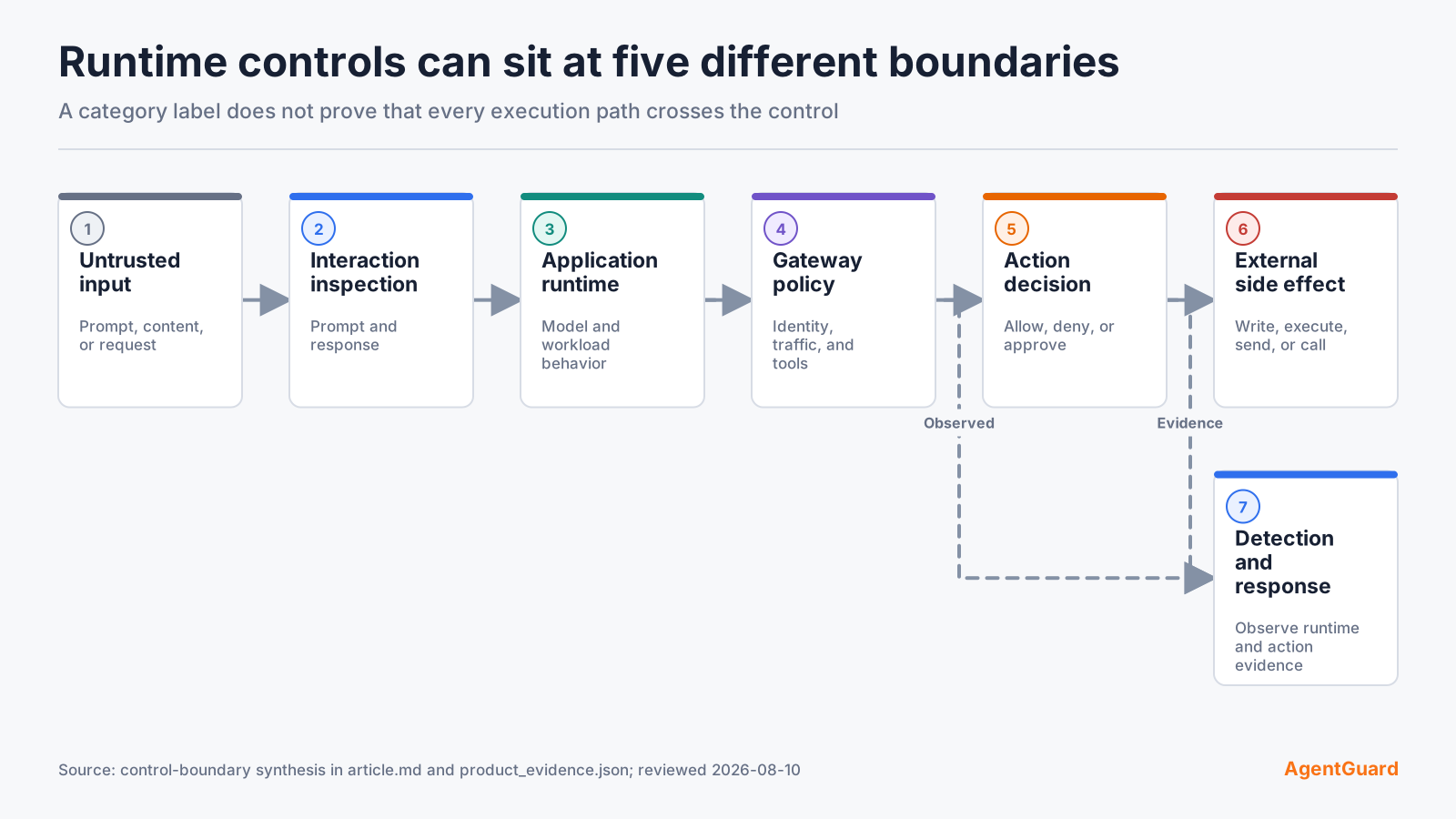
Figure 1. Runtime controls can sit at several boundaries. A vendor category name does not prove coverage across every box.
Four control boundaries that are easy to confuse
1. Prompt and response inspection evaluates the content entering or leaving a model. It can detect prompt injection, unsafe content, sensitive data, or policy violations. This boundary is important, but it does not automatically control every tool or operating-system action that follows.
2. Model and application runtime protection watches live AI interactions, model behavior, application traffic, or workload signals. Depending on the integration, it may detect or block malicious content and suspicious runtime behavior. Buyers still need to establish whether the product acts inline, alerts after observation, or does both.
3. Gateway, identity, and tool policy governs access to models, data, APIs, or MCP tools. This is a strong point for centralized rules and telemetry. Its practical boundary is the traffic that actually traverses the gateway or identity control.
4. Pre-execution action control evaluates a consequential operation immediately before it runs. Examples include a shell command, browser action, file write, secret read, network request, or MCP tool call. This is the boundary to test when the requirement is "stop this action before it changes the environment."
These boundaries should be connected, but they answer different questions. The OWASP AI Agent Security Cheat Sheet likewise treats agent security as a set of controls across inputs, tools, permissions, memory, monitoring, and human oversight. A buyer should ask a vendor to name the implemented boundary instead of accepting a broad platform label.
Detection and prevention also need separate proof. An alert created after a database write is useful for investigation, but it is not the same control as a deny decision made before the write. Likewise, a failed action does not prove policy enforcement. The cause could be a broken credential, an unavailable service, or a bad integration. A valid test records the expected decision, the observed side effect, and the evidence trace.
The shortlist, at a glance
This is not an absolute ranking. It is a shortlist of seven current products with accessible first-party evidence reviewed on August 10, 2026. Public product pages establish documented scope, not independent efficacy. Pricing, universal latency, false-positive rates, and like-for-like coverage are unknown unless a buyer measures them in a controlled POC.
| Tool | Primary documented control point | What the public evidence says it can do | Best fit | What to validate |
|---|---|---|---|---|
| AgentGuard | Local pre-execution agent actions plus component scanning | Apply policy before supported risky actions, allow, block, or request approval, keep an evidence trail, and scan agent components | Developer and security teams controlling shell, MCP, browser, file, network, secret, and sensitive-write paths | Framework coverage, bypass paths, outage behavior, and the exact metadata sent to cloud services |
| Lakera AI Agent Security | Agent discovery and runtime interaction/action enforcement | Discover agents and MCP-connected systems, assess tools and access, and enforce guardrails against prompt attacks, leakage, unsafe tools, and unauthorized actions | Enterprises seeking one agent-lifecycle view across custom, cloud, and low-code environments | Connector coverage, the decision point for each action type, and trace detail |
| Prompt Security by SentinelOne | Workforce, application, and agent AI usage | Discover shadow AI, enforce usage policies, and apply runtime protection across employee tools, homegrown apps, and agents | Organizations consolidating broad AI usage controls into an enterprise security platform | Which autonomous actions are stopped before execution and which controls operate on content or traffic |
| Prisma AIRS AI Runtime Security | AI interaction traffic across apps, models, users, agents, plugins, and external systems | Inspect prompts, responses, and data flows; block named AI threats; expose discovery, session, violation, and policy views | Enterprises that want broad AI runtime protection inside a larger platform | Agent tool-call enforcement, deployment path, bypasses, and performance in the actual stack |
| HiddenLayer AI Runtime Security | Continuous runtime monitoring, detection, and inline protection | Provide agentic visibility, threat detection, inline protection, harness security, and security-operations integration | Teams connecting runtime AI signals to a broader model and SecOps program | Which decisions are inline, supported integration paths, and evidence available for each blocked action |
| Mindgard Defend | Runtime monitoring across prompts, responses, and agent actions | Detect malicious behavior, use red-team intelligence, automate response, and apply context-driven guardrails | Teams that want runtime defense informed by reconnaissance and adversarial testing | Accuracy on the buyer's workloads, response timing, automated remediation scope, and rollback behavior |
| TrueFoundry AI Gateway | Central model, request, and MCP traffic | Apply access, quota, metadata, OAuth2, RBAC, observability, and configurable guardrail policy in a central gateway | Platform teams already centralizing model access and MCP integrations | Direct SDK, local tool, and alternate network paths that can bypass the gateway |
The correct shortlist may contain more than one row. If prompt injection is the main risk, an interaction guardrail may be the first control. If the costly failure is an agent changing production, the POC must include the final action path. If both are material, test how the two decisions and evidence records work together.
Tools that can govern agent actions and interactions
Start this group when the requirement includes what an agent can call or do. Model output alone is too narrow. The products still differ in breadth and deployment model, so the diagram is a routing aid rather than a scorecard.
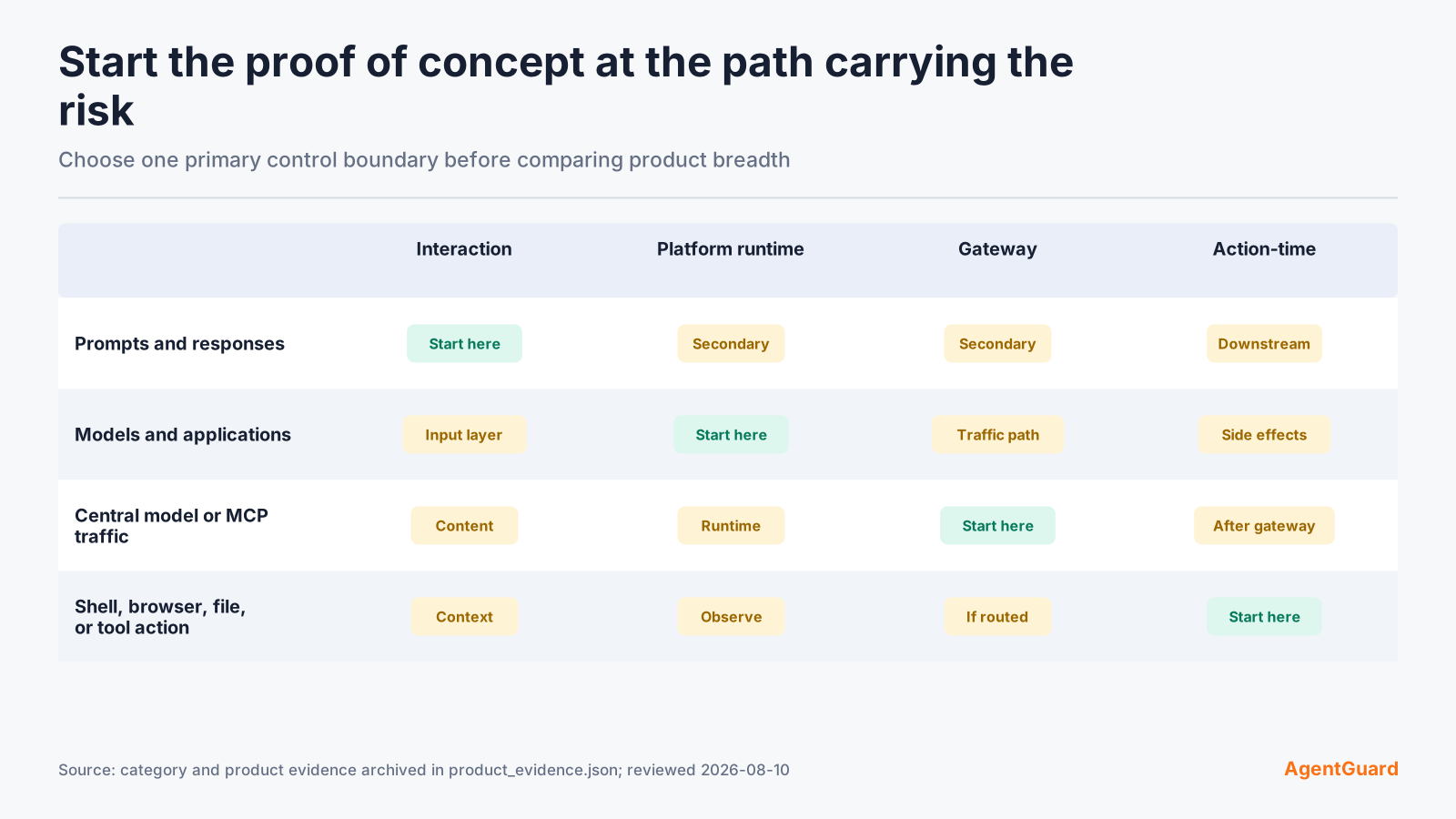
Figure 2. Choose the first POC candidate from the path that carries the side effect, then run the same verification contract.
AgentGuard
AgentGuard is the most direct fit in this shortlist when the requirement is a local policy decision immediately before an observable high-risk action in a supported agent environment. Its public documentation says connected local guards enforce policy before risky actions. A decision can allow the action, deny it, or require approval. That boundary is narrower and more concrete than a general claim to monitor agent behavior.
The runtime control is paired with an evidence path. AgentGuard's Quickstart asks the operator to trigger a deliberate test action and then inspect the decision, risk score, and triggering reasons in Live Activity. The documentation also says policy decisions happen locally, only redacted action metadata is synchronized to the cloud view, and cached policy is used during a cloud outage. Those are testable statements about decision location, fallback, and data handling.
AgentGuard also covers a separate pre-runtime question. Its API documentation describes scanning skills, tools, plugins, MCP servers, and agent code before those components enter a runtime. This matters because runtime policy cannot make a malicious or overprivileged component trustworthy. Teams evaluating MCP security tools should test both the component review and the tool-call execution path.
The advantage is specific: AgentGuard documents pre-execution checks for shell commands, MCP tools, browser actions, file and network activity, secret access, and sensitive writes, while keeping the decision local. It does not follow that every framework or custom execution path is intercepted automatically. The POC should enumerate all adapters and direct calls, then prove that each intended path reaches the policy decision. AgentGuard is the publisher of this article, so treat these first-party claims as inputs to that test, not as an independent award.
Best fit: a team operating coding agents, MCP-connected assistants, or other tool-using agents that needs a clear allow, deny, or approval decision before a supported local side effect.
Lakera AI Agent Security
Lakera's current AI Agent Security page describes a broader lifecycle: discover the agent landscape, assess risk across tools, data access, MCP servers, and autonomy, then enforce protection in real time. It names prompt attacks, data leakage, unsafe tool use, and unauthorized agent actions among the conditions its controls address.
That breadth can reduce the number of disconnected views a security team needs during discovery and policy design. It also means the POC must move past the category promise. For each representative agent, ask which connector sees the input, which component makes the allow or block decision, and whether a tool or action can run through another path. Then verify what evidence remains after a block or approval.
Lakera is a stronger first candidate than a narrow prompt-only filter when the team needs discovery and runtime policy across several enterprise agent environments. AgentGuard is a more focused candidate when the first requirement is a local pre-execution decision around supported developer-agent actions. A buyer may need both types of control if an enterprise interaction layer and a local execution layer carry different risks.
Best fit: an enterprise seeking agent discovery, posture context, and real-time protection across custom, cloud, low-code, and MCP-connected systems.
Prompt Security by SentinelOne
Prompt Security now appears on SentinelOne's platform as coverage for workforce AI use, homegrown applications, and autonomous agents. The public page describes shadow-AI discovery, policy enforcement, compliance controls, and live runtime enforcement across these touchpoints.
This is useful when the program begins with a visibility problem that spans employees and developers as well as production agents. A single enterprise view can expose unsanctioned tools and common policy gaps that a local action guard would not discover on its own. The trade-off is not a proven product weakness; it is an evidence question. The broad public page does not establish the exact pre-side-effect boundary for every autonomous action a buyer may care about.
The POC should therefore separate three cases: sensitive content moving through an AI service, an application request moving through the protected runtime path, and an agent invoking a consequential tool. Record whether each case is blocked inline, creates an alert, requests approval, or remains outside the integration. This prevents broad platform coverage from being mistaken for identical control depth at every touchpoint.
Best fit: organizations that want enterprise-wide AI usage, application, and agent controls integrated into the SentinelOne security platform.
Tools for platform-wide runtime detection and protection
This group foregrounds live AI traffic, models, applications, and runtime behavior. These platforms can be a better starting point when security teams need broad discovery and detection across production AI. They still need an action-path test when an agent can change an external system.
Input attacks remain part of the problem. A concise definition of prompt injection helps teams write the input-side test, but the POC should continue through the tool call and side effect rather than stopping at the model response.
Prisma AIRS AI Runtime Security
Palo Alto Networks describes Prisma AIRS AI Runtime Security as protection for applications while they execute. Its public page says the product monitors prompts, responses, and data flows across apps, models, users, agents, plugins, and external systems. It names prompt injection, malicious URLs, and poisoned content as threats it can detect and block.
The product page also exposes the operational model: discovery of AI applications and communication paths, session and violation views, blocked-prompt detail, and policy management. That makes Prisma AIRS relevant to teams that need a platform view of live AI interactions rather than a stand-alone guardrail.
The validation question is where interaction protection ends and action enforcement begins in the buyer's architecture. If an agent invokes a database operation, shell command, browser workflow, or local tool after the inspected model exchange, the POC must show whether Prisma AIRS remains inline for that action. If it does not, pair the platform with a control at the final execution point.
Best fit: enterprises seeking broad interaction inspection, policy, and runtime visibility within the Prisma AIRS platform.
HiddenLayer AI Runtime Security
HiddenLayer's current runtime page describes continuous visibility, agentic threat detection, automated protection, inline protection, agent harness security, and integration with security operations. It also frames prompt injection, sensitive-data exposure, and unsafe agent actions as runtime risks.
This scope is attractive when the security program already spans model discovery, supply-chain checks, attack simulation, runtime detection, and SecOps response. The runtime product can become one part of that larger operating model instead of an isolated console.
The public page does not provide a universal comparative benchmark for accuracy, latency, or the exact inline boundary of every integration. Those values should remain unknown until tested. Ask HiddenLayer to show the specific control object, decision timing, protected runtime path, evidence record, and response when its service or connector is unavailable. A generic demo of an alert is not enough if the requirement is prevention.
Best fit: security teams that want AI runtime signals and inline controls connected to model security and their existing incident workflow.
Mindgard Defend
Mindgard says Defend continuously monitors prompts, responses, and agent actions. Its product page describes runtime detection and response informed by reconnaissance and adversarial testing, automated response workflows, remediation guidance, and guardrails based on runtime context, risk score, and user intent.
The connection between pre-production testing and live defense is the useful part of this model. A red-team finding can become a production test case rather than a report that ages on a drive. Teams with custom models or domain-specific attack paths may value that feedback loop more than a broad enterprise AI inventory.
The buyer still needs independent success criteria. Do not accept an accuracy or speed claim from any vendor as a transferable result. Build tests from the organization's own prompts, response policies, tools, and agent actions. Verify which response is automatic, which needs a human, whether remediation can be reversed, and what evidence reaches the incident system.
Best fit: teams that want runtime detection and automated response tied closely to AI reconnaissance and adversarial testing.
Gateway-based runtime governance
A gateway is a strong control point when model requests and tool calls are already centralized. TrueFoundry's AI Gateway page describes one interface for model access, observability, quotas, policies, routing, and guardrails. For MCP integrations, it says teams can apply OAuth2, role-based access control, and metadata policy to tool calls. It also describes configurable controls such as PII filtering and toxicity detection.
This makes the gateway useful for platform teams that need consistent identity, cost, model, and safety policy across many applications. It can answer who called which model or registered tool, under what rule, and through which central path. It can also reduce policy duplication across application teams.
The boundary is architectural. A direct model SDK, local MCP server, browser tool, terminal process, or alternate network route may never reach the gateway. That does not make gateway policy ineffective. It means the coverage map must include both governed and bypass paths. Where a local agent can create a side effect after the gateway decision, a pre-execution control such as AgentGuard can provide a separate decision closer to the action.
Best fit: platform teams that can make a central AI gateway the mandatory route for model traffic and selected MCP tools, and that are prepared to test exceptions.
How to evaluate an AI runtime security tool
A product comparison becomes useful only when it changes the POC. The NIST AI Risk Management Framework emphasizes governing, mapping, measuring, and managing risk; for this purchase, that means defining the workflow and expected decision before testing a vendor.
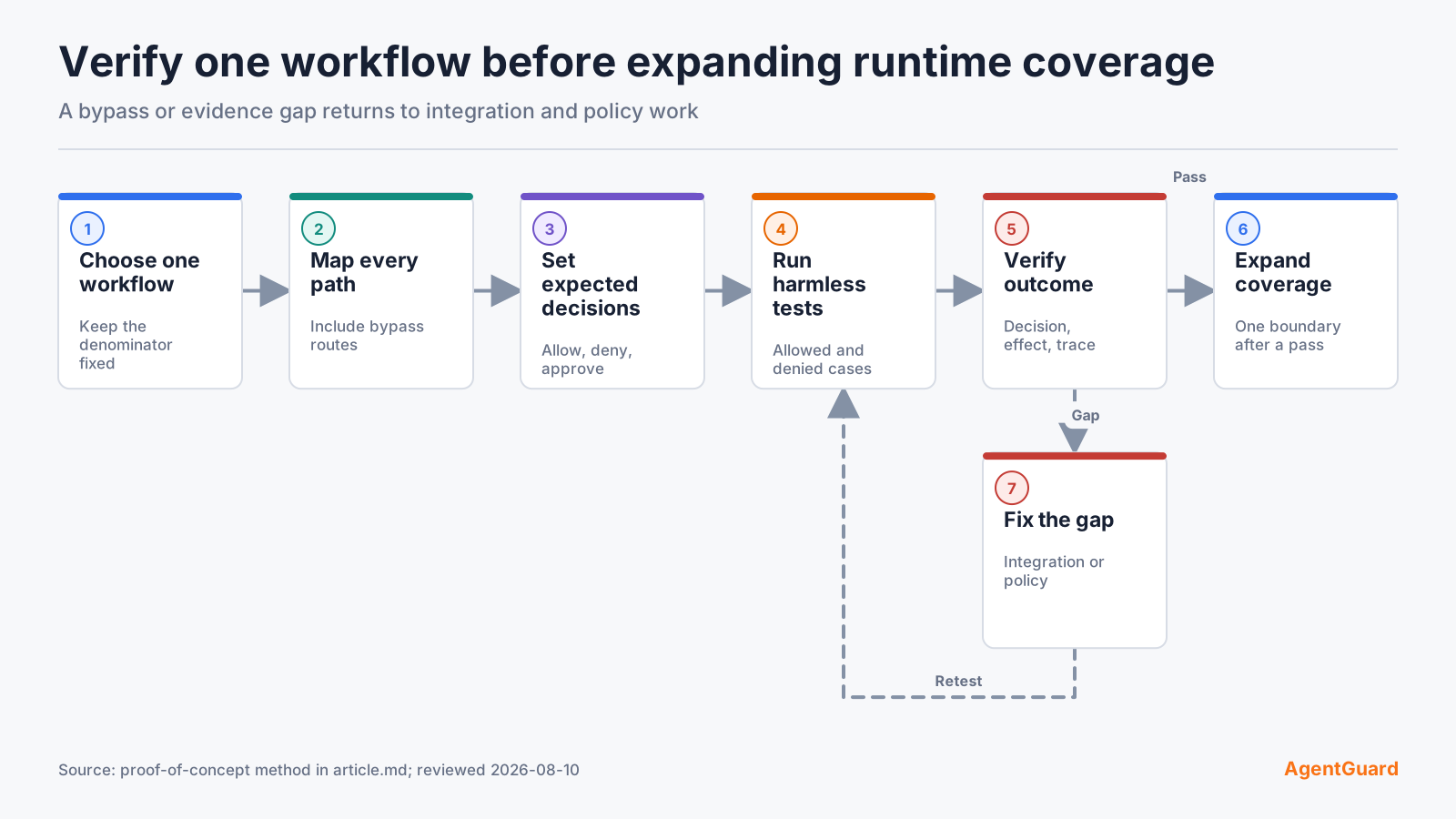
Figure 3. A runtime-security POC is a loop. A missing path or trace returns to integration and policy work before coverage expands.
Test the path, not the product page
1. Choose one bounded workflow. Use a real agent and tool in a non-production environment. Identify the owner, identities, credentials, data, and possible side effects.
2. Map every route to the action. Include the intended gateway, direct SDK calls, local tools, cached behavior, retries, and alternate credentials. A product passes only the paths it actually controls.
3. Write paired cases. Define one harmless action that should be allowed and one harmless action that should be denied or sent for approval. Record the expected decision before running either case.
4. Observe three separate outcomes: the policy decision, the external side effect, and the evidence trace. A deny event with a completed side effect is a failure. A missing trace is an evidence failure even if the action happened to stop.
5. Test degraded conditions. Disconnect the cloud service or connector where the vendor permits a safe test. Confirm cached-policy behavior, timeout behavior, approval behavior, and whether the system fails open or closed.
6. Inspect the data boundary. Record the prompt, code, action arguments, secrets, metadata, and identifiers that remain local or leave the environment. Product labels such as local or private are not enough without an observed request and documented configuration.
Write success criteria before the POC
Use pass/fail statements, not a feature score. For example: "Every production database write from this agent crosses policy P1; the blocked case creates no write; the decision trace names the rule and actor; the cloud event contains no query contents." This statement can be tested. "The platform provides complete runtime protection" cannot.
AgentGuard's documented Quickstart already follows part of this pattern by asking the operator to trigger a deliberate action and inspect its decision evidence. For a bounded local-agent path, you can Test Agent Controls and use the results as one input to the same allow, deny, bypass, outage, and trace checklist.
When one runtime tool is not enough
Do not layer products merely because their pages use different terms. Add a second control only when the path map shows a distinct boundary, owner, or failure that the first control cannot test.
| Observable gap | Primary control | Useful complementary control |
|---|---|---|
| Untrusted prompt reaches an agent, then the agent writes to a sensitive system | Prompt or interaction guardrail | Pre-execution policy at the write or tool-call boundary |
| Approved model traffic leaves through a gateway, but local tools can bypass it | Gateway identity and traffic policy | Local action control on shell, browser, file, network, and MCP paths |
| A component is malicious or overprivileged before execution | Component and supply-chain scanning | Runtime policy for the actions that remain allowed |
| An agent has excessive standing access | Identity governance and least privilege | Runtime decision and trace for each consequential use of that access |
The layers should share an owner, incident route, and evidence vocabulary. Otherwise, one product blocks an action, another creates an alert, and neither record is sufficient to reconstruct the decision. The operating model should answer who changes policy, who approves exceptions, which event is authoritative, and how the team retests after a model, prompt, tool, permission, or integration changes.
AgentGuard is a good complement when the missing layer is a local pre-execution decision for supported agent actions or a scan before an agent component enters the runtime. It is not a replacement for identity governance, broad model monitoring, or every gateway control. Its value is highest when that final action boundary is explicit and verified.
Frequently Asked Questions
What does AI runtime security cover?
AI runtime security can cover prompt and response inspection, live model or application behavior, gateway traffic, identity and tool policy, or pre-execution action decisions. A vendor may implement one or several of these boundaries. Ask what the product observes, when it decides, which side effects it can stop, and what evidence it retains.
Is a prompt guardrail the same as agent action control?
No. A prompt guardrail evaluates content entering or leaving an AI system. An action control evaluates an operation such as a shell command, file write, browser action, network request, secret read, or tool call. The two controls can work together, but a successful prompt check does not prove that a later action is safe or governed.
Which AI runtime security tool is best?
There is no supported universal winner in this evidence set. The best AI runtime security tool is the one that controls the path carrying your material side effect and passes a repeatable POC. Start with the control boundary, then compare integration coverage, decision timing, bypass behavior, outage behavior, evidence quality, data handling, and operational ownership.
Where does AgentGuard fit?
AgentGuard fits teams that need local policy enforcement before observable high-risk actions in supported agent environments. Its public documentation covers allow, deny, and approval decisions, cached policy, redacted audit synchronization, a test-and-evidence workflow, and pre-runtime scanning for agent components. Buyers should verify every relevant framework and direct execution path; the public evidence does not support a claim of automatic universal interception.
Connect one agent, run a safe allow-deny test, and inspect the evidence before expanding coverage.
Test Controls