
Best AI Security Companies for Agent Control
Compare six AI security companies by the control point they document: discovery, inspection, action enforcement, and investigation evidence.
By Agent Guard Team11 min read
Best AI Security Companies for Agent Control
Most lists of the best AI security companies mix two different markets: vendors that use AI to improve conventional security, and vendors that secure AI systems themselves. That makes a shortlist look broader than it is.
The useful question is simpler: where does the product see or control risk in an agent workflow? This guide groups six companies by documented fit, not by an invented universal score, and discloses that AgentGuard publishes the page and is included in the list; its capabilities are treated as first-party documentation, the same as the other vendor profiles.
The short answer: choose by the control point
There is no single best platform for every team. A company that discovers unsanctioned AI assets answers a different problem from one that scans an MCP server before trust, or one that mediates actions during execution. A sensible first shortlist covers the control point that currently creates the most exposure, then checks what remains outside that boundary.
For an AI application with a known runtime path, start with enforcement and decision evidence. For a large estate with unclear ownership, discovery and posture management may come first. For developer-agent environments, component scanning and local action controls may be the urgent gap. These are different purchases even when the vendors all call themselves AI security platforms.
The six companies below are worth a closer look because their public pages document distinct parts of that work: AgentGuard, Lakera, HiddenLayer, Noma, NeuralTrust, and Prompt Security. Inclusion is not a performance ranking. It is a documented-scope shortlist for a buyer who needs to secure agents, connected tools, models, or the data paths around them.
What an AI security company must cover for agents
An agent is not just a model response. It can read data, call tools, select a route, write a file, invoke an API, or hand work to another agent. A usable security platform needs to make some part of that behavior observable and controllable. The NIST AI Risk Management Framework is helpful here because it keeps risk work tied to governance, measurement, and operational management rather than a single feature checkbox.
For buying purposes, break the task into four control points. First, discover the AI assets, identities, models, tools, and agent paths that exist. Second, inspect components and inputs before they are trusted: code, skills, plugins, MCP servers, prompts, and data flows. Third, enforce a decision before a risky action runs. Fourth, retain enough evidence to investigate what happened.
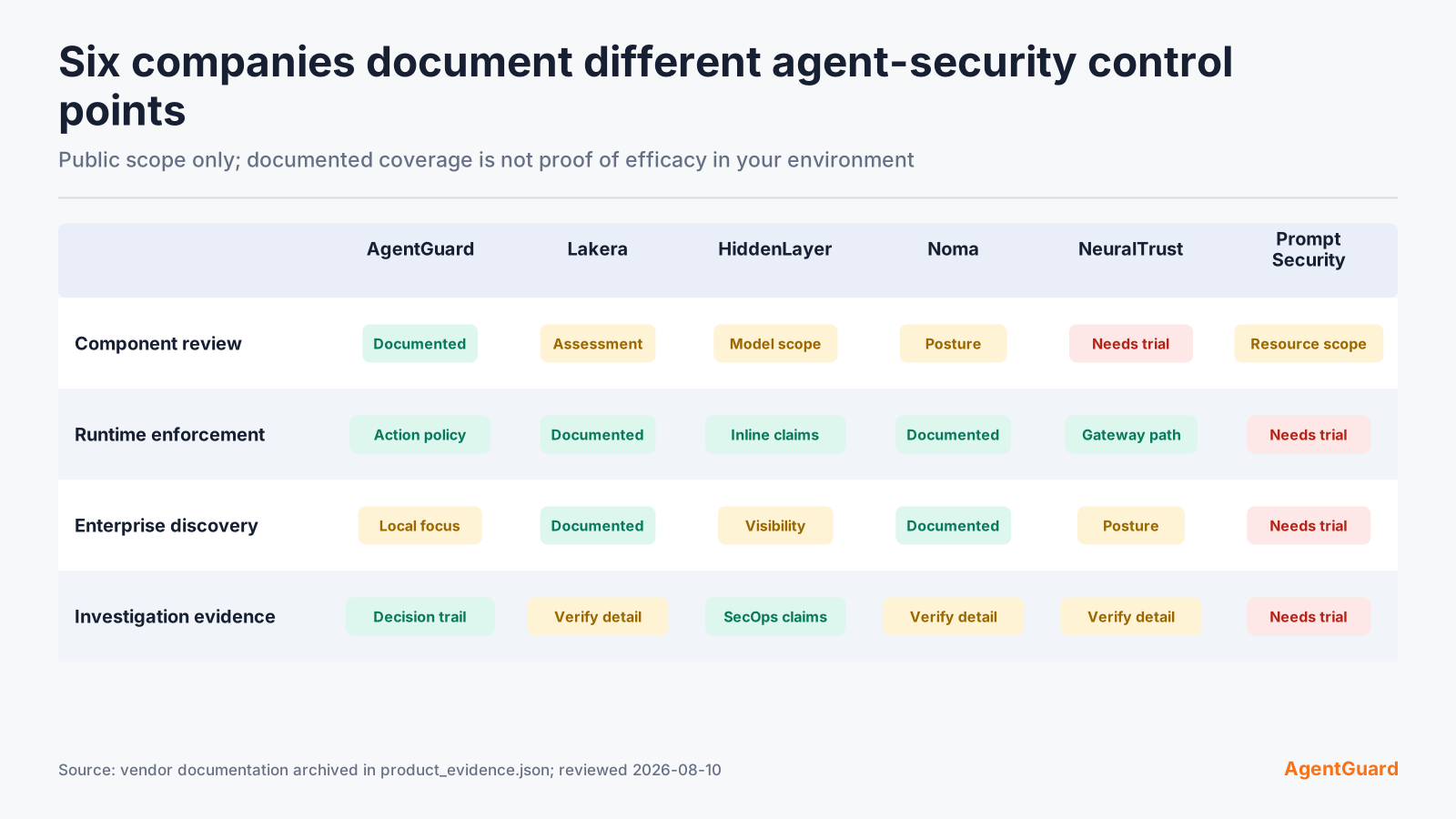
*Control-point matrix: a documented product surface is a starting point for a trial, not proof of full-path coverage. Sources: current first-party product documentation reviewed for each listed company during this August 2026 review; scope labels are evidence categories, not efficacy scores.*
Prompt injection belongs in this model because it can change what an agent attempts to do, not merely what text it displays. The OWASP LLM01:2025 Prompt Injection entry distinguishes direct and indirect variants and lists mitigation considerations. A product that only logs the final answer may have little to say about a compromised tool call before it executes.
This is also why conventional detection products and AI-agent security platforms are not interchangeable. A security product may use AI for alert triage while having no documented control over an agent's tool path. Conversely, an agent platform may provide an execution control but rely on another system for endpoint, identity, or network telemetry. The gap is not a defect by default. It is a boundary the buyer needs to test.
For a broader implementation baseline, see these enterprise AI agent security practices. The point is not to adopt every layer at once. It is to identify which risky action currently lacks an owner, a policy decision, or a usable audit record.
Six AI security companies, grouped by documented fit
The following descriptions state what each company publicly documents. They do not claim independent efficacy, price, latency, or a complete feature inventory. Ask each vendor to demonstrate the exact action path you need to protect.
| Company | Documented fit | A boundary to test in your environment |
|---|---|---|
| AgentGuard | Developer-agent runtime controls and component scanning | Integration depth varies by host; do not assume all third-party MCP runtime calls are fully monitored or blocked. |
| Lakera | Runtime protection for AI applications and agents, plus red teaming | Confirm the deployment point and evidence available for your tools and data paths. |
| HiddenLayer | Enterprise AI runtime visibility, threat detection, inline protection, and security-operations integration | Confirm which integrations observe your agent harness and tool traffic. |
| Noma | AI posture management, agentic access control, red teaming, and runtime protection | Confirm the control boundary for each agent framework and SaaS agent. |
| NeuralTrust | Agent runtime security, gateway, posture management, and red teaming | Confirm the operating model needed to connect agents, models, and tools. |
| Prompt Security | AI-security resources and open-source tooling, including OpenClaw deployment analysis | Confirm which platform capabilities are available for the use case, rather than infer them from resource pages. |
AgentGuard
AgentGuard documents a local-first guard that evaluates high-risk developer-agent actions and a Deep Scan surface for skills, plugins, MCP servers, and agent code. Its Quickstart also documents policy modes, a deliberate test action, and dashboard verification. That combination makes it a reasonable fit when the team needs to inspect dependencies before trust and add a decision point close to a developer-agent workflow.
The important boundary is explicit: AgentGuard's public FAQ does not promise that it can fully monitor or block every third-party MCP server runtime call. A buyer should map the host, hook, and MCP route before treating it as complete runtime coverage. This is still useful: a limitation that is visible before a purchase is easier to design around than a vague claim of full coverage.
For a hands-on look at the documented sequence, Inspect AgentGuard's documented control flow after identifying one representative tool action. Treat the dashboard as a place to verify a decision trail, not as proof that every path in your environment is covered.
Lakera
Lakera publicly presents workforce AI security, AI-agent runtime protection, AI red teaming, prompt-attack prevention, and data-leakage protection. It is a fit to investigate when the concern is the interaction between an AI application or agent and the prompts, data, or users around it, especially when the team also wants adversarial testing in the evaluation.
The buyer question is where the product is placed in the live request and action flow. Ask for an example that includes an indirect prompt injection, a connected tool, and the evidence the security team receives. Without that, a runtime claim is too broad to compare.
HiddenLayer
HiddenLayer's AI Runtime Security page documents continuous visibility, proactive threat detection, automated protection, agentic runtime visibility, inline protection, agent harness security, and security-operations integration. That scope makes it relevant to enterprises that need their AI runtime controls to feed an established detection and response process.
The trade-off to test is integration shape. An enterprise runtime platform can be valuable when it meets existing monitoring and incident workflows, but the team still needs proof that the chosen interceptors or instrumentation see its actual model, agent, and tool paths. A focused AgentGuard vs HiddenLayer comparison is currently a planned follow-up, but its route is not live yet, so it is intentionally not linked here.
Noma
Noma publicly describes AI security posture management, agentic access control with policy-based approvals and runtime enforcement, AI red teaming, and runtime protection. It belongs on a shortlist where the buyer needs an estate-level picture alongside agent access decisions, particularly when homegrown AI, SaaS agents, and coding assistants all coexist.
Its public language covers a broad enterprise surface. That is not the same as proving each workload has an enforceable control. Ask the vendor to identify the agents it discovers, the decision point for a privileged action, and the record available after a policy decision.
NeuralTrust
NeuralTrust presents separate products for agent runtime security, an agent gateway, agent posture management, and AI red teaming. This is useful for buyers who expect different teams to own different parts of the stack: discovery and governance on one side, live interactions with models and tools on another.
The selection work is to decide whether the gateway, runtime, and posture capabilities need to be bought and operated together for the intended path. A product family can reduce integration work, but it can also hide the practical question: which request is actually inspected or stopped?
If MCP is the immediate issue, compare the narrower category of MCP security tools before treating a broad platform profile as a complete answer. The MCP path has its own component-trust and routing questions.
Prompt Security
Prompt Security's current public site centers on AI-security resources and open-source tools, including OpenClaw deployment analysis and agent-security tooling. It is useful for teams that want to examine the AI security problem space and the available open-source starting points alongside commercial evaluations.
The public landing page is not enough to establish the exact enforcement, discovery, or investigation coverage for a specific enterprise environment. Keep the profile on the shortlist only if the vendor can show the relevant production path and its resulting evidence. That standard should apply equally to every company in this article.
How to run a proof of coverage
A proof of coverage should not start with a generic demo. Start with one representative agent workflow that can cause a real but safe-to-test outcome: accessing a protected document, proposing a payment change, calling an internal API, or invoking an MCP tool that can write a file. Define what should be allowed, denied, or approved before the vendor session.
A four-step evaluation
1. Inventory the path. Write down the agent, model, identity, prompt source, tool or MCP server, target system, and existing logging. Unknown elements are the first coverage gaps.
2. Introduce a controlled condition. Use a benign test that would violate the policy you expect to enforce, such as an untrusted tool parameter, a sensitive destination, or an approval-required action. Do not test on customer data or production credentials.
3. Observe the decision. Confirm whether the platform discovered, inspected, warned, blocked, or required approval at the declared control point. A detection after the action is not equivalent to prevention before the action.
4. Retrieve the evidence. Ask for the decision record, policy version, actor or workload context, and a route into your incident process. The result should be reviewable by the team that will own the control after the proof of concept.
This approach gives agent security vendors a fair test because it does not assume every platform has the same architecture. It also prevents a common buying failure: comparing a component scanner with an in-path gateway as though they promise the same result.
When the evaluation scope is ready, Book a focused evaluation around one of those paths. The useful output is a coverage register: what was observed, what was enforced, what evidence was retained, and what remains unprotected across the agreed test boundary.
Keep the register honest about bypasses. A gateway may observe traffic that uses its route but miss a direct client connection. A runtime hook may see an action in one host but not a separate automation process. A scan can identify a risky component before installation without proving the behavior of an already-running agent. Each result is valuable, but it answers a bounded question.
The team should also assign an owner to every gap. Security may own policy approval and incident evidence; the AI platform team may own agent inventory and integration; application teams may own tool permissions. A platform can produce good signals and still fail operationally when no one is responsible for reviewing them. Include this ownership step in the proof of coverage so the chosen product fits the way the organization actually responds to risk.
Frequently Asked Questions
What makes an AI security company different from an AI security tool?
The terms overlap. In this guide, a company is a vendor with a platform or service surface, while a tool is a narrower implementation such as a scanner, gateway, hook, or open-source utility. The relevant distinction is the control point: what the product can discover, inspect, enforce, or help investigate for your agent path.
Can one platform cover every agent risk?
Not as a safe assumption. An agent environment can involve asset discovery, model and component trust, identity, runtime policy, data handling, and incident evidence. A consolidated platform may cover multiple points, but the buyer should verify each one. Separate layers are justified when an important path would otherwise remain unobserved or uncontrolled.
What should a proof of coverage show?
It should show a defined agent action, the policy applied to it, the resulting allow, deny, or approval outcome, and the evidence retained for review. It should also state what the test did not cover. That last line is often the most useful part of the evaluation.
Turn one representative agent action into a reviewable policy decision before committing to a platform.
Book demo